

In the global food and beverage industry, bulk dragon fruit powder is used as a natural ingredient, which has become more and more popular. It has high nutritional value, wide application prospects, and has emerged as a popular clean-label ingredient. Many consumers and food manufacturers are curious: Why is Dragon Fruit Powder Pink? Is it artificially dyed, or is it a gift from nature?
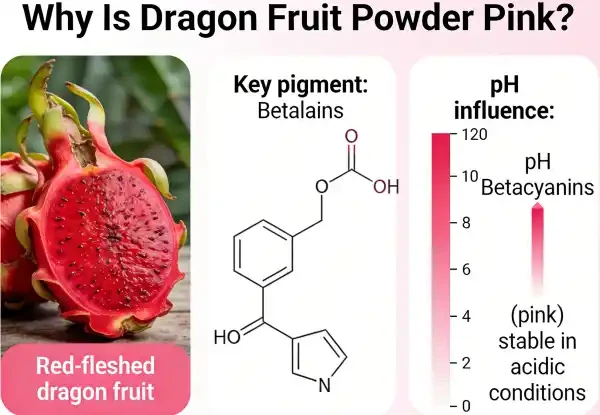
Why Is Dragon Fruit Powder Pink?
Professional dragon fruit powder manufacturers have a set of mature production processes to ensure that their bulk dragon fruit powder maintains a natural pink color and high nutritional value.
Raw Materials
First, the selection of 100% natural raw materials is the basis of the pink color of dragon fruit powder. A reliable dragon fruit powder manufacturer adheres to the principle of "natural origin, high-quality raw materials" and selects high-quality red-fleshed dragon fruit (Hylocereus polyrhizus) from the main producing areas as raw materials. These producing areas have a suitable climate, sufficient sunlight, and clean soil, which provide excellent conditions for the growth of red-fleshed dragon fruit, enabling the fruit to accumulate sufficient betacyanin during the maturation process. Unlike some manufacturers that mix white-fleshed dragon fruit or add artificial pigments to reduce costs, Guanjie Biotech's bulk dragon fruit powder is made from 100% pure red-fleshed dragon fruit, without any additives, carriers, or artificial colors. Every batch of raw materials will go through strict inspection: only dragon fruits with full maturity, bright color, no pests and diseases, and no rot can enter the production link. This ensures that the raw materials have a high content of betacyanin.
Different Technologies
Second, Guanjie Biotech uses advanced spray-drying and freeze-drying technologies, which are the key to retaining the natural pink color and nutritional value of bulk dragon fruit powder. As we mentioned earlier, betacyanin is sensitive to high temperature, so the drying technology directly determines the color and quality of the powder. Guanjie Biotech combines the characteristics of dragon fruit pulp and market demand, and flexibly uses two drying technologies to produce high-quality dragon fruit powder, both of which minimize the degradation of betacyanin.
• Freeze-drying technology
Freeze-drying technology retains the natural color and nutritional components of powdered red pitaya. This technology works by freezing the dragon fruit pulp into a solid state at ultra-low temperature (-40℃ to -60℃), then placing it in a high-vacuum environment to sublimate the water in the pulp directly from a solid state to a gaseous state, without going through the liquid state. The biggest advantage of freeze-drying is that it is at an ultra-low temperature, which can effectively avoid the thermal degradation of betacyanin and other heat-sensitive nutrients. Studies have shown that freeze-dried dragon fruit powder can retain more than 72% of betacyanin, as well as a large amount of vitamin C, rutin, total phenols, and other nutrients. In addition, freeze-drying bulk dragon fruit powder can maintain the original structure and shape of the dragon fruit pulp, making the prepared powder loose and delicate, with a strong natural fruit flavor, and the color is almost the same as the original pulp-bright pink. Guanjie Biotech's freeze-dried dragon fruit powder does not need to add any carriers such as maltodextrin, which is 100% pure fruit powder, so the pink color is more intense and natural, and it can quickly dissolve in water, maintaining the original color of the pulp after rehydration. This bulk dragon fruit powder product is especially suitable for food, health products, and cosmetics that pursue natural and pure ingredients.
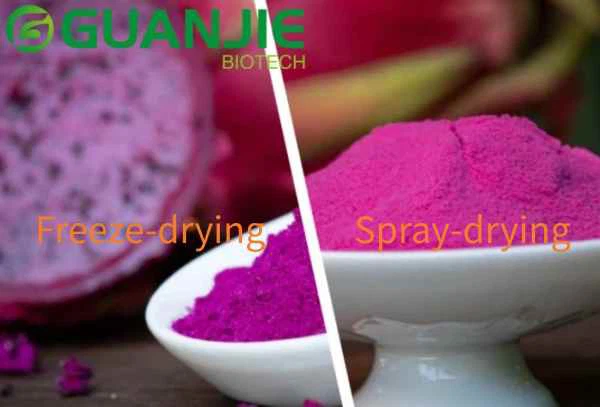
• Spray-drying technology
Spray-drying technology is another important processing method. It is suitable for large-scale production and meets the needs of bulk orders. Spray-drying works by atomizing the dragon fruit pulp into tiny droplets through a high-pressure nozzle, then contacting with hot air in a drying tower to quickly evaporate the water in the droplets, forming a fine red dragon fruit powder. The key to using spray-drying to retain the pink color of bulk dragon fruit powder lies in strictly controlling the temperature of the hot air. Betacyanin will degrade significantly when the temperature exceeds 160℃, so Guanjie Biotech, as a dragon fruit powder manufacturer, has optimized the spray-drying parameters after years of practice. The inlet air temperature is controlled at 140℃ to 150℃, and the outlet air temperature is maintained at 80℃ to 85℃, which minimizes the thermal damage to betacyanin. In addition, Guanjie Biotech only adds a small amount of maltodextrin (15% or less) as a carrier when necessary, which not only ensures the fluidity and shelf life of the powder but also avoids the problem of color fading caused by excessive carriers. Studies have shown that when the maltodextrin concentration is 15%, and the inlet air temperature is 150℃, the retention rate of betacyanin can reach 98.75%. Therefore, Guanjie Biotech's spray-dried dragon fruit powder also maintains a bright pink color, with a loose, fine texture and good solubility, suitable for large-scale applications in beverages, pastries, snacks and other fields.
Strict Quality Control System
From the raw materials to the finished product, every step of bulk dragon fruit powder is strictly controlled. In the raw material step, professional inspectors test the betacyanin content, moisture, and purity of the dragon fruit to ensure that the raw materials meet the standard. In the processing step, real-time monitoring of temperature, pressure, and other parameters is carried out to avoid process deviations that lead to betacyanin degradation. In the finished product step, each batch of dragon fruit powder is tested for color, betacyanin content, particle size, heavy metals, microorganisms, and other indicators, and only products that meet the international standards can leave the factory. Guanjie Biotech's independent third-party testing laboratory uses advanced detection equipment to accurately detect the betacyanin content of each batch of bulk dragon fruit powder products, ensuring that the pink color of the dragon fruit powder bulk is consistent and stable, and the nutritional value meets the requirements. This strict quality control system has won the trust of customers at home and abroad, making Guanjie Biotech's bulk dragon fruit powder a benchmark product in the industry.
Why High-Quality Dragon Fruit Powder Looks Better?
High-quality dragon fruit powder is distinguished by its pigment intensity and overall visual appeal. This is primarily due to a higher concentration of natural betacyanins, which provide a vibrant pink or red color. In addition, advanced drying technologies such as freeze-drying and optimized spray-drying help preserve both color and nutritional integrity. Careful selection of fully ripened, high-quality raw materials further enhances product quality. Minimal processing damage ensures that sensitive compounds remain intact. In contrast, lower-quality dragon bulk powder often appears dull, pale, or uneven in color, typically resulting from poor raw material selection or excessive heat exposure during processing, which can degrade pigments and reduce overall product quality.
Conclusion:
In conclusion, the vibrant pink color of dragon fruit powder is from betacyanins in high-quality red-fleshed dragon fruit, rather than any artificial additives. This appealing color reflects not only the purity of the raw materials but also the effectiveness of advanced processing technologies. By selecting fully ripened fruit and applying controlled freeze-drying or spray-drying techniques, manufacturers can preserve both the pigment and nutritional value. A strict quality control system further ensures consistency, safety, and stability in every batch. Ultimately, the bright pink appearance is a visual indicator of quality, authenticity, and functional benefits, making dried dragon fruit powder a health ingredient in modern food, nutraceutical, and cosmetic applications. Guanjie Biotech is a bulk dragon fruit powder. Welcome to enquire with us at info@gybiotech.com.
References:
[1] Stintzing, F. C., & Carle, R. (2004). Functional properties of anthocyanins and betalains in plants, food, and in human nutrition. Trends in Food Science & Technology, 15(1), 19–38.
[2] Azeredo, H. M. C. (2009). Betalains: properties, sources, applications, and stability – a review. International Journal of Food Science & Technology, 44(12), 2365–2376.
[3] Esquivel, P. (2007). Betalains in pitahaya (Hylocereus spp.): a review. Food Research International, 40(7), 825–834.
[4] Rebecca, O. P. S., Boyce, A. N., & Chandran, S. (2010). Pigment identification and antioxidant properties of red dragon fruit (Hylocereus polyrhizus). African Journal of Biotechnology, 9(10), 1450–1454.
[5] Wu, L. C., Hsu, H. W., Chen, Y. C., Chiu, C. C., Lin, Y. I., & Ho, J. A. A. (2006). Antioxidant and antiproliferative activities of red pitaya. Food Chemistry, 95(2), 319–327.
[6] Quek, S. Y., Chok, N. K., & Swedlund, P. (2007). The physicochemical properties of spray-dried watermelon powders. Chemical Engineering and Processing, 46(5), 386–392.
[7] Mishra, B. B., & Dubey, A. (2013). Stability of betalains in foods. Food Reviews International, 29(3), 267–278.
[8] Tonon, R. V., Brabet, C., & Hubinger, M. D. (2010). Anthocyanin stability and antioxidant activity of spray-dried açai juice. Journal of Food Engineering, 94(3–4), 215–221.
[9] Cai, Y., Sun, M., & Corke, H. (2005). Characterization and application of betalain pigments from plants of the Amaranthaceae. Trends in Food Science & Technology, 16(9), 370–376.
[10] USDA. (2020). Dragon fruit (pitaya) nutritional composition. United States Department of Agriculture FoodData Central.


