

Natural blueberry powder is a concentrated fruit ingredient produced by removing water from fresh blueberries through spray-drying or freeze-drying technologies. This process preserves the fruit's nutritional compounds while significantly increasing shelf stability and concentration. Because fresh blueberries contain about 80–85% water, converting them into natural blueberry powder results in a nutrient-dense ingredient, where vitamins, minerals, sugars, and bioactive compounds are concentrated. So, how about blueberry powder nutrition facts?

Blueberry Powder Nutrition Facts
Blueberry powder is a highly concentrated functional ingredient produced by removing moisture from fresh blueberries, which significantly enhances its nutritional density. Through advanced drying processes, such as spray-drying and freeze-drying, the natural profile of vitamins, minerals, dietary fiber, and phytochemicals is preserved and intensified. According to data from USDA FoodData Central and standard industry analyses, natural blueberry powder offers a well-balanced composition of macronutrients and micronutrients.
Macronutrients
• Energy Content
Natural blueberry powder provides approximately 360–380 kcal (1506–1590 kJ) per 100 grams. This caloric value is primarily derived from naturally occurring carbohydrates and dietary fiber, with no added sugars in high-quality products such as those from Guanjie Biotech.
• Carbohydrates
Carbohydrates are the primary macronutrient, ranging between 70–75 g per 100 g. Within this:
• Dietary fiber
Dietary fiber accounts for 20–25 g (about 30–35% of total carbohydrates), including soluble fiber (pectin, β-glucan) and insoluble fiber from skins and pulp.
• Natural sugars
Natural sugars (fructose, glucose, sucrose) make up approximately 45–50 g.
This composition contributes to a moderate glycemic index (GI ≈ 53), supporting balanced energy release.
• Protein
The protein content of natural blueberry powder is relatively low at 2–3 g per 100 g. However, it contains essential amino acids in small amounts, contributing to basic physiological processes such as tissue repair and enzyme function.
• Fats
Total fat content ranges from 1–2 g per 100 g. The lipid profile is predominantly composed of unsaturated fatty acids, including linoleic acid and α-linolenic acid (omega-6 and omega-3). Saturated fat remains minimal, typically below 0.1 g, supporting cardiovascular-friendly formulations.
• Sodium
Sodium levels are very low, generally less than 5 mg per 100 g. This makes natural blueberry powder suitable for low-sodium diets and heart-health-focused nutritional products.
Micronutrients (Vitamins & Minerals)
Due to the dehydration process, natural blueberry powder contains significantly elevated levels of micronutrients-often 5 to 10 times higher than those found in fresh fruit on a weight basis. It is particularly rich in vitamin C, vitamin K, and various B vitamins, which contribute to immune support, blood clotting, and energy metabolism. Additionally, it provides essential minerals such as potassium, calcium, magnesium, and iron, all of which play critical roles in maintaining electrolyte balance, bone health, and oxygen transport.
|
Nutrient |
Content per 100 g |
% Daily Value (DV) |
Key Functions |
|
Vitamin C |
70–80mg |
78–89% |
Antioxidant, collagen synthesis, immune support, and enhances iron absorption |
|
Vitamin K |
18–20μg |
15–17% |
Blood clotting, bone health, and supports cardiovascular function |
|
Vitamin E |
0.5–0.7mg |
3–5% |
A fat-soluble antioxidant that protects cell membranes from oxidative damage |
|
Thiamine (B1) |
0.3–0.4mg |
25–33% |
Energy metabolism, nerve function |
|
Riboflavin (B2) |
0.2–0.3mg |
12–18% |
Antioxidant, energy production, supports eye health |
|
Niacin (B3) |
2.0–2.5mg |
10–13% |
Cellular metabolism, skin health, and cholesterol regulation |
|
Vitamin B6 |
0.15–0.2mg |
9–12% |
Neurotransmitter synthesis, protein metabolism |
|
Folate (B9) |
35–40μg DFE |
9–10% |
DNA synthesis, fetal development, red blood cell formation |
|
Calcium |
25–30mg |
2–3% |
Bone and teeth health, muscle contraction, nerve signaling |
|
Iron |
0.25–0.3mg |
1–2% |
Oxygen transport, hemoglobin synthesis, and immune function |
|
Potassium |
75–85mg |
2–4% |
Electrolyte balance, blood pressure regulation, and heart health |
|
Magnesium |
25–30mg |
6–7% |
Enzyme function, energy production, and muscle relaxation |
|
Phosphorus |
55–65mg |
5–6% |
Bone health, energy metabolism, and cell membrane structure |
|
Manganese |
0.3–0.4mg |
13–17% |
Antioxidant enzyme (SOD) cofactor, bone development, metabolism |
|
Zinc |
0.15–0.2mg |
1–2% |
Immune function, wound healing, and enzyme activity |
How Does Processing Affect Blueberry Powder?
The nutritional integrity and functional performance of natural blueberry powder are highly influenced by the processing method employed during manufacturing. Among the available technologies, spray drying and freeze drying are the two most widely used techniques in the production of bulk blueberry powder. Each method offers distinct advantages in terms of nutrient retention, cost efficiency, and application suitability. With over 20 years of industry experience, Guanjie Biotech applies both technologies to meet diverse customer requirements while maintaining consistent quality standards.
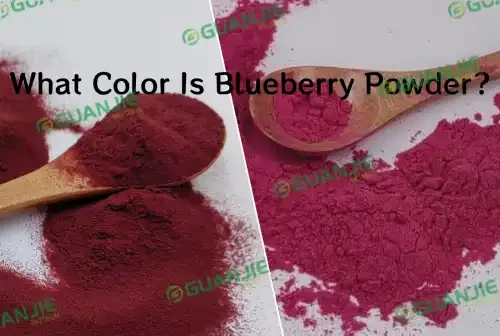
Freeze-Dried Blueberry Powder
Freeze drying, or lyophilization, is an advanced dehydration technique designed to preserve the original characteristics of fresh blueberries. The process begins by rapidly freezing blueberry juice or puree at extremely low temperatures, typically around -40°C. The frozen material is then subjected to a high-vacuum environment, where ice transitions directly into vapor through sublimation, bypassing the liquid phase entirely.
• Preserving Heat-Sensitive Bioactive Compounds
This low-temperature process of natural blueberry powder is particularly beneficial for preserving heat-sensitive bioactive compounds. Key nutrients such as anthocyanins, vitamin C, and other antioxidants remain largely intact, resulting in a final pure blueberry powder product that closely mirrors the nutritional profile of fresh blueberries. Additionally, freeze drying is a purely physical process that generally does not require the addition of carrier agents or stabilizers, ensuring a high-purity, clean-label product.
• Porous Microstructure Formed During Sublimation
Another significant advantage is the porous microstructure formed during sublimation. This structure enhances rehydration capacity, allowing the natural blueberry powder to quickly absorb water and restore its original flavor, color, and aroma. As a result, freeze-dried blueberry powder is especially suitable for applications where product quality and sensory attributes are critical, such as in premium beverages, nutraceuticals, and functional foods.
Spray-Dried Blueberry Powder
Spray drying blueberry powder is a widely adopted method for large-scale, cost-efficient production. In this process, blueberry juice or puree is atomized into fine droplets and introduced into a chamber with hot, dry air. The moisture evaporates almost instantaneously, leaving behind fine, spherical powder particles.
• Production Process and Efficiency
Spray drying is a highly efficient and widely used technique for large-scale blueberry powder production. In this process, blueberry juice or puree is atomized into fine droplets and exposed to a stream of hot, dry air. The moisture evaporates almost instantly, forming fine, spherical powder particles. This rapid drying mechanism enables continuous processing with high throughput, making it a cost-effective solution for bulk blueberry fruit powder manufacturing. In addition, the resulting powder demonstrates excellent flowability and physical stability, which simplifies handling, transportation, and long-term storage in industrial applications.
• Functional Properties and Application Suitability
To improve processability, a small amount of carrier agent-typically maltodextrin-is sometimes incorporated during spray drying. This helps reduce stickiness caused by natural sugars and enhances powder stability and shelf life. Although this may slightly modify the composition, it significantly improves manufacturability and consistency. Reliable bulk blueberry powder suppliers ensure transparency by providing detailed specifications regarding additive use. Spray-dried blueberry powder is therefore ideal for applications such as dry mixes, bakery products, and seasonings, where stability, cost efficiency, and ease of use are prioritized over maximum nutrient preservation.
Both freeze drying and spray drying play essential roles in pure blueberry powder production, each offering unique advantages depending on the intended application. Freeze drying excels in preserving nutritional and sensory quality, while spray drying provides efficiency and practicality for large-scale use. By leveraging both technologies, Guanjie Biotech ensures a versatile product portfolio capable of meeting diverse market demands.
Conclusion
Natural blueberry powder is a highly concentrated food ingredient with an excellent nutritional profile. It provides a rich source of carbohydrates, dietary fiber, vitamins, minerals, and-most importantly-powerful antioxidants such as anthocyanins and polyphenols.
Compared to fresh blueberries, the natural blueberry powder enhances nutrient density, making it used for functional foods, beverages, and dietary supplements. While spray-dried powder offers cost efficiency and scalability, freeze-dried blueberry powder ensures higher nutrient retention. Guanjie Biotech's bulk blueberry powder, produced using advanced drying technologies by 20 years exeriences. Welcome to enquire with us at info@gybiotech.com.
References
[1] United States Department of Agriculture (USDA). (2023). FoodData Central: Blueberries, raw. Retrieved from https://fdc.nal.usda.gov
[2] USDA Agricultural Research Service. (2023). FoodData Central Database. U.S. Department of Agriculture.
[3] European Food Safety Authority. (2021). Scientific opinion on dietary reference values for nutrients. EFSA Journal.
[4] Kalt, W., Cassidy, A., Howard, L. R., Krikorian, R., Stull, A. J., Tremblay, F., & Zamora-Ros, R. (2020). Recent research on the health benefits of blueberries and their anthocyanins. Advances in Nutrition, 11(2), 224–236.
[5] Skrovankova, S., Sumczynski, D., Mlcek, J., Jurikova, T., & Sochor, J. (2015). Bioactive compounds and antioxidant activity in different types of berries. International Journal of Molecular Sciences, 16(10), 24673–24706.
[6] Ezhilarasi, P. N., Karthik, P., Chhanwal, N., & Anandharamakrishnan, C. (2013). Nanoencapsulation techniques for food bioactive components: A review. Food and Bioprocess Technology, 6(3), 628–647.
[7] Tonon, R. V., Brabet, C., & Hubinger, M. D. (2010). Anthocyanin stability and antioxidant activity of spray-dried açai juice produced with different carrier agents. Food Research International, 43(3), 907–914.
[8] Cano-Chauca, M., Stringheta, P. C., Ramos, A. M., & Cal-Vidal, J. (2005). Effect of carriers on the microstructure of mango powder obtained by spray drying. Journal of Food Engineering, 67(1–2), 57–63.
[9] Ratti, C. (2001). Hot air and freeze-drying of high-value foods: A review. Journal of Food Engineering, 49(4), 311–319.
[10] Giampieri, F., Alvarez-Suarez, J. M., & Battino, M. (2014). Strawberry and blueberry polyphenols in cardiovascular health. Nutrition Reviews, 72(3), 201–224.


