

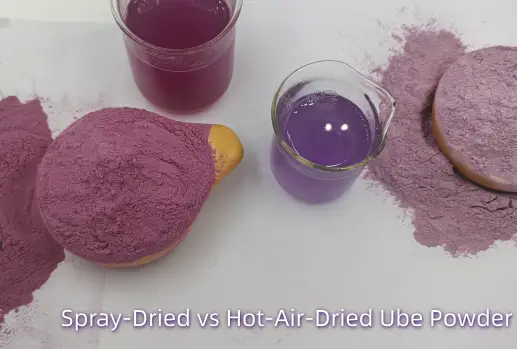
Differences in Processing Principles
Spray drying is a process that converts liquid materials into purple ube powder through rapid moisture evaporation. First, purple yam raw materials are cleaned, processed, and converted into a liquid feed through suitable pretreatment, such as grinding, homogenization, or filtration. The liquid is then pumped into an atomizer, which breaks it into tiny droplets. These droplets come into contact with hot air, causing moisture to evaporate rapidly. Within seconds, the droplets become dry powder particles that are collected through a separation system.
Spray-Dried Purple Yam Powder
The spray-drying process mainly involves four stages: atomization, hot-air contact, moisture evaporation, and powder separation. Because drying happens quickly, this method provides relatively short thermal exposure. However, carriers such as maltodextrin may be required to improve powder formation, depending on the raw material and formulation. The final quality of spray-dried purple yam powder depends on feed concentration, atomization conditions, and drying temperature.
Hot-Air Drying Purple Yam Powder
In contrast, hot-air drying is a conventional dehydration method. Fresh purple yams are washed, peeled, and sliced or diced before being placed in an oven or industrial tunnel dryer. Hot air, generally maintained at approximately 50–65°C, circulates around the materials and gradually removes moisture. Water moves from the interior of the yam slices to the surface before evaporating into the surrounding air.
This process usually takes several hours or longer, depending on slice thickness, moisture content, and drying conditions. Hot-air drying uses relatively simple equipment and is suitable for processing large quantities of solid raw materials. However, prolonged exposure to heat and oxygen may affect heat-sensitive nutrients, natural pigments, and the color of purple yam powder.
Particle Morphology and Physical Properties
The two drying methods produce different particle structures and physical properties.
Spray-Dried Purple Yam Powder
Spray-dried purple ube powder generally consists of spherical or irregularly rounded particles. Its particle-size distribution can be relatively consistent, and the powder often has good flowability. Adding carriers such as maltodextrin can improve particle formation and reduce stickiness. Bulk density can also be adjusted through formulation and processing conditions.
Hot-Air Drying Purple Yam Powder
Hot-air-dried purple yam powder requires additional grinding and sieving after dehydration. Its particles are usually irregular, with uneven shapes and rough surfaces. Grinding may produce different particle sizes, so further screening is needed to achieve the required fineness, such as 80 mesh.
Comparison of the Physical Properties of Purple Yam Powder Prepared by Spray Drying and Hot-Air Drying
|
Comparison Criteria |
Spray drying |
Hot-air drying |
|
Particle Morphology |
Nearly spherical; surface may be wrinkled or smooth/rounded |
Irregular, angular |
|
Particle Size Control |
Adjustable atomization parameters; narrow particle size distribution |
Dependent on pulverization and sieving; relatively broad distribution |
|
Flowability |
Good |
Fair to poor |
|
Typical Drying Temperature |
Inlet air temperature 150–200°C; low product temperature |
50–65°C |
|
Drying Duration |
Seconds to tens of seconds |
Several hours to over ten hours |
|
Carrier Requirement |
Typically requires a carrier, such as maltodextrin |
None |
Differences in Color Characteristics
The natural purple color of purple ube powder comes mainly from anthocyanins, which are water-soluble pigments sensitive to heat, oxygen, and changes in pH. The drying method plays an important role in determining the final color of purple yam powder. Different processing conditions can affect pigment stability, color brightness, and batch consistency.
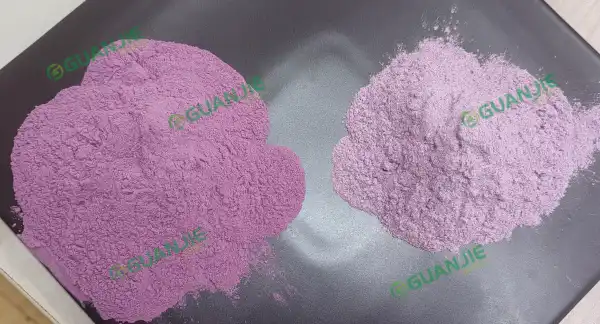
Hot-Air Drying Purple Yam Powder
During hot-air drying, purple yam is exposed to heated air for an extended period. This process may accelerate anthocyanin degradation through oxidation, thermal reactions, and changes in pigment structure. As a result, the final hot-air-dried purple yam powder may develop a darker or less vibrant purple color. However, the actual color depends on the purple yam variety, raw material quality, drying temperature, and processing time.
With suitable temperature control and drying conditions, hot-air drying can produce purple yam powder with a recognizable natural purple appearance. For example, Guanjie Biotech's Pure purple ube powder features a light-purple appearance. Careful selection of raw materials and appropriate drying parameters help maintain its characteristic color while reducing excessive browning.
Spray-Dried Purple Yam Powder
Spray drying uses atomization to convert liquid feed into fine powder particles. Because water evaporates rapidly during this process, the material has a relatively short exposure time to high temperatures. This can help reduce certain forms of heat-related pigment degradation.
However, the final color of spray-dried purple yam powder also depends on the concentration of anthocyanins in the feed solution and the amount of carrier ingredients used. A high carrier proportion may dilute the natural pigment concentration, resulting in a lighter purple color. Variations in raw material quality and feed formulation may also affect color consistency between production batches.
Therefore, when purchasing bulk purple yam powder, food manufacturers should consider not only the drying method but also the raw material source, color specifications, and production parameters.
Differences in Solubility and Dispersion Behavior
Solubility and dispersibility are important properties when selecting purple ube yam powder for different food and beverage applications. Hot-air drying and spray drying produce powders with different particle structures, which can influence their behavior when mixed with water.
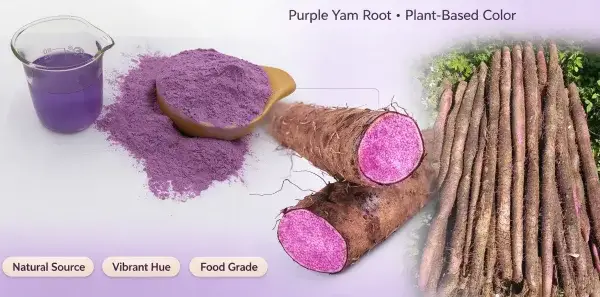
Spray-Dried Purple Yam Powder
Spray-dried purple ube powder generally has a finer and more uniform particle structure. The atomization process helps form small particles with relatively controlled surface characteristics. Depending on the formulation, especially when suitable water-soluble carriers are used, spray-dried powder can disperse quickly under moderate agitation.
This makes spray-dried purple yam ube powder suitable for applications that require convenient mixing and consistent distribution, including:
Instant purple yam drinks
Beverage powder formulations
Instant food mixes
Dairy and plant-based beverage products
Nutritional powder blends
However, it is important to distinguish between dispersibility and true solubility. Purple yam contains natural starch and dietary fiber, which are not completely water-soluble. Therefore, a high solubility index should not be assumed for every spray-dried purple yam powder.
Hot-Air Drying Purple Yam Powder
In comparison, hot-air-dried purple ube powder generally retains more of its original starch structure. Its particles may have irregular shapes and rougher surfaces, which can make rapid wetting and dispersion more difficult. When added directly to cold water, the powder may form lumps or remain suspended instead of producing a completely uniform solution.
Heating, stirring, or homogenization can help improve its dispersion, depending on the formulation and starch characteristics.
Hot-air-dried purple yam powder is particularly suitable for food applications where starch functionality, body, and texture are important. Common applications include:
Bakery and pastry products
Cake and bread premixes
Cookies and biscuits
Ice cream and dessert bases
Porridge and instant food formulations
The starch properties of hot-air-dried purple yam powder can influence water absorption, viscosity, and texture during food processing. These characteristics make it a useful ingredient for manufacturers developing bakery products, dessert formulations, and other starch-based foods.
Differences in Anthocyanin Stability and Storage Performance of Purple Yam Powder
The stability of anthocyanins in purple yam powder is affected by several factors, including temperature, moisture content, water activity, oxygen exposure, and light. Different drying methods can also influence the anthocyanin content, color stability, and storage performance of the final powder.
Hot-Air Drying Purple Yam Powder
During hot-air drying, even at temperatures around 60°C, prolonged exposure to heat and oxygen may cause the degradation of some anthocyanins. Studies indicate that the anthocyanin content of purple yam can decrease during hot-air drying. The degree of pigment loss depends on several processing factors, such as slice thickness, airflow speed, drying temperature, and drying time. However, hot-air-dried purple yam powder can maintain good storage stability when its moisture content is properly controlled. The natural starch matrix may also provide some physical protection for pigment compounds. Sealed, moisture-resistant, and light-protected packaging can further help preserve the powder's natural purple color.
Spray-Dried Purple Yam Powder
In comparison, spray-dried purple ube powder has a shorter heat exposure time, which may help reduce thermal damage to anthocyanins. However, spray drying often uses carrier materials such as maltodextrin. These ingredients can reduce the anthocyanin concentration per unit weight of the finished powder. Carriers do not automatically provide antioxidant protection, so pigment stability still depends on processing conditions, packaging quality, and storage environments.
Application Scenarios and Selection Recommendations
Comparison of Suitable Use Cases for Two Types of Purple Yam Powder
|
Application Areas |
Spray drying applicability: |
Suitability for Hot-Air Drying |
|
Solid beverages / Instant drink mixes |
High (fast dispersion, no sedimentation) |
Low (prone to caking) |
|
Bakery products (bread, cakes) |
Medium (moisture adjustment required) |
High (starch contributes to texture) |
|
Ice cream / Frozen desserts |
Medium-high |
High |
|
Noodles / Extruded food products |
Low |
High (good water-holding capacity) |
|
Natural colorant bases |
Medium (color value affected by carrier) |
Medium (high color value, but the hue tends to be dark) |
|
Cost-sensitive formulations |
Low (carrier and energy consumption increase costs) |
High |
From the perspective of commercial supply, the production of spray-dried purple ube powder entails a higher consumption of raw materials (reports suggest a ratio of up to 20 kg of fresh tubers to 1 kg of powder), and the use of carriers must be explicitly declared on the product label. In contrast, hot-air drying results in relatively lower material loss and requires no added carriers, allowing for a "cleaner" product label.
FAQs:
Q1. What is the main difference between spray-dried and hot-air-dried ube powder?
The main difference is the drying process and the resulting purple ube powder properties. Spray-dried ube powder is produced by atomizing liquid ube material into fine droplets and drying them with hot air. It generally has finer particles and better dispersibility. Hot-air-dried ube powder is made by drying sliced purple yam and grinding it into powder. It usually has irregular particles, retains its natural starch structure, and does not require added carriers.
Q2. Which drying method produces a better purple color in ube powder?
Both drying methods can produce naturally purple ube yam powder, but the final color depends on raw material quality, anthocyanin content, drying temperature, and processing time. Spray drying provides shorter heat exposure, which may help reduce pigment degradation. Hot-air drying may cause some color changes due to prolonged exposure to heat and oxygen. Buyers should request color specifications and samples before purchasing bulk ube powder.
Q3. Is spray-dried ube powder more soluble than hot-air-dried ube powder?
Spray-dried ube powder generally offers better dispersibility, especially when formulated with water-soluble carriers such as maltodextrin. However, natural purple yam contains starch and dietary fiber, so it does not necessarily dissolve completely in water. Hot-air-dried ube powder may require more stirring, heating, or homogenization to achieve an even mixture.
Q4. Does spray drying preserve more anthocyanins than hot-air drying?
Spray drying may help retain anthocyanins because the drying process is relatively short. Hot-air drying involves longer exposure to heat and oxygen, which may increase pigment degradation. However, anthocyanin retention depends on processing parameters, raw material quality, and carrier concentration. Laboratory testing is necessary to compare the actual anthocyanin content of different ube powder products.
Q5. Does spray-dried ube powder contain maltodextrin?
Many spray-dried ube powder products use maltodextrin or other carriers to improve drying efficiency, powder formation, and flowability. However, the carrier content varies between manufacturers and formulations. Buyers looking for 100% pure purple yam powder without additives should confirm the ingredient list and manufacturing process with their suppliers. Hot-air-dried ube powder generally does not require carriers.
Q6. Which type of ube powder is better for bakery products?
Hot-air-dried purple ube powder is often suitable for bakery applications such as bread, cakes, cookies, biscuits, and pastry mixes. Its natural starch content can contribute to product texture and water absorption. Spray-dried ube powder can also be used in bakery formulations, particularly when fine particles and convenient mixing are required. The best choice depends on the desired color, texture, and formulation requirements.
Conclusion:
Spray drying and hot-air drying have different effects on the quality of purple yam powder. Spray-dried purple yam powder consists of fine particles that disperse quickly and have a lighter color, making it suitable for instant beverages; however, it requires the use of a carrier and entails higher costs. Hot-air-dried purple yam powder consists of coarser particles, retains more starch, and has a darker color; it is well-suited for baked goods and starch-based food products, while also offering a "cleaner" label. The choice between these methods should be based on specific application requirements, color specifications, and cost considerations.
Guanjie Biotech is a professional purple yam powder supplier and manufacturer, offering natural purple yam powder and purple sweet potato powder for food manufacturers. Our hot-air-dried purple yam powder features a natural light-purple color and is made without additives or carrier agents. It is suitable for various food applications, including baked goods, pastries, ice cream, and blended powder mixes. As an experienced bulk purple yam powder supplier, we provide OEM and ODM services to meet different business requirements. Customized options include particle size, packaging specifications, and product formulations. Unlike spray-dried powders, our whole-powder product contains no added carriers such as maltodextrin. For instant beverages and other applications requiring high dispersibility, additional formulation adjustments may be necessary. Contact Guanjie Biotech for purple yam powder wholesale and customized ingredient solutions. Welcome to enquire with us at info@gybiotech.com.
References:
[1] Ahmed, M., Akter, M. S., & Eun, J. B. (2010). Impact of α-amylase and maltodextrin on physicochemical, functional and antioxidant capacity of spray-dried purple sweet potato flour. Journal of the Science of Food and Agriculture, 90(3), 494–502.
[2] Grabowski, J. A., Truong, V. D., & Daubert, C. R. (2008). Nutritional and rheological characterization of spray dried sweetpotato powder. LWT – Food Science and Technology, 41(2), 206–216.
[3] Shalini, R., & Gupta, D. K. (2010). Utilization of pomelo peels to manufacture value-added products – a review. Journal of Food Science and Technology, 47(4), 365–372.
[4]Fang, Z., & Bhandari, B. (2012). Comparing the efficiency of protein and maltodextrin on spray drying of bayberry juice. Food Research International, 48(2), 478–483.


