

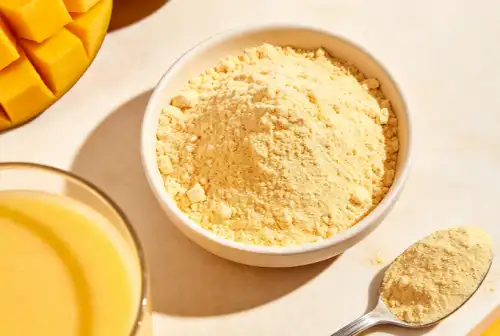
Mango powder is a versatile natural powder widely used in beverages, bakery products, dairy foods, frozen desserts, and snacks. Mango powder solubility is a critical quality parameter that directly affects processing efficiency, product stability, texture, and consumer experience. For food manufacturers sourcing bulk mango powder, excellent solubility ensures uniform dispersion, consistent flavor, and efficient production. Poorly soluble mango fruit powder can cause sedimentation, beverage separation, clumping, uneven flavor distribution, reduced production yields, and higher manufacturing costs. Choosing a reliable mango powder manufacturer helps ensure consistent product quality and processing performance.
The Core Industry Value of Mango Powder Solubility in Food Production
In industrialized mass production scenarios, the solubility of mango powder directly impacts the efficiency of the entire production chain and the quality of the finished product. It is a core basis for manufacturers to select raw materials and optimize production processes, and its value is mainly reflected in three dimensions: production process compatibility, finished product quality stability, and production cost control.
Improves Production Efficiency and Process Compatibility
Mango powder solubility directly influences manufacturing efficiency in modern food production. High-quality spray-dried mango powder disperses rapidly during mixing, homogenization, and filling, reducing clumping, sedimentation, and equipment fouling. Faster dissolution shortens production cycles, supports continuous processing, lowers energy consumption, and increases overall productivity for large-scale food manufacturers.
Ensures Consistent Product Quality and Shelf Stability
Excellent mango powder solubility ensures uniform flavor, color, and texture throughout beverages, dairy products, bakery products, and nutritional formulations. Proper dissolution minimizes sedimentation, layering, and uneven flavor distribution while improving product appearance. Better ingredient dispersion also enhances storage stability, reduces oxidation risks, and extends finished product shelf life.
Reduces Manufacturing Costs and Raw Material Waste
Highly soluble bulk mango powder maximizes ingredient utilization by allowing complete flavor release and efficient formulation. Manufacturers can reduce dosage requirements, minimize production losses, lower equipment maintenance costs, and decrease rework caused by poor dispersion. Consistent mango powder quality helps improve production yield while reducing overall manufacturing expenses.
What Factors Affect The Solubility Of Mango Powder?
The solubility of mango powder is influenced by multiple internal and external factors, including raw material characteristics, processing technology, and formulation conditions. Key factors affecting the water solubility of natural mango powder include mango pulp composition, fiber content, drying methods, particle size, moisture level, and the use of functional additives. Advanced production techniques such as spray drying and freeze drying help improve dispersibility and dissolution performance, making bulk mango powder suitable for beverages, food formulations, and nutraceutical applications.
|
Mango Powder Solubility |
Raw material components (sugar, pectin, dietary fiber) |
|
Drying process (spray drying vs. freeze drying) |
|
|
Carrier and extraction aids (maltodextrin, anti-caking agents) |
|
|
Particle physical properties (particle size, porosity, hygroscopicity) |
|
|
Processing aqueous phase conditions (water temperature, shear force, pH/ionic strength) |
Native Composition and Structure of Mango
Mango contains abundant fructose and glucose, providing excellent water solubility while increasing hygroscopicity and heat sensitivity. Natural pectin and dietary fiber significantly influence its dispersion behavior. Pectin rapidly hydrates and forms a viscous colloidal layer, which may encapsulate dry particles and create "fish-eye" clumps if mixing is inadequate. Insoluble fibers, including cellulose and hemicellulose, remain suspended in water rather than dissolving, affecting the dispersion and mouthfeel of mango powder in food formulations.
Drying Technologies
|
Drying Process |
Particle Microstructure |
Solubility and rehydration properties |
Industrial Application Costs |
|
Spray Dried Mango Powder |
Spherical microparticles, porous, uniform density |
Rapid dissolution and excellent water solubility. |
Moderate cost, suitable for large-scale mass production |
|
Freeze Dried Mango Powder |
Sponge-like porous structure, large specific surface area |
Rehydrates extremely quickly, retaining its natural structure. |
High equipment investment and energy costs |
|
Hot Air Drying Mango Powder |
Larger particles, plate-like or irregular, dense |
Slow dissolution and prone to precipitation. |
Low cost, suitable for foods with low solubility requirements |
Carrier Materials and Drying Aids
Pure mango juice has a high sugar content, making it prone to stickiness, wall deposition, and caking during spray drying. Therefore, mango powder manufacturers typically incorporate carrier materials to improve powder stability and processing efficiency. Maltodextrin is the most widely used carrier because its low dextrose equivalent (DE) increases the glass transition temperature, reduces hygroscopicity, and enhances the solubility of mango powder. Gum arabic and modified starch provide excellent emulsification and encapsulation properties, protecting natural carotenoids such as β-carotene while improving pigment stability, powder flowability, and uniform dispersion during reconstitution, making them ideal for bulk mango powder production.
Physical Properties of Mango Powder Particles
The physical characteristics of mango fruit powder directly influence its dispersibility and rehydration performance. A finer particle size (typically 200–300 mesh) increases the surface area, allowing faster water absorption and improved wetting. However, excessively fine particles may generate electrostatic attraction, reducing flowability and causing floating powder during mixing. Particle porosity and bulk density also affect dissolution efficiency. Highly porous particles enable water to penetrate rapidly through capillary action, accelerating particle breakdown and dispersion. Optimizing these physical parameters helps mango powder suppliers produce high-quality natural mango powder with excellent solubility, stability, and performance across food and beverage applications.
Mango Powder Solubility Adaptability Requirements for Different Food and Beverage Categories
Food manufacturers should select mango powder based on the solubility requirements of each food and beverage application. Different products require varying dissolution speed, dispersibility, and suspension stability to achieve consistent processing and product quality. Choosing the appropriate spray-dried mango powder, freeze-dried mango powder, or instant mango powder improves manufacturing efficiency and sensory performance. Proper solubility ensures smooth processing in beverages, dairy products, bakery formulations, nutritional supplements, and functional foods while supporting clean-label product development and stable commercial production.
|
Uses |
Core Solubility Technology Requirements: |
Compatible with solubility standards |
Preferred Powder Processes: |
|
Instant Beverages |
Rapid and complete dissolution at room temperature, with no clumping, residue, or stratification; highest requirements for instantaneous dissolution capacity. |
≥70% |
Spray-dried and vacuum freeze-dried modified mango powder |
|
Bottled Liquid Beverages |
Thorough dissolution, long-term system stability, no sedimentation or stratification during shelf life, suitable for high-temperature filling. |
65%-70% |
Parameter-optimized spray-dried mango powder |
|
Baked and Puffed Foods |
Uniform particle size, good dispersibility, strong high-temperature stability, no agglomeration or clumping. |
60%-65% |
Conventional spray-dried industrial-grade mango powder |
|
Frozen Desserts and Dairy Products |
Stable dissolution and dispersion at low temperatures, rapid fusion at 0-10℃, with no particle suspension, clumping, or stratification. |
≥68% |
Low-temperature modified spray-dried and vacuum freeze-dried mango powder. |
Key Pain Points and Solutions for Food Manufacturers in Mango Powder Applications
Food manufacturers face challenges including mango powder solubility, dispersion, caking, and processing stability. Optimized formulations, proper particle size selection, controlled hydration, and suitable mixing technologies improve production efficiency, product consistency, and the performance of natural mango powder across diverse food applications.
|
Production Pain Points: |
Process/Formulation Solutions: Dry powder premixing / Select high water-soluble mango powder |
|
Clumping and floating powder (Fish-eyes) |
Add colloids (xanthan gum/CMC) to increase suspending power |
|
Solution layering and sedimentation |
Control production environment: RH < 40% + anti-caking agent |
|
Hygroscopic clumping leading to poor flowability |
Adjust pre-dissolution temperature (recommended 40–50°C) |
|
High viscosity upon heating hindering mixing. |
Process/Formulation Solutions: Dry powder premixing / Select high water-soluble mango powder |
Pain Point 1: Clumping and Floating During Powder Reconstitution
One of the most common processing challenges when using mango powder is clumping and floating during water addition. This occurs because the natural sugars and pectin rapidly absorb moisture, forming a concentrated gel layer around each particle. The hydrated surface blocks further water penetration, resulting in poor dispersion and incomplete dissolution.
To improve reconstitution, manufacturers should first apply the dry blending method. Pre-mixing bulk mango powder with easily soluble ingredients such as granulated sugar, maltodextrin, or instant beverage bases at a ratio of 1:3 to 1:5 helps distribute particles evenly and minimizes localized hydration.
For large-scale production, using a powder induction system or a high-shear mixer is highly recommended. High mechanical shear quickly breaks the hydrated surface layer, allowing the powder to disperse uniformly and improving processing efficiency for mango powder manufacturers and beverage producers.
Pain Point 2: Sedimentation During Liquid Storage
Natural mango fruit powder contains insoluble dietary fiber and plant cell wall fragments that may gradually settle during storage. This natural sedimentation can affect product appearance and consumer acceptance in beverages.
A practical solution is to incorporate small amounts of hydrocolloids such as xanthan gum or sodium carboxymethyl cellulose (CMC). These ingredients create a stable three-dimensional suspension network that increases viscosity while maintaining good pourability.
In addition, high-pressure homogenization at 15–25 MPa reduces particle size to approximately 1–5 μm, significantly slowing sedimentation and improving long-term stability in beverage formulations.
Pain Point 3: Moisture Absorption and Caking
Because natural mango powder has low moisture content and strong hygroscopicity, it readily absorbs moisture in humid processing environments. Excess humidity causes particles to soften, stick together, and form hard lumps, reducing powder flow and disrupting automated feeding systems.
To minimize caking, production areas should maintain a temperature below 22°C and a relative humidity below 45%. Where permitted by local food regulations, adding 0.5%–1.5% food-grade silicon dioxide or magnesium trisilicate can further improve flowability and reduce moisture-related agglomeration.
Proper environmental control, suitable anti-caking agents, and optimized processing equipment enable mango powder suppliers to deliver consistent product quality while ensuring efficient manufacturing performance across beverage, bakery, dairy, and functional food applications.
FAQs:
Q1: Why is it difficult to achieve 100% complete water solubility in pure natural mango powder?
A: Pure natural mango powder contains insoluble dietary fiber and pectin from whole mango pulp. These components prevent complete dissolution, making clarified beverages require filtration and soluble carriers.
Q2: What is the solubility difference between spray-dried and freeze-dried mango powder?
A: Spray-dried mango powder offers faster dissolution due to uniform particles and carriers, while freeze-dried mango powder provides excellent rehydration but retains natural fibers, causing slight turbidity.
Q3: How can mango powder clumping (fish-eyes) be reduced during industrial mixing?
A: Mango powder clumping occurs from instant surface hydration. Improve dispersion through dry blending, high-shear mixing, controlled water temperature, and proper processing conditions.
Q4: How does the Water Solubility Index (WSI) affect mango powder quality?
A: Mango powder with low WSI may cause sedimentation and rough texture, while high WSI improves dispersion, smoothness, stability, and suitability for beverage production.
Q5: Why does mango powder absorb moisture and form lumps after opening?
A: Mango powder contains hygroscopic sugars like fructose and glucose. High humidity causes moisture absorption, surface stickiness, and clumping. Store below 45% RH.
Q6: How can sedimentation in mango powder beverages be reduced?
A: Natural mango powder may contain fruit fibers causing sedimentation. Stabilizers like xanthan gum, CMC, pectin, and homogenization improve beverage stability.
Q7: Which COA specifications should buyers check when purchasing mango powder?
A: Buyers should check moisture content, particle size, carrier content, WSI, rehydration time, bulk density, and flowability to evaluate mango powder quality.
Q8: Is spray-dried mango powder better than freeze-dried mango powder?
A: Spray-dried mango powder suits beverages requiring high solubility, while freeze-dried mango powder better preserves natural flavor, nutrients, and fruit characteristics.
Q9: What moisture content is recommended for bulk mango powder?
A: High-quality bulk mango powder generally maintains moisture below 5%, reducing clumping risk, improving shelf stability, and supporting better storage and transportation performance.
Q10: What applications use mango powder in the food industry?
A: Mango powder is widely used in beverages, bakery products, dairy foods, snacks, supplements, sauces, and clean label formulations requiring natural fruit flavor.
Conclusion
In conclusion, mango powder solubility is a critical quality parameter that directly affects processing efficiency, product consistency, and commercial performance. Choosing high-quality mango powder from a reliable mango powder supplier helps manufacturers improve dissolution, production stability, and finished product quality. Different food applications require specific solubility characteristics, making proper raw material selection and process optimization essential. Effective management of bulk mango powder supports lower production costs, consistent quality, and reliable performance across beverage, bakery, dairy, and functional food applications. Welcome to enquire with us at info@gybiotech.com.
References:
[1] Ahmed, A. A., & Yıldız, G. (2025). Effects of Ultrasound and Microwave–Hot Air Drying on the Drying Kinetics and Physicochemical Properties of Mango Powder. International Journal of Food Science, *2025*, 6693603. https://doi.org/10.1155/ijfo/6693603
[2] Zotarelli, M. F., Durigon, A., da Silva, V. M., Hubinger, M. D., & Laurindo, J. B. (2022). Dehydration of mango powders produced by cast-tape drying, freeze drying, and spray drying. Drying Technology, *40*(1), 175-187.
[3] Zaini, S. N. M. (2009). Production of Mangifera indica powder using spray dryer and the effects of drying on its physical properties [Bachelor's thesis, Universiti Malaysia Pahang].
[4[ Shen Qiaomei, Bi Xianghong, Lin Kewei, Li Wenjun, Huang Wenqian, & Xiao Gengsheng. (2026). Effects of different powdering processes on the physicochemical properties and structural characteristics of mango powder. Food Industry Technology, (3), 99-108.


