

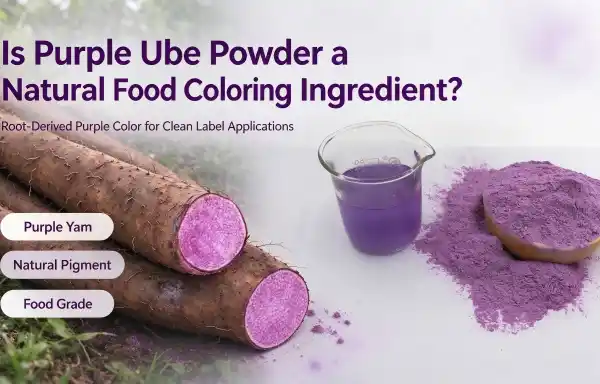
Purple yam powder (purple ube powder) is a natural food ingredient with coloring properties, making it suitable for applications requiring natural purple food coloring. Its purple color primarily comes from anthocyanins, which are water-soluble natural pigments. Unlike high-purity pigment extracts, natural purple yam powder is a whole-food ingredient that provides color, characteristic yam flavor, and naturally occurring nutritional components. Food manufacturers can directly incorporate purple ube powder into baked goods, beverages, noodles, desserts, and other food formulations. As a versatile purple yam powder for food applications, it offers a convenient option for developing naturally colored food products.

Natural Pigment Properties and Chemical Composition of Purple Yam Powder
Purple yam powder, also known as purple ube powder, is derived from the tubers of Dioscorea alata L. It is widely used as a natural food ingredient and a plant-based coloring agent in food and beverage formulations. Its natural purple color comes mainly from water-soluble anthocyanins, making natural purple yam powder a potential alternative to synthetic food colorants.
Natural Purple Color: Water-Soluble Anthocyanins
The purple color of purple yam powder is primarily attributed to naturally occurring anthocyanins. These pigments mainly include glycosides of acylated cyanidin and delphinidin, which contribute to the characteristic deep-purple and purplish-red shades of purple ube powder.
Chemical Stability and Structural Characteristics
Unlike non-acylated anthocyanins, purple yam anthocyanins may contain acyl groups derived from phenolic acids, such as caffeic acid and ferulic acid. This structural feature can improve pigment stability under certain processing conditions, including heat and light exposure. Therefore, purple yam powder for food coloring is worth considering for food manufacturers developing naturally colored products. Its pigment performance still depends on processing temperature, pH, and storage conditions.
Physical and Chemical Properties of Purple Yam Powder as a Natural Pigment
In food industry applications, these physical and chemical properties determine the scope of a pigment's utility and the parameters for its processing.
Table of Physical and Chemical Indicators
|
Indicator items |
Parameters and Characteristics |
Food industry application significance |
|
Appearance and color |
Uniform powder, ranging in color from purplish-red to deep purple |
Gives the end product a uniform and natural coloring effect |
|
Solubility |
Good water solubility; highly hydrophilic |
Easily dispersed in aqueous systems (e.g. beverages, dairy products) |
|
pH sensitivity |
Red in acidic conditions (pH < 4); purple in neutral conditions (pH 6–7); blue/greenish-gray in alkaline conditions (pH > 8) |
Color tone control can be achieved by adjusting the pH value of the system |
|
Thermal stability |
Maintains high color stability under standard heating (80°C–100°C) |
Suitable for baking, cooking and pasteurization processes |
|
Light stability |
Superior to conventional, non-acylated anthocyanins |
Extend the appreciation period and shelf life of transparent packaged foods |
Effect of System pH on the Coloration of Purple Yam Powder
The anthocyanins in purple yam powder are typical pH-sensitive chromophores:
Under acidic conditions (pH 1.0–3.5), the molecules exist primarily as flavylium cations, exhibiting a bright red or purplish-red color.
Under neutral conditions (pH 5.5–7.0), they convert into quinonoidal base structures, appearing as a stable purple.
Under alkaline conditions (pH > 7.5), further deprotonation results in the formation of phenolate anions, which appear blue-purple; in highly alkaline environments, they may shift toward a greenish-yellow hue and undergo degradation.
Differentiation from Synthetic Pigments and High-Purity Natural Colorants
In food formulation, purple ube powder and purple yam powder offer a different value proposition from synthetic pigments, such as Brilliant Blue and Carmoisine, and high-purity natural colorants, including radish red, beet red, and copper chlorophyllin. Synthetic food colors provide strong color intensity, excellent stability, and low usage rates. However, some manufacturers are exploring natural alternatives to meet growing clean-label preferences. High-purity natural colorants offer another option, but their costs can be higher, and their stability varies depending on the pigment and processing conditions.
The competitive advantage of natural purple yam powder is not its color intensity or stability alone. Instead, it combines natural purple coloration with the appeal of a recognizable plant-based ingredient. This makes purple ube powder suitable for food manufacturers developing clean-label products and formulations featuring functional ingredients.
Purple yam (Ube) is gaining attention as an anthocyanin-rich ingredient because of its naturally vibrant purple color. Some purple yam materials can contain more than 300 mg of anthocyanins per 100 g, depending on the variety, raw material, and testing method. Anthocyanins are plant pigments with antioxidant activity. However, when purple yam powder is used at low inclusion levels for coloring, its nutritional contribution should not be overstated.
For B2B food manufacturers, the value of bulk purple ube powder lies in its dual positioning as a natural purple food ingredient and a plant-derived source of color. It can also support ingredient-label transparency by allowing manufacturers to list purple yam powder as an ingredient rather than relying solely on synthetic color additives.
What Is Purple Ube Powder and Purple Yam Powder Used For in the Food Industry?
Due to its natural purple color and nutritional composition, purple yam powder is widely used as a functional ingredient in the food processing industry. Also known as purple ube powder in many food applications, it is suitable for various formulations, including bakery products, dairy products, beverages, confectionery, and frozen foods. Food manufacturers use natural purple yam powder to improve product appearance while adding plant-based ingredients and dietary fiber to their formulations.
The following sections explain the major applications of purple yam powder for food manufacturing and its potential in different food processing sectors.
Bakery and Baked Goods
Purple yam powder for baking is commonly used in bread, sliced loaves, cookies, cakes, biscuits, and traditional pastries. When incorporated into flour, batters, or dough, it provides a natural purple color that helps manufacturers develop visually distinctive bakery products.
It can also be used in specialty products such as Chinese steamed rice cakes (gaotuan) and mooncakes. Depending on the formulation, baking temperature, and processing conditions, purple yam powder can retain part of its natural color during heat treatment. Manufacturers should conduct formulation tests to evaluate color stability and determine the appropriate addition level for different bakery applications.
Dairy Products and Ice Cream
Purple yam powder for dairy products is suitable for yogurt, ice cream, flavored milk, milkshakes, and plant-based dairy alternatives. It contributes a natural purple appearance and can also influence the texture and mouthfeel of finished products.
In dairy formulations with a pH of approximately 6.5–6.8, the resulting color and dispersion depend on the powder's composition, processing method, and interaction with other ingredients. Its starch and dietary fiber components may contribute to viscosity and product consistency.
For commercial applications, manufacturers should evaluate solubility, dispersion, and color stability in the final formulation.
Powdered and Ready-to-Drink Beverages
Purple ube powder for beverages is increasingly suitable for instant beverage mixes, meal replacement powders, smoothies, instant oatmeal, and functional drink formulations. It can serve as a primary flavor and color ingredient or as a complementary plant-based ingredient.
Purple yam powder adds natural color and contributes carbohydrates and dietary fiber, depending on its specifications. It can be incorporated into dry beverage blends or tested in liquid beverage systems. Particle size, moisture content, and dispersibility are important factors when selecting a suitable purple yam powder ingredient for beverage manufacturing.
Confectionery and Frozen Flour-Based Products
Bulk purple yam powder is also used in confectionery and traditional flour-based foods, including soft candies, hard candies, tangyuan (glutinous rice balls), steamed bun wrappers, and mantou (Chinese steamed buns).
It provides a distinctive purple appearance and can help manufacturers develop naturally colored food products. In frozen and refrigerated applications, formulation compatibility, moisture control, and freeze-thaw stability should be evaluated to maintain consistent product quality.
Purple Yam Powder Formulation Guide
When using purple yam powder (purple ube powder) as a natural food coloring ingredient, manufacturers should consider pH sensitivity, thermal stability, dosage, texture, and raw material consistency. These factors directly affect the color performance and quality of finished food products.
pH Sensitivity
The anthocyanins in purple yam can change color depending on the pH of the food system. Under acidic conditions, they generally produce red to purplish-red tones, while neutral or alkaline environments may cause blue shifts or color fading. Therefore, purple yam powder for food coloring is more suitable for acidic or mildly acidic products, such as fruit juice beverages, yogurt, and jams. In neutral-pH baked goods, the final color may become grayish-purple.
Thermal Processing Stability
Prolonged exposure to high temperatures can accelerate anthocyanin degradation. For better color retention, purple ube powder can be added after heating or used in products with mild thermal processing. For steamed buns, noodles, and other flour-based products, manufacturers should optimize cooking time and processing conditions.
Dosage and Texture Balance
Purple yam powder contains natural starch. Excessive addition may increase viscosity, create a sticky texture, or make products too dense. Manufacturers can combine bulk purple yam powder with a concentrated natural colorant to achieve the desired shade without significantly changing product texture.
Raw Material Standardization
Anthocyanin content and color intensity vary with yam variety, growing conditions, harvest time, and storage. For consistent formulations, purple yam powder suppliers should provide batch-specific COA data, including color values and relevant quality specifications.
|
Application Scenarios |
Applicability |
Critical Control Points |
|
Cold drinks / Instant powdered mixes |
High |
Solubility and color uniformity |
|
Acidic dairy products / Fruit juices |
Medium-High |
pH range (acidic conditions), light-shielding packaging |
|
Baked goods and pastries |
Medium |
Baking temperature and duration, color retention |
|
Steamed or boiled noodle products |
Medium-Low |
Cooking loss, impact of additive dosage on texture |
|
High-temperature puffed foods |
Low |
Significant thermal degradation of anthocyanins |
The Trend Toward Natural Color Alternatives and Regulatory Compliance
Driven by growing consumer demand for healthier products and clean-label formulations, food manufacturers are increasingly adopting natural coloring ingredients instead of synthetic food colorants. Purple ube powder and purple yam powder are gaining attention as plant-based ingredients that can provide natural purple hues in food and beverage applications.
Regulatory Compliance
The regulatory status of purple yam powder varies by country, region, botanical source, and intended application. In markets such as China, the European Union, the United States, and Japan, manufacturers should verify applicable food ingredient regulations, permitted uses, and labeling requirements before incorporating purple yam powder into commercial products. Usage levels should follow relevant local regulations and food safety standards.
Clean-Label Advantages
Listing purple yam powder, natural purple food coloring, or purple yam blend powder on an ingredient label can support clean-label positioning. Compared with synthetic colorants, natural purple ube powder offers manufacturers a plant-derived ingredient option for developing naturally colored beverages, bakery products, desserts, and food formulations.
FAQs:
Q1. Does purple yam powder contain anthocyanins and antioxidants?
Yes. Purple yam naturally contains anthocyanins, a group of plant pigments with antioxidant activity. Some purple yam varieties contain acylated cyanidin and delphinidin derivatives.
Certain purple yam materials have been reported to contain more than 300 mg of anthocyanins per 100 g, although the actual concentration varies with botanical variety, growing conditions, processing methods, and analytical procedures.
Q2:Is purple yam powder water-soluble?
Purple yam powder contains water-soluble anthocyanin pigments, but the entire powder should not automatically be classified as fully water-soluble.
Its starch, dietary fiber, and other insoluble components may affect dispersion and sedimentation. The actual performance depends on the drying process, particle size, raw material composition, and formulation.
For beverage applications, manufacturers should evaluate dispersibility, sedimentation, particle size, and color uniformity. Fine-mesh powder or a specially processed grade may be more suitable for instant beverage formulations.
Q2:Does purple yam powder change color depending on pH?
Yes. Anthocyanins in purple yam powder are pH-sensitive pigments. Their molecular structures change under different pH conditions, resulting in different colors.
Typical color changes include:
• Acidic conditions (pH 1.0–3.5): Red or purplish-red.
• Mildly acidic to near-neutral conditions: Purple or reddish-purple, depending on the formulation.
• Neutral conditions (approximately pH 6–7): Purple shades may develop.
• Alkaline conditions (pH above 7.5): Blue-purple or grayish tones may appear, followed by possible pigment degradation.
For food manufacturers, pH testing is important when developing purple beverages, yogurt, jams, sauces, and other products containing anthocyanin-rich ingredients.
Q3:What gives purple yam powder its natural purple color?
The natural purple color of purple yam powder primarily comes from anthocyanins, which are water-soluble plant pigments. These pigments include acylated cyanidin and delphinidin glycosides.
Acylated anthocyanins contain additional chemical groups derived from phenolic acids, such as caffeic acid and ferulic acid. These structural characteristics may improve pigment stability under certain processing conditions.
The actual anthocyanin content and color intensity vary depending on yam variety, cultivation conditions, harvesting time, and processing methods.
Q4:What is the difference between purple yam powder and purple sweet potato powder?
Purple yam powder and purple sweet potato powder come from different botanical sources, although both contain anthocyanins and are used as natural purple food ingredients.
|
Feature |
Purple yam powder |
Purple sweet potato powder |
|
Botanical source |
Dioscorea alata L. |
Ipomoea batatas |
|
Main pigments |
Anthocyanins |
Anthocyanins |
|
Flavor |
Characteristic yam flavor |
Characteristic sweet potato flavor |
|
Main components |
Starch, fiber, and anthocyanins |
Starch, fiber, and anthocyanins |
|
Applications |
Ube desserts, bakery, beverages |
Bakery, snacks, beverages, desserts |
The two ingredients should not be treated as interchangeable without evaluating color, flavor, texture, and processing performance.
Q5:How much purple ube powder should be added to food formulations?
The recommended addition level depends on the desired purple color, product category, raw material quality, and formulation requirements.
Food manufacturers should consider the following factors when determining the dosage:
- Anthocyanin content and natural color intensity.
- Desired color shade and uniformity.
- Starch content and its effect on viscosity.
- Product pH and processing temperature.
- Flavor compatibility with other ingredients.
Excessive purple yam powder may increase viscosity, produce a sticky texture, or affect the flavor of finished products. For stronger purple coloration without significantly changing texture, manufacturers can evaluate combining purple yam powder with a concentrated natural colorant.
Conclusion
Strictly speaking, purple yam powder is better classified as a natural food ingredient with coloring properties rather than a high-purity pigment extract. Its natural anthocyanins, mainly acylated cyanidin and delphinidin glycosides, contribute to its purple color and offer better thermal and light stability than some non-acylated anthocyanins. The color of purple ube powder varies with pH: reddish-purple under acidic conditions, purple near neutral pH, and bluish-gray under alkaline conditions. Its stability also depends on processing temperature, dosage, and raw material quality. Excessive heat may cause color degradation, while high inclusion levels can affect the texture of finished products.
With its natural color and ingredient functionality, natural purple yam powder is suitable for beverage mixes, acidic dairy products, and low-to-medium-temperature baked goods. It may be less suitable for high-temperature extrusion applications. As a professional purple yam powder manufacturer and supplier, Guanjie Biotech provides quality-controlled production and flexible bulk supply, along with customized OEM and ODM services for food ingredient buyers. Welcome to enquire with us at info@gybiotech.com.
References:
[1] Tsukui, A. (1988). Stability of Anthocyanin Pigments of Philippine Powdered Purple Yam: Effect of pH, Heat, Light and Oxygen. Journal of Home Economics of Japan, *39*(3), 209-215.
[2] Kumazawa, S., et al. (2015). New acylated anthocyanins from purple yam and their antioxidant activity. Bioscience, Biotechnology, and Biochemistry, *79*(9), 1484-1492.
[3] Sandoval, A.L.C., Sumague, Ma.J.V., Santiago, D.M.O., et al. (2023). Optimization and anthocyanin extraction from purple yam (Dioscorea alata) peels for food colorant and antimicrobial. University of the Philippines at Los Baños.
[4] Purple yam and food application: a review of potential functional food development. (2026). ScienceDirect.
[5] Absorption of acylated anthocyanins from purple yam extract in rats. (2025). Bioscience, Biotechnology, and Biochemistry, *89*(3), 431.


