

Purple yam powder and purple sweet potato powder differ in botanical origin, appearance, nutritional composition, processing methods, and applications. Although both are purple plant-based ingredients, their color intensity, starch properties, and functional characteristics vary. For food manufacturers and ingredient buyers, understanding these differences helps select the right purple yam powder supplier or bulk purple sweet potato powder manufacturer. Both ingredients are used in bakery products, beverages, desserts, and functional foods, depending on formulation requirements and desired color.

Purple Yam Powder Vs Purple Sweet Potato Powder
Differences in Botanical Origin and Raw Material Characteristics
Purple yam powder and purple sweet potato powder are two plant-based ingredients used in food and beverage formulations. Although both have a purple color, they come from different botanical species and have distinct raw material characteristics.
Purple yam powder is derived from purple yam varieties belonging to the Dioscorea genus in the Dioscoreaceae family. The tubers are often cylindrical or irregularly shaped, with purplish-brown skin. Their flesh may range from light purple to deeper violet, sometimes with white or pale vein-like patterns.
In comparison, purple sweet potato powder is made from purple-fleshed varieties of Ipomoea batatas, a member of the Convolvulaceae family. The roots are generally spindle-shaped or elliptical, with purple skin and purple flesh. The intensity of the flesh color varies depending on the cultivar and growing conditions.
Color Characteristics and Appearance
One of the main differences between purple yam powder and purple sweet potato powder is their natural color. However, the actual shade depends on the plant variety, anthocyanin content, and processing conditions.
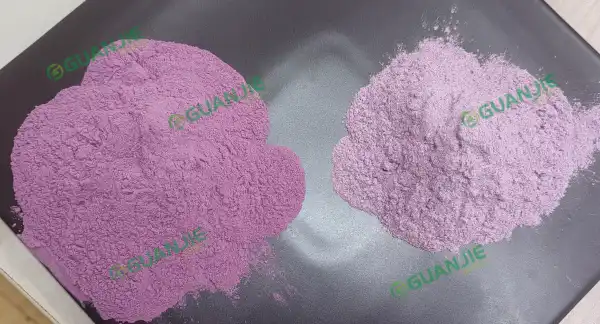
Purple yam powder may have a light purple, pale violet, or pinkish-purple appearance. Some varieties contain white or light-colored areas within the flesh, which can affect the uniformity and intensity of the finished powder. After drying and grinding, the powder may produce a softer purple tone in food formulations.
Purple sweet potato powder generally ranges from deep purple to reddish-purple, depending on the cultivar. Purple sweet potatoes contain anthocyanins, which contribute to their characteristic color. When the raw material has a high anthocyanin content, the resulting powder may provide stronger purple coloration in certain food applications.
|
Comparison Criteria |
Purple Yam Powder |
Purple Sweet Potato Powder |
|
Powder Color |
Light purple, soft and pale in tone |
Deep purple, rich |
|
Color Uniformity |
Often features white streaks; relatively low uniformity |
Uniform and consistent color |
|
Tinting Strength |
Mild intensity; requires a higher inclusion rate |
Highly potent; effective even at low inclusion levels |
Purple Yam Powder and Purple Sweet Potato Powder Nutritional Differences
Purple yam powder and purple sweet potato powder offer different nutritional profiles and functional properties for food ingredient applications.
Purple yam powder is valued for its mucilaginous proteins, dietary fiber, and diosgenin-related compounds. Research on purple yam from Zhejiang Province reports approximately 13.82% crude protein, 25.13% crude fiber, and 2.14% diosgenin. These figures are specific to the studied material and may vary by variety and processing method. Diosgenin is a steroidal sapogenin used in research and the development of steroidal compounds. Purple yam also contains essential amino acids, with glutamic acid contributing to its savory flavor. Its mucilage may provide emulsifying and thickening properties, making purple yam powder suitable for selected food formulations.
Purple sweet potato powder is known for its anthocyanin content, natural purple color, and dietary fiber. Its acylated anthocyanins contribute antioxidant activity and generally offer better stability than non-acylated anthocyanins. Purple sweet potatoes also provide minerals, including potassium and manganese. Depending on the raw material and processing conditions, purple sweet potato powder can be used in beverages, bakery products, snacks, and natural food-coloring applications.
|
Functional Components / Nutritional Indicators |
Purple Yam Powder |
Purple sweet potato powder |
|
Characteristic Active Substances |
Diosgenin, mucoproteins, allantoin |
Anthocyanins (acylated), selenium |
|
Crude Protein (dry basis, reference value) |
Approximately 13.8% |
Moderate levels; significant variation between varieties |
|
Dietary Fiber |
Approximately 1.0 g/100g (based on fresh weight) |
Approximately 2.5 g/100g (based on fresh weight) |
|
Pigmentation-related Components |
Anthocyanins (low content) |
Anthocyanins (relatively high content) |
Purple Yam Powder and Purple Sweet Potato Powder Processing Characteristics and Thermal Behavior
Purple yam powder and purple sweet potato powder have different thermal and functional properties that influence their applications in food processing.
Differential scanning calorimetry (DSC) analysis shows that purple yam flour has gelatinization onset, peak, and conclusion temperatures of approximately 78.16°C, 80.91°C, and 84.48°C, respectively, with a gelatinization enthalpy of 10.43 J/g. Its higher gelatinization temperatures compared with wheat flour indicate that adequate heating is essential during baking and steaming. Rapid Visco Analyzer (RVA) results show a higher peak viscosity (3,945.67 cP) and a lower breakdown value (64.33 cP). These properties suggest good paste stability under heating and shear. Its lower setback value may also indicate a reduced tendency toward starch retrogradation during cooling.
In contrast, purple sweet potato powder contains carbohydrates, dietary fiber, and natural sugars that affect its processing performance. During high-temperature processing, its sugars may contribute to Maillard reactions and caramelization, depending on the formulation and processing conditions. Its fiber content can influence dough structure and texture, particularly in gluten-containing bakery products. In addition, purple sweet potato flour may offer useful water- and oil-holding properties in bakery fillings and meat products.
Purple Yam Powder and Purple Sweet Potato Powder Uses and Formulation Recommendation
Purple yam powder and purple sweet potato powder offer different functional properties for industrial food production. By understanding their differences in color, flavor, texture, and formulation performance, food manufacturers can select the right ingredient or combine both powders to meet specific product development goals.
• Applications of Purple Yam Powder
Purple yam powder is suitable for food formulations that require a smooth texture, mild flavor, and natural purple color. It can be used in noodles, beverages, powdered drink mixes, and plant-based food products.
In noodle formulations, a preliminary blend containing 10% purple yam powder and 5% purple sweet potato powder may help improve product color and diversify the ingredient profile. However, processing performance, noodle integrity, and breakage rates should be verified through trials under actual production conditions.
For beverages and instant drink mixes, purple yam powder provides a mild flavor that can complement fruit, dairy, and other flavor ingredients. Its starches and polysaccharides may also influence viscosity and mouthfeel, depending on the raw material and processing method. Manufacturers should evaluate solubility, sedimentation, and suspension stability when developing purple yam powder beverages.
• Applications of Purple Sweet Potato Powder
Purple sweet potato powder is particularly useful in applications where strong purple color is a key product requirement. Common applications include baked goods, ice cream, dessert mixes, nutritional powders, and meal-replacement formulations.
Its natural anthocyanin pigments contribute to its purple color, making purple sweet potato powder for food coloring a potential option for manufacturers seeking plant-derived color ingredients. Color intensity and stability depend on the powder specification, processing temperature, pH, and storage conditions.
Purple sweet potato powder also contributes a characteristic sweet potato flavor. Food developers should consider this flavor when formulating products with delicate or complex taste profiles.
• Combining Purple Yam Powder and Purple Sweet Potato Powder
Combining natural purple yam powder and purple sweet potato powder can help manufacturers balance color, flavor, and texture. Purple sweet potato powder primarily contributes purple pigmentation and characteristic flavor, while purple yam powder can contribute starches and polysaccharides that affect the texture of the final product.
This ingredient combination may be suitable for beverage powders, bakery mixes, noodles, desserts, and other food applications. The optimal ratio depends on the desired color intensity, sensory profile, processing conditions, and finished-product specifications.
• Formulation Recommendations for Food Manufacturers
Before commercial production, manufacturers should conduct small-scale formulation trials to determine the appropriate inclusion rate. Evaluate color retention, moisture content, particle size, dispersibility, sensory characteristics, and stability during processing and storage.
When sourcing a bulk purple yam powder or purple sweet potato powder supplier, request a technical data sheet (TDS), certificate of analysis (COA), and relevant food safety documentation. Confirm the botanical source, processing method, carrier ingredients, and available specifications to support consistent quality and reliable large-scale production.
FAQs:
Q1. Is purple yam powder the same as ube powder?
A: Purple yam powder is commonly marketed as ube powder when it is made from purple yam (Dioscorea alata). Ube is widely used in Filipino desserts, bakery products, ice cream, and beverage applications. However, not every purple-colored root powder is ube. Buyers should verify the botanical source, ingredient declaration, and product specifications to ensure that the powder meets their formulation requirements.
Q2. What are the main applications of purple yam powder and purple sweet potato powder?
A: Purple ube powder and purple sweet potato powder are used in a range of food and beverage applications, including:
Bakery products, cakes, cookies, and bread
Ice cream, frozen desserts, and dairy-based products
Smoothies, milk drinks, and instant beverage mixes
Noodles, pastries, and dessert fillings
Snack foods, confectionery, and powdered food blends
Natural Purple yam powder is often selected for its distinctive yam flavor and traditional dessert applications, while purple sweet potato powder is used in products requiring a purple color, mild flavor, and root vegetable solids.
Q3. Which powder is better for natural purple coloring: purple yam powder or purple sweet potato powder?
A: The better option depends on the target color, formulation, and processing conditions. Both powders may contribute purple color through naturally occurring anthocyanins, but their color intensity and stability vary with the raw material and manufacturing process. Purple sweet potato powder is often considered for color-oriented food applications, while purple yam powder can provide both color and characteristic yam flavor. Formulators should test the finished product under the intended pH, temperature, and storage conditions.
Q4. Are purple yam powder and purple sweet potato powder water-soluble?
A: Neither powder should automatically be considered fully water-soluble. Both contain plant solids and starch, so their behavior in water depends on particle size, processing method, temperature, and formulation conditions. Fine powders may disperse more readily, but dispersion is different from complete dissolution. For instant beverages, manufacturers should evaluate wetting, sedimentation, viscosity, and dispersibility before selecting a suitable grade.
Q5.Do purple yam powder and purple sweet potato powder contain additives?
A: Some commercial powders contain only the dried root ingredient, while others may include carriers such as maltodextrin or other processing ingredients, depending on the manufacturing method. Buyers seeking 100% pure purple yam powder or purple sweet potato powder should confirm the full ingredient declaration, processing aids, and any carrier content with the supplier. Claims such as "no additives" should be supported by the product specification and manufacturing information.
Conclusion:
Purple yam powder and purple sweet potato powder are natural plant-based ingredients derived from different botanical species. Purple yam powder contains diosgenin-related compounds and provides functional properties for food processing, while purple sweet potato powder is rich in anthocyanins and offers strong natural coloring potential. Both ingredients are suitable for noodles, instant beverage mixes, bakery products, and other food formulations. Manufacturers can select purple yam powder or purple sweet potato powder based on their desired color, texture, and processing requirements. For commercial production, small-scale trials are recommended to optimize the ingredient ratio, flavor profile, and processing stability before large-scale manufacturing.
Guanjie Biotech is a purple yam powder and purple sweet potato powder supplier, providing bulk quantities of both ingredients for food and beverage applications. The company also offers OEM and ODM services to support customized specifications and formulation development. Welcome to enquire with us at info@gybiotech.com.
References:
[1] Kusnandar, F., Azhmia, F. H., & Budi, F. S. (2026). Physicochemical Characteristics of Pre-gelatinized Purple Sweet Potato (Ipomoea batatas var. Ayamurasaki) Flour and Their Effects on Analog Rice. FAO AGRIS.
[2] Liu, Y., Shen, W., Jin, W., Li, F., Chen, X., Jia, X., & Cai, H. (2024). Physicochemical characterization of a composite flour: Blending purple sweet potato and rice flours. ScienceDirect.
[3] Rosida, R. (2016). Physicochemical Properties and Starch Digestibility of Autoclaved-Cooled Water Yam (Dioscorea alata L.) Flour. International Journal of Food Properties.
[4] Liu Ying, Shi Shanshan, & Wang Caisheng. (2010). Determination of nutritional components and diosgenin content in purple yam from Zhejiang. *Journal of Anhui Agricultural Sciences*, *38*(9), 4563-4564.
[5] Qian Li, Yang Ruijin, Zhao Wei, Hua Xiao, & Zhang Wenbin. (2017). Effects of drying processes on the physicochemical properties and anthocyanin content of purple sweet potato flour. *Science and Technology of Food Industry*, *38*(11), 189-194.
[6} Xiong Tian, Mei Xin, Cai Fang, He Jianjun, Shi Jianbin, Cai Sha, Sui Yong, Chen Xueling, Fan Chuanhui, & Zhou Deshun. (2023). Quality analysis of purple sweet potato flour prepared via different drying processes. *Science and Technology of Food Industry*, (6), 49-57.


