

Mango powder is a widely used natural fruit ingredient in the food and beverage industry, with applications in beverages, dairy products, bakery, confectionery, ice cream, meal replacement products, and nutritional foods. When sourcing bulk mango powder, manufacturers should evaluate more than color, flavor, and solubility. Mango powder moisture content is a critical quality indicator that directly affects shelf life, caking resistance, aroma stability, nutrient retention, flowability, transportation safety, and processing performance. Professional mango powder suppliers and mango powder manufacturers include moisture testing as a key quality control standard.
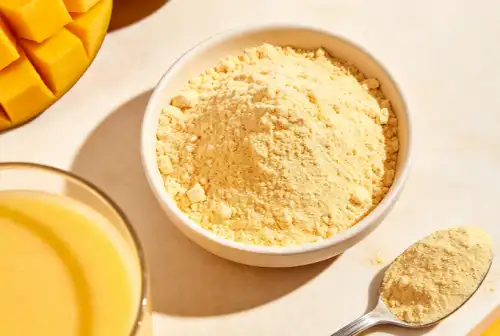
What Is The Moisture Content Of Mango Powder?
Moisture content is one of the most important quality indicators of mango powder, representing the percentage of water by weight in the finished product. Accurate moisture analysis helps evaluate product stability, shelf life, and storage performance. Common testing methods include the oven drying method, vacuum drying method, and Karl Fischer titration, with the oven drying method being the most widely used in the food industry. The moisture content of natural mango powder, freeze-dried mango powder, and spray-dried mango powder varies depending on the manufacturing process.
|
Product Types: |
Moisture Content(%) |
|
Spray-dried mango powder |
3%–6% |
|
Freeze-dried mango powder |
2%–5% |
|
High-sugar carrier-based mango powder |
3%–5% |
|
Carrier-free freeze-dried mango powder |
2%–4% |
Why Does Moisture Content Affect the Shelf Life of Mango Powder?
The shelf life of mango powder depends not only on the manufacturing process and packaging but also on its moisture content. For the food and beverage industry, moisture content is one of the most important quality indicators for evaluating the stability of natural mango powder. It influences not only the product's appearance, flowability, and processing performance but also its microbial stability, nutrient retention, color, flavor, and transportation safety throughout storage.
For this reason, manufacturers and buyers of bulk mango powder typically treat moisture content as a critical quality specification. It is usually evaluated together with water activity (Aw) to provide a more comprehensive assessment of product stability and shelf life.
Increased Risk of Microbial Contamination
Although spray-dried mango powder and freeze-dried mango powder undergo dehydration processes that significantly reduce moisture, they are not completely sterile. During production, packaging, transportation, or storage, airborne microorganisms-including yeast, molds, and spore-forming bacteria-may still contaminate the product.
Higher moisture content creates a more favorable environment for microbial activity. Water activity vs moisture content in dried fruits are similar. While water activity is the primary factor governing microbial growth, moisture content is closely related to water activity. As moisture content increases, water activity often rises as well, increasing the risk of mold growth, fermentation, spoilage, and reduced shelf life.
For this reason, reputable mango powder manufacturers strictly control both moisture content and water activity to ensure excellent microbial stability during storage.
Accelerated Degradation of Natural Active Compounds
Mango fruit powder naturally contains vitamin C, carotenoids, polyphenols, and other bioactive compounds that are sensitive to oxygen, light, and moisture. Excess moisture acts as a reaction medium, accelerating oxidation and hydrolysis.
Vitamin C is particularly vulnerable to oxidative degradation, resulting in lower nutritional value and reduced antioxidant capacity. Carotenoids and polyphenols may also gradually decline, decreasing the functional value of the product.
To improve ingredient stability, high-quality mango powder suppliers commonly use rapid drying technology, oxygen-barrier packaging, vacuum sealing, or nitrogen flushing, combined with low-temperature storage.
Reduced Color Stability
Color is one of the most important quality attributes for food manufacturers and consumers. Higher moisture content promotes Maillard reactions and non-enzymatic browning during storage.
Natural sugars such as glucose and fructose react with amino acids under favorable moisture conditions, gradually changing the powder's color from bright yellow to dark yellow or brown. Degradation products of vitamin C also contribute to browning reactions.
For manufacturers of beverages, dairy products, bakery products, and nutritional supplements, maintaining consistent color is essential. Therefore, controlling the moisture content of mango powder is an effective strategy for reducing discoloration during storage.
Increased Agglomeration and Caking
Natural mango powder is highly hygroscopic, especially spray-dried mango powder formulated with carriers such as maltodextrin. Under humid conditions, the powder readily absorbs moisture from the surrounding air.
As moisture increases, liquid bridges form between particles, leading to caking and agglomeration. This reduces flowability, negatively affecting automated weighing, conveying, mixing, and packaging operations.
Agglomerated powder also dissolves more slowly and disperses less uniformly, which may reduce mixing efficiency in beverages and powdered food products. In severe cases, additional grinding is required, increasing production costs.
Reduced Flavor Stability

The characteristic mango aroma comes from volatile compounds such as esters, terpenes, aldehydes, and lactones. These compounds are highly sensitive to moisture, oxygen, and temperature. As moisture content increases, volatile compounds migrate and evaporate more rapidly, resulting in weaker fruit aroma and lower flavor stability during long-term storage.
For manufacturers of juices, dairy beverages, confectionery, and functional foods, aroma loss often requires the addition of extra flavorings, increasing formulation costs. Maintaining low moisture content helps preserve the authentic flavor of mango fruit powder.
Poor Powder Flowability
Modern food manufacturing relies heavily on automated conveying, dosing, blending, and packaging systems. These processes require powders with excellent flowability.
When moisture content increases, friction and adhesion between powder particles also increase, causing bridging, hopper blockage, and inconsistent feeding during production.
For this reason, buyers of bulk mango powder often request technical specifications beyond moisture content, including bulk density, tapped density, particle size distribution, and angle of repose, to evaluate overall processing performance.
Reduced Transportation and Storage Stability
Export-grade bulk mango powder often undergoes 30–45 days of ocean transportation followed by several months of warehouse storage. During this period, products may be exposed to high temperatures, high humidity, and repeated temperature fluctuations.
If the initial moisture content is too high, the powder is more likely to absorb additional moisture, resulting in caking, package swelling, microbial contamination, and shortened shelf life.
Therefore, professional mango powder manufacturers typically use high-barrier aluminum foil bags, vacuum packaging, or nitrogen-flushed packaging together with effective moisture-proof protection. These measures help maintain product quality throughout transportation and long-term storage while ensuring consistent performance across the global supply chain.
The Impact of Different Production Processes on the Moisture Content of Mango Powder
The final moisture content of mango powder is directly influenced by the production process. Different drying technologies provide varying dehydration efficiencies and processing conditions, resulting in differences in moisture levels, product quality, shelf life, and application performance. For mango powder manufacturers and food formulators, selecting the appropriate production method is essential for achieving the desired product specifications and meeting different market requirements.
Spray-dried mango powder
Spray-dried mango powder is the most widely used product in the global food industry. This production method typically produces food-grade mango powder with a stable moisture content of 3%–6%. Spray-drying offers high production efficiency, excellent batch consistency, and relatively low manufacturing costs, making it ideal for large-scale industrial production. Due to its cost-effectiveness and stable quality, bulk mango powder produced by spray drying is commonly used in beverages, solid drink mixes, bakery products, confectionery, dairy products, and other mainstream food applications. It remains the most versatile and commercially available type of natural mango powder.
Freeze-dried mango powder
Freeze-dried mango powder generally has a lower moisture content of 2%–4%. The low-temperature vacuum drying process effectively preserves the mango's natural flavor, aroma compounds, color, vitamins, and other heat-sensitive nutrients. As a result, freeze-dried products offer superior sensory quality and nutritional retention compared with conventional drying methods. However, the production process requires specialized equipment and longer processing times, leading to higher manufacturing costs. Therefore, freeze dried mango powder is primarily used in premium foods, dietary supplements, infant nutrition, functional foods, and other high-value applications where product quality is the highest priority.
Vacuum-dried mango powder
Vacuum-dried mango powder also achieves low hygroscopic properties of fruit powders levels while minimizing oxidation during processing. The vacuum environment reduces thermal damage, helping preserve the natural color, flavor, and quality of the mango powder. In addition, this production method provides excellent storage stability and extends product shelf life by reducing moisture-related deterioration. Although vacuum drying is more expensive than spray drying, it is well suited for producing premium mango fruit powder used in high-end food, beverage, nutraceutical, and health product formulations. For manufacturers seeking consistent quality and enhanced product stability, vacuum-dried mango powder represents an excellent solution for value-added applications.
Ultimately, each production technology offers distinct advantages. Choosing the appropriate manufacturing process depends on product positioning, quality requirements, production costs, and the intended mango powder applications. Understanding these differences enables food manufacturers to select the most suitable mango powder supplier and optimize product performance for their target markets.
How to Control the Moisture Content of Mango Powder and Extend Its Shelf Life?
Maintaining the proper moisture content is essential for preserving the quality, stability, and shelf life of mango powder. Professional mango powder manufacturers and bulk mango powder suppliers typically implement the following practices to improve product stability and ensure consistent quality.
Optimize the Drying Process
Select the most suitable drying technology, such as spray-dried mango powder, freeze-dried mango powder, or vacuum drying, based on the intended application. Proper drying achieves the target moisture level while minimizing the loss of natural flavor, color, and nutrients.
Control Production Environment Humidity
Maintain low relative humidity in the production and packaging areas to prevent natural mango powder from absorbing moisture during processing.
Use High-Barrier Packaging
Package mango fruit powder in aluminum foil laminate bags, multi-layer barrier pouches, or high-barrier drums to minimize moisture penetration and protect product quality.
Apply Vacuum or Nitrogen-Flushed Packaging
Vacuum sealing or nitrogen flushing helps reduce oxygen and moisture exposure, slowing oxidation, browning, and flavor deterioration.
Store Under Appropriate Conditions
Store bulk mango powder in a cool, dry, and dark environment. Avoid high temperatures, excessive humidity, and frequent temperature fluctuations to maximize shelf life.
Reseal Immediately After Opening
After opening, reseal the package promptly. For large containers, use desiccants or nitrogen flushing when necessary to minimize moisture absorption and maintain the quality of organic mango powder throughout storage.
How To Choose Mango Powder?
|
Drying Technology |
Moisture Content (%) |
Target Water Activity (Aw) |
Typical Shelf Life |
Primary B2B Applications |
|
Freeze-Dried (FD) |
2% – 4% |
< 0.30 |
24 Months |
Premium Nutraceuticals, Infant Food, Clean-Label Products |
|
Spray-Dried (SD) |
3% – 6% |
< 0.40 |
18–24 Months |
Instant Beverages, Confectionery, Dairy, Bakery |
|
Vacuum-Dried (VD) |
3% – 5% |
< 0.35 |
18 Months |
Functional Foods, Health Supplements |
FAQs:
Q1: What is the critical Water Activity threshold to prevent caking in bulk mango powder?
A: While moisture content measures the total water percentage, water activity dictates chemical and microbial stability. To prevent moisture-induced agglomeration and non-enzymatic browning, the critical water activity threshold for natural mango powder should be maintained below 0.30 to 0.40 at room temperature. Exceeding a water activity of 0.60 significantly increases the risk of mold growth and rapid flavor loss during storage.
Q2: How does carrier addition affect the moisture stability of spray-dried mango powder?
A: Natural mangoes are rich in fructose and organic acids, which possess a low Glass Transition Temperature and high hygroscopicity. Adding food-grade carriers like maltodextrin (typically 10%–30%) increases the overall Glass Transition Temperature of the spray-dried powder. This higher thermal and moisture stability prevents the powder from transitioning into a sticky, rubbery state, thereby reducing caking, improving flowability, and extending shelf life in commercial applications.
Q3: Does adding carriers like Maltodextrin help improve moisture control and shelf life?
Yes. Pure mango juice contains high levels of low-molecular-weight sugars (fructose and glucose) with low glass transition temperatures, making unformulated mango powder extremely hygroscopic. Adding food-grade carriers like Maltodextrin (typically 10%–30%) during spray drying increases the overall $T_g$, reduces moisture sensitivity, improves powder flowability, and minimizes caking under ambient humidity.
Q4: How should bulk mango powder be packaged to protect against moisture absorption during ocean shipment?
Bulk export-grade mango powder requires high-barrier, moisture-proof packaging. Standard industry protection includes sealing the powder in multi-layer aluminum foil bags (with Water Vapor Transmission Rate, WVTR < 0.1g/m2/24h) paired with heavy-duty polyethylene liners, placed inside corrugated cartons or fiber drums. Nitrogen flushing or vacuum sealing is strongly recommended for non-carrier freeze-dried grades.
Q5: What additional technical parameters should B2B buyers request alongside moisture testing on a COA?
When evaluating a Certificate of Analysis (COA) from a mango powder supplier, procurement teams should inspect Water Activity, Bulk & Tapped Density (for packaging volume calculation), Particle Size Distribution (Mesh size), Solubility/Dispersibility Index, pH value, and Microbiological Counts to ensure complete processing compatibility.
Conclusion
For food and beverage manufacturers, moisture content is one of the most critical quality indicators affecting the stability and shelf life of mango powder. Proper moisture control helps minimize microbial growth, slow the degradation of vitamins and natural pigments, reduce browning and caking, and maintain excellent flowability, solubility, and processing performance. However, moisture content alone is not sufficient to evaluate product stability. Buyers should also assess water activity (Aw), packaging barrier performance, manufacturing processes, storage conditions, and microbiological specifications. When sourcing bulk, freeze-dried, or spray-dried mango powder, choose a reliable mango powder supplier or manufacturer that provides consistent moisture control, comprehensive quality testing, and secure packaging to ensure product consistency, regulatory compliance, and long-term supply chain reliability. Guanjie Biotech is a bulk mango powder supplier; we can provide a bulk mango powder COA specification. Welcome to enquire with us at info@gybiotech.com.
References:
[1] Jaya, S., & Das, H. (2005). Accelerated storage, shelf life and color of mango powder. Journal of Food Processing and Preservation, *29*(1), 45-62.
[2]Vu, N. D., Nguyen, T. T. N. H., Dang, T. H. N., & Pham, B. A. (2025). Kinetic Models for the Changes in Moisture, Bioactive Compounds, and Antioxidant Activities During the Storage of Tu Quy Mango Powder (Mangifera indica L.). Food Science & Nutrition, *13*.
[3]Korbel, E., Servent, A., Billaud, C., & Brat, P. (2024). Heat Inactivation of Polyphenol Oxidase and Peroxidase as a Function of Water Activity: A Case Study of Mango Drying. Drying Technology.
[4]Shen, Q., Bi, X., Lin, K., Li, W., Huang, W., & Xiao, G. (2026). Effects of Different Grinding Processes on the Physicochemical Properties and Structural Characteristics of Mango Powder. Science and Technology of Food Industry, *47*(3), 99-108.
[6]Shen Qiaomei, Bi Xianjiang, Lin Kewei, Li Wenjun, Huang Wenquan, & Xiao Gengsheng. (2026). Effects of different powdering processes on the physicochemical properties and structural characteristics of mango powder. Food Industry Technology, *47*(3), 99-108.
[7]Lin Kewei, Li Zijian, Li Linjing, et al. (2025). Effects of different physical field treatment technologies on the quality of freeze-dried mango powder. Food Industry Technology, *46*(12), 41-49. doi: 10.13386/j.issn1002-0306.2024060133.


