

Purple sweet potato powder and Ube powder have gained widespread attention in a market where demand for natural food colorings and functional ingredients continues to grow. This is mainly due to their high anthocyanin content and unique appearance. Although sweet potato purple powder and Ube powder (purple yam powder) look very similar, they are fundamentally different. The differences include botanical origin, physicochemical properties, flavor compound profile, and processing stability. What is the difference between purple sweet potato and ube?

What Is The Difference Between Purple Sweet Potato Powder And Ube Powder?
The differences include botanical origin, physicochemical properties, and flavor compound profile.
Botanical Origin and Raw Material Identification
For bulk purple sweet potato powder and ube powder, clearly defining raw material biomarkers is the first step in quality control.
Purple Sweet Potato Powder
Purple Sweet Potato Powder is derived from the tuberous root of the convolvulaceae family. Sweet potato powder purple is made from the tuberous root of the genus Ipomoea L., which belongs to the family Convolvulaceae. It is related to the common sweet potato. Its purple color comes from its high anthocyanin content. The tuber is spindle-shaped with smooth skin. After steaming or cooking, it becomes soft and slightly fibrous, with a texture between potato and yam.
Supply Stability Analysis:
Purple sweet potato cultivation technology is well established. Production remains stable in major growing regions such as China, Okinawa in Japan, and the United States. Chinese varieties such as "Jihei" and "Ziluolan" provide high starch yields and stable pigment content. These varieties support the global supply chain.
Ube Powder
Ube powder is produced from Dioscorea alata L. It is internationally known as Ube and is often translated into Chinese as "ginseng sweet potato" or "purple yam." However, it is not the same as traditional Chinese yams. It belongs to the Dioscoreaceae family and is only distantly related to purple sweet potato.
Key Identifying Characteristics:
• Texture:
Ube has low water content. Its flesh is firm and rich in mucoprotein. The raw surface feels slippery.
• Appearance:
Its skin is rough and dark brown. The tuber shape is usually irregular. This clearly differs from the smooth, spindle-shaped purple sweet potato.
• Rarity:
Compared with purple sweet potato, high-quality Ube raw materials are less common. Ube also requires a tropical growing environment. As a result, purple yam ube powder is usually more expensive than ordinary purple sweet potato powder.
Physicochemical Indicators and Flavor Profiles
These indicators are important for B-end customers when selecting raw materials. They directly affect the final product formulation.
Color Expression: Differences in Anthocyanin Stability
Both ingredients obtain their purple color from anthocyanins. However, their anthocyanin structures respond differently to environmental conditions.
• Purple Sweet Potato Powder:
Purple sweet potato powder is rich in acylated anthocyanins. This structure provides high stability within a pH range of 3.0–7.0 and good heat resistance. During baking or extrusion puffing, it usually retains its purple color better than Ube powder.
• Ube Powder:
The anthocyanins in Ube powder are more sensitive to pH changes. Under acidic conditions (pH < 4), Ube powder shows a brighter bluish-purple color with fluorescent tones. Purple sweet potato powder cannot easily achieve this effect. This is one reason why high-end beverages and candies often use Ube.
Texture and Flavor Compounds

• Purple Sweet Potato Powder:
It has a mild flavor and a typical sweet potato aroma. The sweetness is moderate. It has no earthy or herbal aftertaste. This makes it highly versatile in formulations and less likely to overpower other flavors.
• Ube Powder:
Ube has a unique vanilla-like and nutty aroma. Its flavor is sometimes compared to white chocolate or pistachio. This distinct flavor profile is a signature characteristic of Ube, but it can also limit its applications. Due to its mucoprotein content, Ube powder also develops a smoother and thicker texture after rehydration.
Functional Nutritional Components
• Purple Sweet Potato Powder:
It is rich in dietary fiber and provides a strong feeling of fullness. It is commonly used in meal replacement products.
• Ube Powder:
Ube contains higher levels of potassium and diosgenin, a compound rarely found in potatoes. This contributes to its "food and medicine homology" value.
If the product focuses on high fiber and antioxidant content, purple sweet potato powder is the more cost-effective option. If the goal is to achieve a unique flavor and a smooth texture, Ube powder is irreplaceable.
What Are Purple Sweet Potato And Ube Powder Used For?
In industrialized production, raw material processing tolerance determines success or failure.
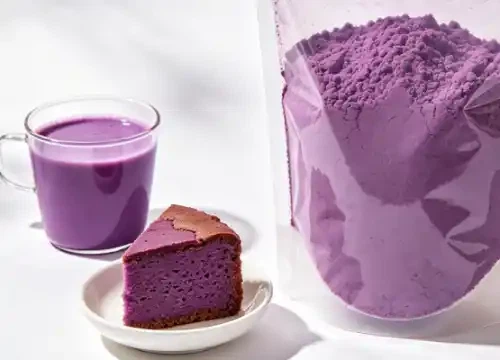
What Is Purple Sweet Potato Powder Used For?
Purple sweet potato powder bulk has stable physical properties and a mild flavor. It is widely used in B2B applications:
• Baking premixes:
It is resistant to high-temperature baking. It is not prone to browning. It is suitable for toast, mooncakes, and European-style bread. Research data shows that in high-sugar and high-oil systems, purple sweet potato powder has better color stability than Ube bulk powder.
• Extruded puffed foods:
In products such as cereal crisps and rice crackers, it provides a uniform purple cross-section. After puffing, the texture is crisp. It has no obvious bitterness.
• Solid beverages and meal replacements:
Purple sweet potato bulk powder has good water solubility and suspension stability. It is suitable for direct mixing and packaging. It does not easily clump when exposed to water.
• Noodles and rice noodles:
The typical addition ratio is 3%–10%. Purple sweet potato powder bulk gives a natural purple color to wet noodle products. It does not damage the gluten network structure.
What Is Ube Powder Used For?
Ube powder is mainly used in categories that require a premium flavor and strong visual appeal:

• Ice cream and frozen desserts:
Its vanilla and nutty flavor is released at low temperatures. Its viscosity helps improve melt resistance and smooth texture.
• Milk tea and specialty beverages:
It is used as a base for "dirty tea" or milk foam. Natural Ube Powder provides a strong coating effect and a distinctive aroma.
• Sandwich sauces and fillings:
It is often mixed with condensed milk to make "Ube Halaya, " a purple yam jam. Ube bulk powder is used in bread fillings and mille-feuille cakes.
• Candy and chocolate:
It provides a vibrant color under acidic conditions. Natural Ube Powder is used for purple coatings and fondant products.
Substitutability and Limitations Analysis
Can they substitute for each other? Based on market testing, a 1:1 direct substitution is not recommended.
• If purple sweet potato powder replaces Ube powder:
The product loses its characteristic vanilla flavor. The texture of frozen desserts may become less smooth due to higher fiber content.
• If Ube powder replaces purple sweet potato powder:
Production cost increases significantly. Ube powder has a higher color fading rate under high-temperature baking. The final product may appear grayish-brown.
Conclusion:
Natural purple sweet potato powder and Ube Powder represent two different product logics. Purple sweet potato powder combines functionality and versatility, making it suitable for large-scale industrial production and the base construction of health foods. While Ube powder serves as a carrier of emotional consumption and unique flavor, ideal for creating high-priced, viral products.
Guanjie Biotech advises B2B customers to clearly define the flavor positioning and cost structure of the final product during the initial selection process. If a stable, heat-resistant, and cost-effective purple solution is required, purple sweet potato powder is the first choice. If the goal is to recreate authentic Southeast Asian desserts and attract consumers with their unique aroma, natural Ube powder is irreplaceable.
As a large-scale Ube Powder and Purple Sweet Potato Powder supplier with many years of export experience, Guanjie Biotech is committed to providing stable supplies, complete certificates of origin, and professional technical support to help global clients develop more competitive purple health foods. For more information on the technical parameters and quality standards, please contact the technical team at info@gybiotech.com.
References:
[1] Li An, Xiao Rui, He Sheng, et al. Research progress on anthocyanins from purple sweet potato: extraction, identification, stability, bioactivity, application, and biotransformation [J]. Molecular, 2019, 24(21): 3816.
[2] Bantugan, M.A. Nutritional value, physicochemical and sensory characteristics of Halaya jam made from purple yam (Dioscorea alata L.) with purple sweet potato [Ipomea batatas (L.) Lam.] and purple taro [Colocasia esculenta (L.) Schott] as compatibilizers [D]. University of the Philippines, Los Baños, 2015.
[3] Functional study and development of anthocyanins from colored potatoes [J]. Food Research and Development, 2015(13).
[4] Li, A., Xiao, R., He, S., et al. Research Advances of Purple Sweet Potato Anthocyanins: Extraction, Identification, Stability, Bioactivity, Application, and Biotransformation[J]. Molecules, 2019, 24(21): 3816.
[5] Bantugan, M.A. Nutritional value, physico-chemical and sensory properties of purple yam (Dioscorea alata L.)-based jam (Halaya) using purple sweetpotato [Ipomea batatas (L.) Lam.] and purple taro [Colocasia esculenta (L.) Schott as extenders[D]. University of the Philippines Los Baños, 2015.
[6] Azizah, N., Anggia, M., Ulanda, F. Functional Analysis of Ubie Frozen Food as a Snack Rich in Antioxidants and Anthocyanins with The Best Processing Technology Innovation[J]. Indonesian Journal of Food Technology, 2024, 3(2): 143-153.


