

The solution of natural carrot powder depends on the processes. Spray-dried carrot powder can be easily dissolved in water, while freeze-dried carrot bulk powder cannot be dissolved in water. Let 's look at reasons and their uses.

Why Does Spray-Dried Carrot Powder Dissolve In Water?
This process produces natural carrot powder that reconstitutes quickly and completely in water, resulting in a solution-like consistency.
• Raw Material Preparation:
Whole carrots are first washed, peeled, and trimmed.
• Juicing and Pulp Removal:
The critical step: the carrots are crushed and pressed or centrifuged. This process separates the liquid juice (containing soluble sugars, minerals, vitamins, and fine suspended solids) from the insoluble pulp and fiber (comprising cellulose, hemicellulose, and lignin).
• Carrier Addition:
The carrot juice, now largely free of coarse insoluble matter, is often mixed with a carrier agent like maltodextrin or gum arabic. This is essential because the natural sugars in carrot juice (sucrose, glucose, fructose) are hygroscopic and sticky, making them extremely difficult to spray-dry into a free-flowing powder on their own. The carrier acts as a drying aid, encapsulating the juice solids.
• Homogenization and Spray-Drying:
The juice-carrier mixture is homogenized to create a uniform liquid feed. It is then pumped into a spray-dryer tower, where it is atomized into a fine mist of tiny droplets. These droplets encounter a blast of hot air, causing the water to evaporate almost instantly. What remains are fine, hollow spherical particles of natural carrot powder, each containing the dissolved solids from the juice encapsulated within the dried carrier matrix.
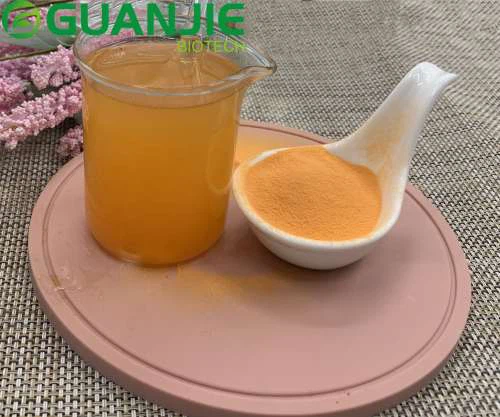 |
Why Spray-Dried Carrot Juice Powder "Dissolves"? Spray-dried carrot powder contains highly water-soluble carrier agents, like maltodextrin, which form its matrix. Upon contact with water, these carriers dissolve instantly, releasing the soluble compounds from the original juice-such as sugars, minerals, and vitamins-directly into the liquid. Any minuscule insoluble particles (like fine cellular debris or pigments) that remain are so finely milled and effectively dispersed by the dissolving carrier that they form a stable colloidal dispersion. This results in a smooth, uniform beverage that remains homogenous without significant sedimentation, mimicking a true solution in both appearance and mouthfeel. The result is a clear or slightly cloudy beverage that appears to be a solution and remains largely uniform, with minimal sedimentation. In fact, natural carrot powder is a very fine dispersion with excellent dissolution characteristics, even if not a true molecular solution. |
Why doesn't Freeze-Dried Carrot Powder Dissolve in Water?
This process takes the opposite approach, intentionally preserving the very components that are insoluble.
• Raw Material Preparation: Similar initial steps: washing, peeling.
• Processing and Drying: The whole carrot, or specifically the pulp leftover from the juicing process, is used. It is typically pureed or finely ground into a slurry.
• Freeze-Drying (Lyophilization): The carrot slurry is frozen solid. Then, it is placed in a vacuum chamber. Under a deep vacuum, the frozen water undergoes sublimation, turning directly from ice into vapor without passing through a liquid phase. This process gently removes water while preserving the physical and cellular structure of the carrot material.
• Milling: The resulting brittle, frozen matrix is then milled into a powder.
 |
Why Freeze-Dried Carrot Powder Does Not Dissolve? • Natural carrot powder consists almost entirely of intact, dried cellular matrices and dense dietary fibers-primarily cellulose and hemicellulose. These complex carbohydrates form robust, rigid plant cell walls that are impervious to water at a molecular level. The human digestive system lacks the enzyme cellulase to break them down, and water alone cannot dissolve these structural polymers. • Consequently, when added to water, the natural carrot powder does not form a solution. Instead, the particles hydrophilically absorb water, causing them to swell and become softer, but their fundamental structural integrity remains completely intact. They persist as distinct microscopic solid particles. • This results in the immediate formation of a coarse, heterogeneous suspension. Gravity acts swiftly on these hydrated yet insoluble particles, causing them to settle rapidly to the bottom of the container once agitation ceases. Therefore, the primary functional purpose of freeze-dried natural carrot powder is not to dissolve for beverages, but to impart texture, concentrated dietary fiber, natural density, and color in applications like baking, smoothie boosts, and fiber supplements. Its value lies in its insolubility, providing tangible physical structure to food products. |
Comparative Summary Table
|
Feature |
Spray-Dried Carrot Juice Powder |
Freeze-Dried Carrot Powder |
|
Primary Raw Material |
Clarified Carrot Juice |
Carrot Pulp or Whole Carrot |
|
Key Process |
Atomization + Rapid Hot-Air Drying |
Freezing + Sublimation under Vacuum |
|
Fiber Content |
Very Low ( virtually removed) |
Very High (fully retained) |
|
Carrier Agents |
Almost always used (Maltodextrin, etc.) |
Rarely used |
|
Particle Structure |
Homogeneous, soluble carbohydrate matrix |
Porous, shards of intact cellular fiber |
|
Behavior in Water |
Dissolves to form a solution |
Disperses to form a suspension |
|
Mixture Appearance |
Clear/Translucent, no settling |
Opaque, cloudy, and settles rapidly |
|
Primary Function |
Flavor, color, soluble nutrients |
Fiber, texture, "whole food" nutrients |
How to Choose the Right Carrot Powder?
Selecting the appropriate natural carrot powder is crucial for achieving the desired outcome in your product, whether it's a smooth beverage, a baked good, or a nutritional supplement. The choice hinges on understanding the pure carrot powder's production method, intended application, and key quality indicators. Here's a detailed guide to making an informed decision.
The end use is the single most important factor. Ask yourself: What is the primary purpose of the carrot powder?
• For Beverages & "Instant" Dissolution:
If you are making a smoothie, instant drink mix, or protein shake where a smooth texture is desired, you need a spray-dried carrot juice powder. This type is processed to have excellent dissolution properties, creating a uniform liquid with minimal graininess. It prioritizes soluble nutrients and color.
• For Baking & Cooking:
If you are adding it to bread, cake, pasta, or soup for color, flavor, and a nutrient boost, a finely milled freeze-dried or air-dried powder made from the whole carrot or pulp is ideal. Its slight texture integrates well into solid matrices and it provides a high dietary fiber content.
• For Fiber Supplementation:
If the goal is to increase fiber intake, you must choose a natural carrot powder made specifically from carrot pulp. This type is insoluble and will not dissolve, but it can be easily mixed into yogurts, oatmeal, or smoothies for a fiber boost.
• For Natural Coloring:
If you are using it as a natural colorant for icings, cheeses, or dairy products, both types can work. A spray-dried juice powder will offer a more intense and uniform color dispersion in liquids, while a whole carrot powder is excellent for coloring doughs and dry mixes.
The manufacturing process defines the natural carrot powder's functionality.
• Spray-Drying:
Involves juicing carrots and then spraying the liquid into a hot chamber to evaporate water. The resulting powder is fine, dissolves well, and has a bright color. It often contains a carrier like maltodextrin to aid the process.
• Freeze-Drying:
Involves freezing fresh carrots and removing the ice via sublimation in a vacuum. This best preserves the raw flavor, heat-sensitive nutrients (like vitamin C), and the intact cellular structure, resulting in an insoluble powder that must be mixed or baked.
• Air-Drying/Dehydration:
A more economical method where carrots are dried with warm air and then milled. It can lead to greater nutrient loss due to heat but produces a shelf-stable, fibrous natural carrot powder suitable for many applications.
Once you know the type you need, assess its quality.
• Color:
The powder should have a vibrant, consistent orange hue. A dull, brownish, or faded color can indicate oxidation, old age, or poor processing conditions.
• Particle Size (Granulation):
Check the mesh size (e.g., 80 mesh, 100 mesh). A finer powder (higher mesh number) will blend more smoothly and have a less gritty mouthfeel, which is critical for beverages.
• Ingredient List:
Scrutinize the label. A pure carrot powder should contain nothing but "carrots." Some spray-dried versions will legitimately list a carrier like "maltodextrin" or "gum arabic" to aid solubility. Avoid products with added sugars, starches, or artificial additives if you want a pure product.
• Origin & Certifications:
Depending on your standards, you may look for natural carrot powders made from organic carrots or those with certifications like HALAL, HACCP and so on.
• Supplier Reputation:
Source your natural carrot powder from a reputable bulk supplier like Guanjie Biotech. Established suppliers provide crucial documentation like Certificate of Analysis (COA), which details microbiological safety, heavy metal content, and other quality benchmarks, ensuring you receive a safe, consistent, and high-quality product.
Therefore, the assertion that "spray-dried carrot juice powder can be dissolved in water, while freeze-dried carrot powder cannot" is perfectly accurate and underscores a critical principle in food science. The term "dissolve" for the spray-dried juice powder is a functional description of its excellent reconstitution properties, though technically it remains a fine colloidal dispersion. If you need natural carrot powder, you can enquire Guanjie Biotech at info@gybiotech.com. We can provide suitable carrot bulk powder products.
References:
[1] Bhandari, B. R., Datta, N., & Howes, T. (1997). Problems associated with the spray drying of sugar-rich foods. International Journal of Food Science & Technology, 32(4), 283-289.
[2] Shishir, M. R. I., & Chen, W. (2017). Trends of spray drying: A critical review on drying of fruit and vegetable juices. Trends in Food Science & Technology, 65, 49-67.
[3] Jaya, S., & Das, H. (2004). Effect of maltodextrin, glycerol monostearate and tricalcium phosphate on vacuum-dried mango powder properties. Journal of Food Engineering, 63(2), 125-134.
[4] Fellows, P. J. (2017). Food Processing Technology: Principles and Practice (4th ed.). Woodhead Publishing.
[5] Vaclavik, V. A., & Christian, E. W. (2014). Essentials of Food Science (4th ed.). Springer.
[6] Matejčeková, Z., Liptáková, D., & Valík, Ľ. (2016). Nutritional and Sensory Evaluation of Vegetable Powders. In Vegetables: Importance of Quality Vegetables to Human Health (pp. 125–148). IntechOpen.
·


