

Blue spirulina phycocyanin powder has been revered for decades as a nutritional powerhouse, lauded for its high protein, vitamin, and mineral content. However, the true crown jewel of this superfood is not its chlorophyll-green hue but its brilliant blue pigment: Phycocyanin. This unique compound is not merely responsible for spirulina's distinctive color. It is a potent bioactive molecule with profound implications for human health and industry. The question of "how much phycocyanin is in spirulina" is therefore not a simple one. The answer is complex, varying significantly based on a multitude of factors.
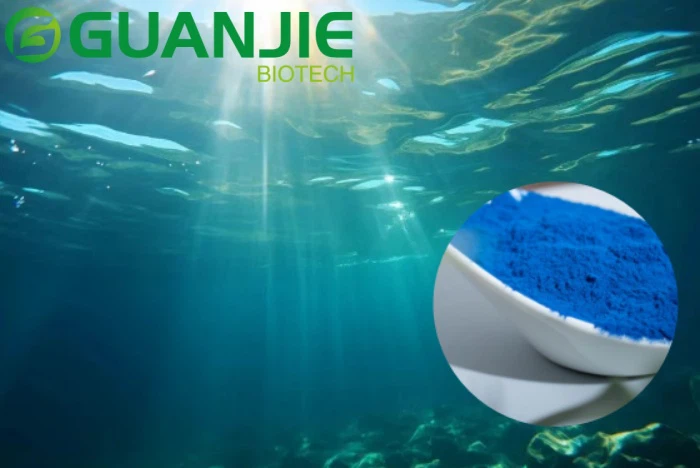
How Much Phycocyanin in Spirulina?
Unlike standardized pharmaceutical compounds, the blue spirulina phycocyanin powder content in spirulina is not a fixed number. It exists within a range, typically cited in scientific literature and industry standards as between 10% to 20% of its dry weight. This means that in 100 grams of high-quality spirulina powder, one can expect to find approximately 10 to 20 grams of phycocyanin.
However, this range is a generalization. More precise breakdowns reveal even broader possibilities:
• Low-End Biomass (Poor Conditions):
As low as 5-8%. This is often found in wild-harvested or poorly cultivated spirulina where growth conditions are suboptimal.
• Standard-Grade Biomass (Average Cultivation):
10-15%. This represents most commercially available spirulina used in blue spirulina phycocyanin powder form for general nutrition.
• High-Grade/Premium Biomass (Optimized Cultivation):
15-20%. This is achieved through meticulous control of growth parameters specifically to enhance phycocyanin synthesis.
• Extracted Phycocyanin Powder:
This is a different product altogether. Through extraction and purification processes, suppliers can produce powders that are >95% pure phycocyanin. This is the blue spirulina phycocyanin powder product form used for its vibrant colorant and concentrated therapeutic properties, distinct from consuming whole spirulina biomass.

The vast disparity between 5% and 20% underscores that the method of cultivation, processing, and even the spirulina strain itself are critical determinants of its final phycocyanin potency.
Key Factors Influencing Phycocyanin Content
Blue spirulina phycocyanin powder is a light-harvesting pigment-protein complex. Its primary biological role is to absorb sunlight (specifically orange and yellow light, which chlorophyll absorbs poorly) and transfer that energy for photosynthesis. Its production is therefore highly responsive to environmental stimuli. The major factors influencing its concentration are:
Light Intensity and Quality:
This is arguably the most significant factor. Phycocyanin synthesis is inversely related to light intensity.
• High Light Intensity:
Under very bright light, spirulina produces less blue spirulina phycocyanin powder because it doesn't need as much "antenna" to capture sufficient light energy. The algae prioritize growth rate over pigment production.
• Low Light Intensity:
In lower light conditions, spirulina ramps up phycocyanin production to maximize its light-capturing efficiency. This is a classic physiological response to light stress.
• Light Spectrum:
Research shows that specific wavelengths of light can trigger higher phycocyanin production. For instance, light in the orange-red spectrum is most effective at stimulating phycocyanin synthesis compared to white or blue light.
Nutrient Availability (especially Nitrogen):
Nitrogen is a fundamental building block for all proteins, and since blue spirulina phycocyanin powder is a protein-pigment complex, its biosynthesis is heavily dependent on nitrogen availability.
• Nitrogen-Replete Conditions:
When nitrogen is abundant (e.g., from nitrate fertilizers like NaNO₃ or KNO₃ in growth media), spirulina can freely synthesize phycocyanin.
• Nitrogen-Limited Conditions:
A scarcity of nitrogen forces the organism to degrade its internal nitrogen reserves. Phycocyanin, being a nitrogen-rich protein, is one of the first compounds to be broken down (a process called chlorosis) to recycle nitrogen for essential metabolic functions. This drastically reduces phycocyanin content.
Strain Selection:
Not all spirulina strains are created equal. Hundreds of strains of Arthrospira platensis and maxima exist, each with a unique genetic blueprint that predisposes it to different growth rates, protein profiles, and pigment production. Bioprospecting for high-phycocyanin-yielding strains is an active area of research for commercial producers.

Growth Phase (Cultivation Time):
The blue spirulina phycocyanin powder content varies throughout the growth cycle of a spirulina culture.
• Logarithmic Phase:
During rapid growth, protein and pigment synthesis is high.
• Stationary Phase:
As growth slows due to nutrient depletion or high density, phycocyanin can begin to degrade. Harvesting at the precise moment is crucial to maximize yield.
Stress Factors:
Certain abiotic stresses, like salinity or temperature, can be manipulated to boost phycocyanin. For example, moderate salinity stress has been shown in some studies to increase pigment production as a protective response.
Processing and Drying:
Finally, how the biomass is treated post-harvest is vital. Blue spirulina phycocyanin powder is highly sensitive to heat and light.
• Spray-Drying:
A common method, but excessive heat can denature the protein, reducing its content and bioactivity.
• Freeze-Drying (Lyophilization):
Considered the gold standard for preservation, as it uses low temperatures that best preserve the integrity of heat-sensitive compounds like phycocyanin. Powder processed this way often has a higher retained phycocyanin percentage.
How To Choose Phycocyanin?
Consuming whole spirulina powder provides a beneficial dose of phycocyanin within its natural matrix of other nutrients. However, to achieve therapeutic doses or to use it as a pure colorant, extraction and purification are necessary. This is where specialized suppliers play a critical role.
Companies like Guanjie Biotech operate at this intersection of biotechnology and production. High-purity phycocyanin powder from suppliers like this has been instrumental in advancing clinical research and making this powerful compound accessible to manufacturers worldwide.
Guanjie Biotech uses the following process of blue spirulina phycocyanin powder. The process begins with the acceptance and storage of raw materials (algae). The algae then undergoes cell wall breaking, filtration, and multiple concentration and separation steps to extract and purify the compound. Additives like trehalose are introduced before spray drying into a powder. The powdered phycocyanin is then sieved, blended, and heat sterilized. Simultaneously, packaging materials are processed. The final blue spirulina phycocyanin powder product is packed into sterile aluminum bags, sealed, placed into cartons or barrels, and stored before delivery.
Conclusion
The question of blue spirulina phycocyanin powder content in spirulina reveals a fascinating narrative of biology, environment, and human ingenuity. While a typical range of 10-20% serves as a useful benchmark, the true value is understanding the dynamic interplay of light, nutrients, and genetics that determines this percentage. The extensive body of research surrounding phycocyanin elevates it from a simple pigment to a multifaceted nutraceutical with demonstrated antioxidant, anti-inflammatory, neuroprotective, and hepatoprotective properties. Its journey from a component within spirulina cells to a purified, high-value powder underscores the advancement of algal biotechnology.
Suppliers like Guanjie Biotech are pivotal in this chain, transforming cultivated algae into a standardized, potent ingredient blue spirulina phycocyanin powder that fuels innovation in the health, food, and cosmetic industries, truly unlocking the potential of nature's "blue gold." Welcome to enquire with us at info@gybiotech.com.
References
[1] Benedetti, S., Benvenuti, F., Pagliarani, S., Francogli, S., Scoglio, S., & Canestrari, F. (2004). Antioxidant properties of a novel phycocyanin extract from the blue-green alga Aphanizomenon flos-aquae. Life Sciences, *75*(19), 2353-2362.
[2] Romay, C., Armesto, J., Remirez, D., González, R., Ledon, N., & García, I. (1998). Antioxidant and anti-inflammatory properties of C-phycocyanin from blue-green algae. Inflammation Research, *47*(1), 36-41. (This is the seminal study on COX-2 inhibition).
[3] Pentón-Rol, G., Marín-Prida, J., Pardo-Andreu, G., Martínez-Sánchez, G., Acosta-Medina, E. F., Valdivia-Acosta, A., ... & Pentón-Arias, E. (2016). C-Phycocyanin is neuroprotective against global cerebral ischemia/reperfusion injury in rats. Journal of Alzheimer's Disease, *51*(2), ̈.
[4] Fernández-Rojas, B., Hernández-Juárez, J., & Pedraza-Chaverri, J. (2014). Nutraceutical properties of phycocyanin. Journal of Functional Foods, *11*, 375-392. (A excellent review article covering multiple benefits).
[5] Li, B., Chu, X., Gao, M., & Li, W. (2010). Apoptotic mechanism of MCF-7 breast cells in vivo and in vitro induced by photodynamic therapy with C-phycocyanin. Acta Biochimica et Biophysica Sinica, *42*(1), 80-89.
[6] Sekar, S., & Chandramohan, M. (2008). Phycobiliproteins as a commodity: trends in applied research, patents and commercialization. Journal of Applied Phycology, *20*(2), 113-136.


