

Pure Blueberry powder is widely used in functional foods, beverages, dietary supplements, and nutraceutical formulations. However, one frequent technical question from formulators and buyers is whether pure blueberry powder dissolves in water. The solubility behavior helps manufacturers optimize formulations and achieve consistent texture, color, and nutritional benefits in final products.

Does Blueberry Powder Dissolve In Water?
Blueberry fruit powder (whole fruit powder) does not fully dissolve in water. Blueberry juice powder is much more water-soluble and disperses easily.
Why Blueberry Fruit Powder Does Not Easily Dissolve?

The main reason blueberry fruit powder does not dissolve well in water is its natural dietary fiber and plant structure. Unlike juice powder, whole fruit powder retains most of the original components of the berry, including insoluble materials that cannot form a true solution.
Insoluble Fiber Content
Whole blueberries naturally contain structural fibers such as cellulose, lignin, and hemicellulose. These compounds are rigid and do not dissolve in water. When bulk blueberry fruit powder is mixed with water, the fiber particles absorb moisture and swell, but they remain as solid particles. Over time, gravity causes these hydrated particles to settle at the bottom, which is why visible sediment often appears in beverages made with fruit powder.
Pectin Behavior
Blueberries also contain natural pectin, a soluble fiber that behaves differently from simple sugars. Pectin can partially dissolve, but it tends to increase viscosity and may form gel-like structures depending on pH and concentration. Instead of producing a clear solution, pectin contributes to cloudiness and slight thickening, which further reduces the perception of complete dissolution.
Particle Size Effects
Grinding blueberries into pure blueberry fruit powder reduces particle size but does not remove insoluble structures. Even finely milled or micronized powders still contain cell wall fragments and fiber particles. Smaller particles disperse more evenly in water and improve mouthfeel, but they still cannot dissolve at the molecular level.
Hydrophobic Components
The outer skin of blueberries contains waxy, lipophilic compounds that repel water. These hydrophobic components reduce wetting efficiency, causing powder to float initially and sometimes form clumps. Additional stirring or mixing is often required, which further contributes to the impression that blueberry fruit powder has poor solubility.
Why Blueberry Juice Powder Dissolves Easily?
Blueberry juice powder has excellent water solubility mainly because most insoluble components are removed during processing, leaving behind compounds that naturally dissolve in water.
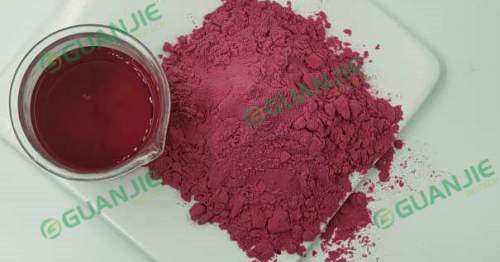
Removal of Insoluble Components During Juice Processing
One of the primary reasons bulk blueberry juice powder dissolves well in water is the elimination of insoluble materials during production. When fresh blueberries are processed into juice, the pulp, skin fragments, and most dietary fiber are removed through filtration and clarification steps. Suspended solids are significantly reduced, leaving a liquid that mainly contains water-soluble nutrients and phytochemicals. Because insoluble plant cell wall components are absent, the resulting powder does not form sediment when mixed with water, allowing for a much smoother and more uniform solution compared to whole fruit powder.
Spray Drying with Functional Carriers
Pure Blueberry juice powder is typically produced using spray-drying technology with carrier agents such as maltodextrin or gum arabic. These carriers play several important roles. They improve powder flowability, reduce hygroscopicity, prevent clumping, and enhance instant wettability when the powder contacts water. As a result, the powder disperses quickly without forming lumps. The carriers also help encapsulate sensitive compounds like anthocyanins, improving stability while maintaining excellent rehydration performance.
Naturally Water-Soluble Chemical Composition
The chemical profile of blueberry juice powder further explains its high solubility. It mainly contains simple sugars (glucose and fructose), organic acids (such as citric and malic acid), anthocyanins, and other water-soluble polyphenols. These molecules dissolve readily at the molecular level in aqueous systems. Since the formulation lacks insoluble fiber and structural plant tissues, blueberry juice powder can dissolve rapidly and produce a clear or uniformly colored beverage with minimal residue.
Fruit Powder vs Juice Powder
|
Property |
Blueberry Fruit Powder |
Blueberry Juice Powder |
|
Fiber content |
High |
Very low |
|
True solubility |
Poor |
Good |
|
Forms sediment |
Yes |
Minimal |
|
Beverage clarity |
Cloudy |
Clear to slightly colored |
|
Nutritional completeness |
Whole fruit profile |
Reduced fiber |
|
Application |
Smoothies, bakery, capsules |
Instant drinks, beverages |
How to choose Blueberry powder?
Beverage Formulation
In beverage systems, the choice between blueberry fruit powder and blueberry juice powder depends mainly on the desired texture and clarity. For clear or ready-to-drink beverages, manufacturers typically select juice powder because it dissolves quickly, produces minimal sediment, and delivers an attractive, transparent purple color that improves consumer appeal. In contrast, blueberry fruit powder is more appropriate for thicker beverage formats such as smoothies, protein drinks, and yogurt-based beverages. Its natural fiber content contributes body and viscosity, creating a richer mouthfeel that aligns well with these applications.
Capsule and Tablet Manufacturing
For dietary supplements in capsule or tablet form, solubility is generally not a critical factor because the powder is consumed directly rather than dispersed in liquid before ingestion. In these cases, bulk blueberry fruit powder is often preferred due to its whole-fruit composition, higher dietary fiber content, and stronger "natural" or "clean label" positioning, which can enhance marketing value and consumer perception.
Bakery Applications
Blueberry fruit powder also performs well in bakery products such as cakes, cookies, and nutrition bars. The presence of fiber can improve product structure and moisture retention, while dissolution is unnecessary during processing. Additionally, the powder maintains acceptable stability under typical baking temperatures, making it suitable for heat-processed food formulations.
Conclusion
Blueberry powder does not always dissolve in water, and this behavior depends on the product type. Blueberry fruit powder cannot dissolve easily because it contains natural plant fibers, intact cell structures, and insoluble components that remain suspended rather than forming a true solution. This is a normal physical property and often indicates a more natural, whole-food composition.
In contrast, blueberry juice powder dissolves easily because insoluble materials are removed during processing, leaving mainly water-soluble compounds such as sugars, acids, and anthocyanins. The addition of carriers and spray-drying technology further enhances solubility.
Understanding this difference helps consumers and manufacturers choose the right product based on application needs. If nutritional completeness and fiber are priorities, fruit powder is preferable. If instant solubility and beverage clarity are required, juice powder is the better option. Guanjie Biotech is a natural blueberry powder supplier. We can provide suitable blueberry powder to you that meets your needs. Welcome to enquire with us at info@gybiotech.com.
References
[1] Castrejón, A. D. R., Eichholz, I., Rohn, S., Kroh, L. W., & Huyskens-Keil, S. (2008). Phenolic profile and antioxidant activity of highbush blueberry (Vaccinium corymbosum L.) during fruit maturation and ripening. Food Chemistry, 109(3), 564–572.
[2] Cho, M. J., Howard, L. R., Prior, R. L., & Clark, J. R. (2004). Flavonoid glycosides and antioxidant capacity of various blackberry and blueberry genotypes determined by high-performance liquid chromatography/mass spectrometry. Journal of the Science of Food and Agriculture, 84(13), 1771–1782.
[3] Rodríguez-Amaya, D. B. (2016). Natural food pigments and colorants. In Anthocyanins: Chemistry, analysis, and stability (pp. 45–67). Wiley-Blackwell.
Thakur, B. R., Singh, R. K., & Handa, A. K. (1997). Chemistry and uses of pectin - A review. Critical Reviews in Food Science and Nutrition, 37(1), 47–73.
[4] Elleuch, M., Bedigian, D., Roiseux, O., Besbes, S., Blecker, C., & Attia, H. (2011). Dietary fibre and fibre-rich by-products of food processing: Characterisation, technological functionality and commercial applications. Food Chemistry, 124(2), 411–421.
[5] Gharsallaoui, A., Roudaut, G., Chambin, O., Voilley, A., & Saurel, R. (2007). Applications of spray-drying in microencapsulation of food ingredients: An overview. Food Research International, 40(9), 1107–1121.
[6] AOAC International. (2019). Official Methods of Analysis (21st ed.). AOAC International. (Methods for dietary fiber determination).


