

Matcha green tea leaf powder has surged into global prominence as a modern superfood. But what exactly is in this finely milled tea that justifies its revered status? To simply state that matcha powder contains "ground green tea leaves" is to tell only a fraction of the story. The true answer lies in a sophisticated symphony of biochemical compounds-polyphenols, amino acids, vitamins, minerals, and methylxanthines-that work in concert to create its distinct flavor, vibrant color, and renowned health benefits. Let's look at the ingredients of matcha powder.
Whole-Leaf Ingestion vs. Matcha Powder

The primary factor that differentiates matcha from all other teas is the mode of consumption. With steeped teas (black, oolong, white, standard green), hot water acts as a solvent, extracting a portion of the water-soluble compounds from the leaf. The leaf itself is discarded, meaning you only ingest a fraction of its potential nutritional content.
However, matcha green tea leaf powder involves consuming the entire leaf in a powdered form. This means you are ingesting 100% of the leaf's biochemical inventory. The concentration of every compound-be it antioxidants, vitamins, or caffeine-is therefore exponentially higher. A single serving of matcha (approximately 1 gram or ½ teaspoon) is nutritionally equivalent to drinking the entirety of 10-15 cups of steeped green tea. This whole-leaf ingestion is the foundational principle behind matcha's potent ingredient profile.
What Ingredients Are In Matcha Powder?
We can categorize the ingredients in matcha green tea leaf powder into several key groups.
Polyphenols: The Antioxidant Powerhouse
Polyphenols are a class of micronutrients found in plants, renowned for their antioxidant properties. They combat oxidative stress caused by free radicals, a process linked to chronic diseases and aging. The most significant polyphenols in matcha are flavonoids, specifically a type called catechins.
• Epigallocatechin Gallate (EGCG):
This is the superstar catechin and the most researched compound in 100 Pure Matcha Powder. EGCG is a potent antioxidant, believed to be up to 100 times more powerful than vitamins C and E. In matcha green tea leaf powder, EGCG levels are exceptionally high due to the shading process and whole-leaf consumption. Studies have linked EGCG to a wide range of benefits, including:
• Enhanced Metabolism and Fat Oxidation:
EGCG can increase the rate of thermogenesis (the body's process of burning calories) from a typical 8-10% of daily energy expenditure to between 35-43%, aiding in weight management.
• Cardioprotective Effects:
It helps reduce the oxidation of LDL ("bad") cholesterol, improves arterial function, and may lower blood pressure.
• Neuroprotective Potential:
Research suggests EGCG can cross the blood-brain barrier and may help protect neurons, potentially reducing the risk of neurodegenerative diseases like Alzheimer's and Parkinson's.
• Anticancer Properties:
While not a cure, numerous in vitro and animal studies have shown that EGCG can inhibit the proliferation of cancer cells and induce apoptosis (programmed cell death) in various cancer cell lines.
• Other Catechins:
Matcha green tea leaf powder also contains significant amounts of other catechins, including Epicatechin (EC), Epigallocatechin (EGC), and Epicatechin Gallate (ECG). Each contributes to the overall antioxidant capacity and health-promoting effects synergistically.
Why is matcha green tea leaf powder's catechin content so high? The answer lies in the shading process. About 20-30 days before harvest, the tea plants (Camellia sinensis) are covered with shade cloths. This drastic reduction in sunlight shocks the plant. In a desperate attempt to perform photosynthesis with minimal light, the leaves ramp up production of chlorophyll (hence the deep green color) and secondary metabolites, including the protective catechins. This process concentrates these powerful compounds within each leaf.
Methylxanthines: The Stimulants
This class of compounds includes the well-known stimulants caffeine, theobromine, and theophylline.
• Caffeine:
Matcha green tea leaf powder contains caffeine, typically between 35-70mg per serving (compared to 80-100mg in a cup of coffee). However, the experience of matcha caffeine is profoundly different from that of coffee. This is due to the presence of L-Theanine and the fact that the caffeine is bound to other compounds in the leaf, leading to a slower, more sustained release into the bloodstream. This results in a state of "calm alertness" without the jitters, anxiety, or energy crashes associated with coffee.
• Theanine: The Zen Molecule
L-Theanine is a rare amino acid almost exclusively found in the tea plant. It is the single most important ingredient responsible for matcha's unique effect on consciousness. Theanine promotes relaxation and reduces stress without causing drowsiness. It achieves this by:
Increasing alpha brain wave activity, which is associated with a state of relaxed mental alertness, similar to that achieved during meditation.
Boosting levels of GABA, serotonin, and dopamine-neurotransmitters that regulate mood, emotion, sleep, and appetite.
Counteracting the stimulating effects of caffeine. The combination of L-Theanine and caffeine is a synergistic pairing that enhances cognitive performance, improves focus and memory, and promotes a state of tranquil energy.
Why is Theanine so high in Matcha green tea leaf powder? Again, the shading process is key. The reduction of sunlight increases the synthesis of L-Theanine in the roots of the tea plant, which is then transported to the leaves. High-quality, shade-grown matcha from Japan has the highest levels of L-Theanine, which is why its flavor is more umami and sweet and less bitter than lower-grade, unshaded green tea powders.
Nutritional Components: Vitamins and Minerals
Because you consume the entire leaf, Matcha green tea leaf powder is a notable source of several micronutrients.
• Vitamins:
Vitamin C:
A powerful antioxidant that supports immune function and skin health.
Vitamin A (from Beta-Carotene):
Essential for vision, immune function, and reproduction.
Vitamin E:
A fat-soluble antioxidant that protects cell membranes from damage.
Vitamin K:
Crucial for blood clotting and bone metabolism.
Complex Vitamins:
Including B1 (Thiamine), B2 (Riboflavin), and Niacin, which play vital roles in energy production and cellular metabolism.
• Minerals:
Potassium: An electrolyte that helps regulate fluid balance, nerve signals, and muscle contractions.
Calcium: Essential for bone health and muscular function.
Iron: Necessary for the formation of red blood cells and oxygen transport.
Magnesium: Involved in over 300 biochemical reactions in the body, including energy creation and DNA synthesis.
Zinc: Supports immune function, wound healing, and DNA synthesis.
Trace Minerals: Matcha green tea leaf powder also contains manganese, chromium, and selenium.
Chlorophyll: The Liquid Sunshine
The intense, vibrant green color of matcha is a direct indicator of its extremely high chlorophyll content. Chlorophyll is the pigment that allows Matcha green tea leaf powder plants to absorb energy from light. For humans, it is celebrated for its potential detoxifying properties. Chlorophyll is believed to help cleanse the blood by helping the body eliminate heavy metals and other harmful toxins. It also has anti-inflammatory and antioxidant properties and is often called "liquid sunshine" for its purported energizing effects.
Why is the chlorophyll content so high? The shading process forces the plant to overproduce chlorophyll to capture every available photon of light, resulting in the deep jade-green color that defines premium pure leaf matcha green tea powder.
Dietary Fiber
The entire tea leaf is rich in insoluble fiber. In Matcha green tea leaf powder, this fiber is present in a fine, soluble form. Dietary fiber aids in digestion, helps promote a feeling of fullness (satiety), and supports a healthy gut microbiome by acting as a prebiotic-food for the beneficial bacteria in our intestines.
Other Bioactive Compounds
• Saponins:
These are bitter-tasting compounds with antimicrobial and anti-inflammatory properties. They contribute to the complex, slightly astringent flavor profile of high-quality matcha green tea leaf powder.
• Flavonols:
Such as quercetin and kaempferol, which possess strong antioxidant and anti-inflammatory effects.
Conclusion:
Matcha green tea leaf powder is not merely an ingredient; it is a dense, complex repository of bioactive compounds meticulously developed through unique agricultural practices. Its ingredient list tells a story of sunlight deprivation leading to nutrient super-saturation, of synergistic relationships between calming theanine and alerting caffeine, and of a whole-food approach that delivers a potent dose of antioxidants, vitamins, and minerals. Understanding its composition moves us beyond trend-driven consumption to an appreciation of matcha as a truly remarkable functional food, honed by nature and perfected by tradition. Whether whisked in a tranquil ceremony or blended into a modern health elixir, each bowl of matcha green tea leaf powder offers a complete, concentrated package of wellness from the leaf to the cup.
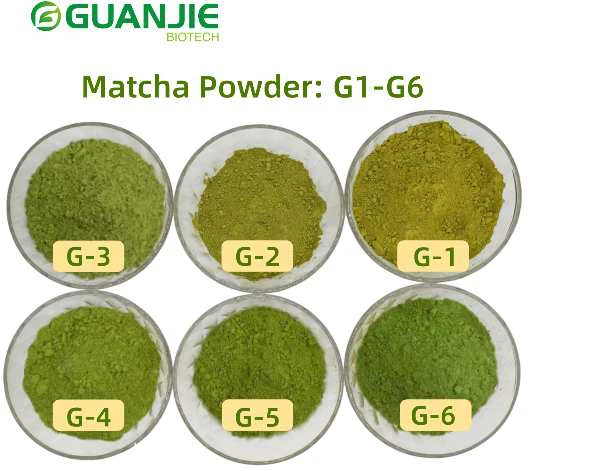
For bulk Matcha green tea leaf powder applications in the food and beverage industry, where consistency, volume, and cost-effectiveness are paramount, partnering with a reliable supplier is critical. Guanjie Biotech is a bulk green leaf matcha Powder supplier that provides a range of grades suitable for various industrial applications, from health supplements and functional foods to beverages and confectionery, ensuring a steady supply of this potent ingredient. Guanjie Biotech has focused on Matcha green tea leaf powder production, research, and sale for many years. We have 6 grades matcha powder, welcome to enquire with us at info@gybiotech.com.
References
[1] Weiss, D. J., & Anderton, C. R. (2003). Determination of catechins in matcha green tea by micellar electrokinetic chromatography. Journal of Chromatography A, 1011(1-2), 173-180.
[2] Dietz, C., & Dekker, M. (2017). Effect of Green Tea Phytochemicals on Mood and Cognition. Current Pharmaceutical Design, 23(19), 2876-2905.
[3] Unno, K., et al. (2018). Stress-Reducing Function of Matcha Green Tea in Animal Experiments and Clinical Trials. Nutrients, 10(10), 1468.
[4] Fujioka, K., et al. (2016). Theanine, the main amino acid in tea, reduces stress responses in humans. Journal of Health Science, 62(6), 589-594.
[5] Horie, H., et al. (2017). Chemical Components of Matcha and Its Processing. Japan Agricultural Research Quarterly: JARQ, 51(3), 193-203.
[6] Kakuda, T. (2011). Neuroprotective effects of the green tea components theanine and catechins. Biological and Pharmaceutical Bulletin, 34(12), 1701-1705.
[7] Suzuki, Y., & Miyoshi, N. (2006). The production and development of matcha. Foods & Food Ingredients Journal of Japan, 211(5), 1-8.


