

Bulk Phycocyanin powder is a brilliant blue, light-harvesting pigment-protein complex found exclusively in cyanobacteria, more commonly known as blue-green algae. It is not only responsible for the characteristic azure hue of these organisms but also possesses a remarkable array of documented bioactivities, including potent antioxidant, anti-inflammatory, neuroprotective, and hepatoprotective properties. But what foods contain phycocyanin?

What is Phycocyanin?
To understand which foods contain phycocyanin, one must first understand its origin. Phycocyanin is a phycobiliprotein, a complex of proteins and brightly colored pigments that function as accessory pigments in the photosynthesis of cyanobacteria, red algae, and cryptomonads. Its name is derived from the Greek words phycos (algae) and kyanos (blue).
Structurally, it is composed of two subunits: alpha (α) and beta (β), which aggregate to form a trimeric (αβ)₃ or hexameric (αβ)₆ structure. Crucially, each subunit is covalently bound to a linear tetrapyrrole chromophore called phycocyanobilin, which is responsible for absorbing light (primarily orange and yellow wavelengths around 620 nm) and giving phycocyanin its intense blue color. This specific chromophore is also the key to its powerful biological activities, particularly its antioxidant capacity, which is often cited as being significantly higher than many common antioxidants like vitamin C and E on an ORAC (Oxygen Radical Absorbance Capacity) scale.
It is critical to distinguish Bulk Phycocyanin powder from chlorophyll. While both are involved in photosynthesis, chlorophyll is green and ubiquitous in all green plants and algae. Phycocyanin is blue and is found in significant quantities only in specific types of blue-green algae. Therefore, the list of "foods" containing meaningful amounts of phycocyanin is exceptionally short and specialized.
What Foods Contain Phycocyanin?
The term "foods containing phycocyanin" is somewhat misleading, as it is not a nutrient distributed across a wide range of fruits, vegetables, or grains. Instead, it is concentrated in a very specific biomass. The following are the primary sources:
Spirulina (Arthrospira platensis and Arthrospira maxima):
This is, by an enormous margin, the most significant and commercially available dietary source of phycocyanin. Spirulina is a filamentous, spiral-shaped cyanobacterium that has been consumed for centuries by various cultures, from the Kanembu people around Lake Chad in Africa to the Aztecs of Mexico (who harvested it from Lake Texcoco).
- Phycocyanin Content:
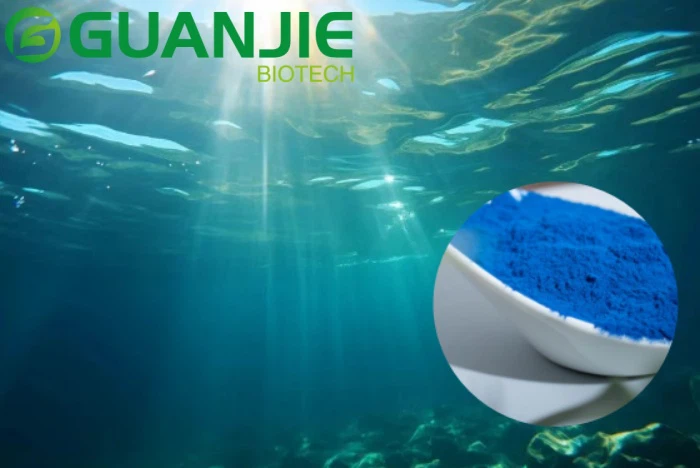
Spirulina biomass is comprised of 55-70% protein by dry weight. Within this protein fraction, phycocyanin is the major component, constituting up to 20% of its dry weight and up to 15% of its wet weight. This makes Bulk Phycocyanin powder the richest natural source of this compound on the planet. It is the reason why high-quality Spirulina powder or tablets have a deep blue-green color; the green comes from chlorophyll, and the blue comes from phycocyanin.
- Consumption Forms:
Powder: The most common form. Blue spirulina phycocyanin powder can be mixed into water, smoothies, juices, or sprinkled on foods.
Tablets/Capsules: A convenient option for those who dislike the taste.
Flakes: Sometimes used as a dietary supplement or food coloring.
Functional Food Ingredient: Increasingly, Bulk Phycocyanin powder is being incorporated into energy bars, snacks, pasta, and beverages to boost their nutritional and antioxidant profile.
Aphanizomenon flos-aquae (AFA):
This is another type of blue-green algae, often harvested from Upper Klamath Lake in Oregon, USA. It is also marketed as a superfood and contains phycocyanin. However, its phycocyanin content is generally lower than that of Spirulina. Furthermore, AFA has been a subject of controversy due to the potential for contamination with microcystins (toxins produced by other harmful cyanobacteria like Microcystis aeruginosa) if not rigorously tested and processed. Therefore, while it is a source, Bulk Phycocyanin powder remains the more reliable and studied option.
Phycocyanin supplements
Beyond consuming the whole algae, purified phycocyanin is extracted on an industrial scale, primarily from Spirulina, for use as a natural blue food coloring. It is known as Lina Blue or Spirulina Blue and is designated as E18 in the European Union (though it is often listed as "Spirulina Extract" in ingredients). You can find it in:
•Ice cream and frozen desserts: Bulk Phycocyanin powder provides stable, appealing blue tones without synthetic additives.
•Chewing gum and candies: Creating a spectrum of blue and green shades (when mixed with yellow colors like turmeric).
•Dairy products: Coloring yogurts, ice pops, and some cheeses.
•Beverages and soft drinks: Offering a stable, vibrant color in liquid applications.
•Decorative cake icings and coatings: Delivering a bright, natural blue for artistic baking.
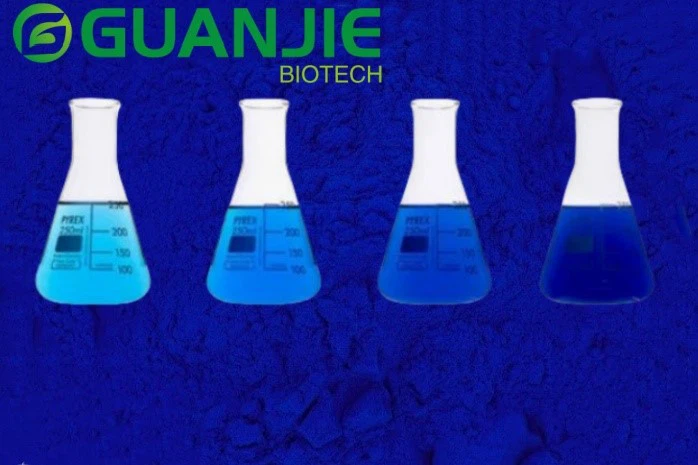
In this context, while the food contains phycocyanin, the concentration is typically much lower than what is found in a serving of Spirulina powder, as it is used primarily for color rather than nutritional benefit.
Bulk Phycocyanin powder provides a vibrant, cyan-blue hue that is exceptionally difficult to source naturally, traditionally filling a void for food manufacturers seeking to replace artificial colorants like Brilliant Blue FCF (FD&C Blue No. 1). To meet this rising global demand, more and more specialized Spirulina phycocyanin powder suppliers produce this bulk phycocyanin powder. Guanjie Biotech, as a high-purity blue Spirulina phycocyanin powder supplier, our blue spirulina phycocyanin powder products are used in the food, beverage, and nutraceutical industries.
What is Not a Source?
Chlorella, a popular green microalgae, does not contain phycocyanin. It is rich in chlorophyll, giving it its deep green color, but it lacks the phycobiliproteins that characterize cyanobacteria like Spirulina. Other superfoods like wheatgrass, barley grass, or moringa are also not sources of phycocyanin.
So phycocyanin is from Spirulina, Aphanizomenon Flos-Aquae, and phycocyanin supplements. Phycocyanin is a remarkable natural compound whose primary, and almost exclusive, dietary source is the cyanobacterium Spirulina. It is present in smaller amounts in AFA algae and as a food colorant (E18). Blue spirulina phycocyanin powder or tablets remain the most potent and reliable way to consume it.
Sourcing high-quality blue spirulina powder is critical for product success. Partnering with an established blue spirulina phycocyanin powder manufacturer like Guanjie Biotech guarantees a premium ingredient that meets stringent industry standards and aligns with consumer demand for purity and potency. As a standout ingredient in the evolving superfood market, blue spirulina offers significant potential for innovative, nutrient-dense product development. To explore how Bulk Phycocyanin powder can benefit your business, contact Guanjie Biotech at info@gybiotech.com.
References
[1]Romay, C., Armesto, J., Remirez, D., González, R., Ledon, N., & García, I. (1998). Antioxidant and anti-inflammatory properties of C-phycocyanin from blue-green algae. Inflammation Research, *47*(1), 36–41.
[2]Subhashini, J., Mahipal, S. V., Reddy, M. C., Reddy, M. M., Rachamallu, A., & Reddanna, P. (2004). Molecular mechanisms in C-Phycocyanin induced apoptosis in human chronic myeloid leukemia cell line-K562. Biochemical Pharmacology, *68*(3), 453–462.
[3]Pentón-Rol, G., Marín-Prida, J., Pardo-Andreu, G., Martínez-Sánchez, G., Acosta-Medina, E. F., Valdivia-Acosta, A., ... & Pentón-Arias, E. (2011). C-Phycocyanin is neuroprotective against global cerebral ischemia/reperfusion injury in gerbils. Brain Research Bulletin, *86*(1-2), 42–52.
[4]Vadiraja, B. B., Gaikwad, N. W., & Madyastha, K. M. (1998). Hepatoprotective effect of C-phycocyanin: protection for carbon tetrachloride and R-(+)-pulegone-mediated hepatotoxicity in rats. Biochemical and Biophysical Research Communications, *249*(2), 428–431.
[5]Remirez, D., Fernández, V., Tapia, G., González, R., & Videla, L. A. (2002). Influence of C-phycocyanin on hepatocellular parameters related to liver oxidative stress and Kupffer cell functioning. Inflammation Research, *51*(7), 351–356.
[6]Wang, Y., Chang, C., Chen, Y., & Chiang, S. (2012). C-Phycocyanin Protects against Oxidative Stress and Mitochondrial Dysfunction in MPP+-Induced Neurotoxicity. Evidence-Based Complementary and Alternative Medicine, *2012*, 1-10.
[7]Nagaoka, S., Shimizu, K., Kaneko, H., Shibayama, F., Morikawa, K., Kanamaru, Y., ... & Kato, T. (2005). A novel protein C-phycocyanin plays a crucial role in the hypocholesterolemic action of Spirulina platensis concentrate in rats. The Journal of Nutrition, *135*(10), 2425–2430.
[8]Park, H. J., Lee, Y. J., Ryu, H. K., Kim, M. H., Chung, H. W., & Kim, W. Y. (2008). A randomized double-blind, placebo-controlled study to establish the effects of spirulina in elderly Koreans. Annals of Nutrition and Metabolism, *52*(4), 322–328.
[9]Hirahashi, T., Matsumoto, M., Hazeki, K., Saeki, Y., Ui, M., & Seya, T. (2002). Activation of the human innate immune system by Spirulina: augmentation of interferon production and NK cytotoxicity by oral administration of hot water extract of Spirulina platensis. International Immunopharmacology, *2*(4), 423–434.
[10]Mao, T. K., Van de Water, J., & Gershwin, M. E. (2005). Effects of a Spirulina-based dietary supplement on cytokine production from allergic rhinitis patients. Journal of Medicinal Food, *8*(1), 27–30.
[11]Lu, H. K., Hsieh, C. C., Hsu, J. J., Yang, Y. K., & Chou, H. N. (2006). Preventive effects of Spirulina platensis on skeletal muscle damage under exercise-induced oxidative stress. European Journal of Applied Physiology, *98*(2), 220–226.
[12]Sørensen, L., Hantke, A., & Eriksen, N. T. (2013). Purification of the photosynthetic pigment C-phycocyanin from the heterotrophic microalga Galdieria sulphuraria. Journal of the Science of Food and Agriculture, *93*(12), 2933–2938.
[13]Eriksen, N. T. (2008). Production of phycocyanin-a pigment with applications in biology, biotechnology, foods and medicine. Applied Microbiology and Biotechnology, *80*(1), 1–14. [14]Fernández-Rojas, B., Hernández-Juárez, J., & Pedraza-Chaverri, J. (2014). Nutraceutical properties of phycocyanin. Journal of Functional Foods, *11*, 375–392.
[15]Wu, Q., Liu, L., Miron, A., Klímová, B., Wan, D., & Kuča, K. (2016). The antioxidant, immunomodulatory, and anti-inflammatory activities of Spirulina: an overview. Archives of Toxicology, *90*(8), 1817–1840.


