Natural Phycocyanin is a natural blue pigment-protein extracted from cyanobacteria, especially Spirulina. As a natural blue pigment with antioxidant properties, pure phycocyanin powder is widely used in food and beverages, dietary supplements, cosmetics, and other functional products. For industrial applications, phycocyanin particle size and Polydispersity Index (PDI) are important physical properties that can affect solubility, dispersion stability, bioavailability, and fluorescence performance. In aqueous solutions, phycocyanin naturally occurs as monomers, trimers, and hexamers, with particle sizes typically around 6–15 nm. Processing methods such as microencapsulation, nanoemulsification, liposomal encapsulation, and spray drying can significantly alter particle size and distribution.
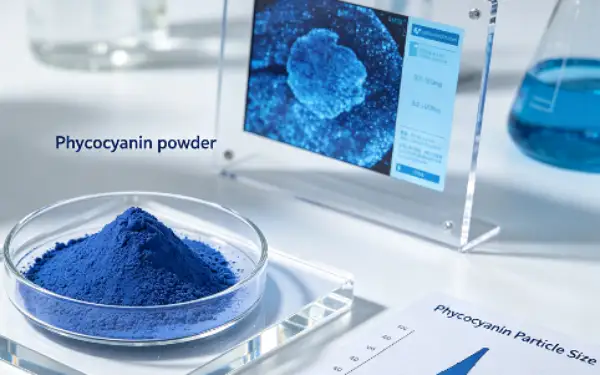
Phycocyanin Particle Size and Uses
To clearly illustrate the varying particle size requirements across different application scenarios, the table below outlines the technical specifications and control objectives for key fields:
|
Application Areas |
Niche Applications |
Recommended particle size ranges |
Key Performance Requirements / Objectives |
|
Biomedicine and fluorescence detection |
Fluorescent probes, flow cytometry, photodynamic therapy |
5 nm – 15 nm (natural molecular scale) |
High monodispersity (PDI < 0.1), maintenance of specific binding conformation, absence of aggregation or precipitation |
|
High-end transdermal cosmetics |
Active skincare serums, anti-aging nano-emulsions |
20 nm – 100 nm (nanocarriers) |
High transdermal absorption rate, stratum corneum penetration, enhanced photothermal stability |
|
Functional beverages and clear liquids |
Clear beverages, functional sports waters |
50 nm – 200 nm (microemulsions/nanomicelles) |
High transparency, absence of Tyndall effect/precipitation, improved acid stability |
|
Dietary supplements and nutritional foods |
Oral liquids, softgels, targeted absorption formulations |
100 nm – 500 nm (liposomes/nanoparticles) |
Enhanced resistance to gastrointestinal enzymatic degradation, increased absorption by small intestinal epithelial cells |
|
General foods, baked goods, and confectionery |
Compressed candies, powdered drink mixes, baked goods |
10 μm – 150 μm (spray-dried powders) |
Good powder flowability, moisture and caking resistance, rapid dissolution |
|
Targeted release and microencapsulation for taste masking |
Enteric-coated microcapsules, composite functional food ingredients |
100 μm – 500 μm (microcapsules) |
High encapsulation efficiency (>85%), odor masking, environment-responsive enteric release |
Analysis of Phycocyanin Uses and Particle Size Guidelines
Phycocyanin bulk powder is a water-soluble phycobiliprotein commonly obtained from Arthrospira (often called Spirulina). It is widely studied and used as a natural blue pigment, functional ingredient, research reagent, and component of encapsulated delivery systems. For manufacturers and R&D teams, phycocyanin particle size is an important quality parameter because it can influence dispersion, stability, appearance, processing performance, and formulation compatibility.
However, particle size requirements vary significantly by application. A specification suitable for a research reagent may not be appropriate for a beverage, cosmetic formulation, or spray-dried phycocyanin powder. The following guidelines summarize typical particle-size considerations for different application scenarios.
Biomedical Research, Research Reagents, and Fluorescent Labeling
Phycocyanin can be used in research applications because its phycocyanobilin chromophore provides characteristic fluorescence. Applications may include fluorescent labeling, flow cytometry research, immunofluorescence studies, and other laboratory investigations.
Particle size considerations: Native phycocyanin exists as protein subunits and oligomeric assemblies rather than conventional solid particles. Reported hydrodynamic dimensions can fall within the nanometer scale, depending on concentration, pH, ionic strength, temperature, aggregation state, and measurement method. Therefore, a fixed 5–15 nm phycocyanin particle size should not be treated as a universal specification.
• Physical mechanism:
The optical properties of phycocyanin depend on the structure of the protein and the interaction between its apoprotein and phycocyanobilin chromophore. Changes in pH, temperature, ionic strength, or other environmental conditions can promote protein aggregation. Increased aggregation may cause light scattering, reduced fluorescence intensity, and changes in functional performance.
• Quality control:
For research-grade phycocyanin, manufacturers may monitor molecular integrity, aggregation behavior, purity, absorbance characteristics, and particle-size distribution. Techniques such as ultrafiltration, chromatography, and controlled formulation can help maintain the desired protein state.
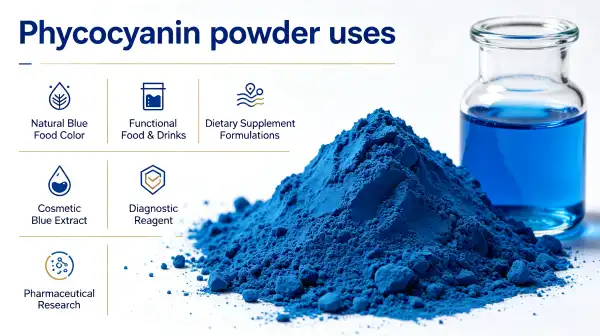
High-End Cosmetics and Transdermal Delivery Systems
Phycocyanin for cosmetics is being investigated for applications such as serums, creams, masks, and other formulations. It may function as a natural blue colorant and as a source of antioxidant-related activity in cosmetic formulations.
• Particle size considerations:
When phycocyanin is incorporated into nanoemulsions, liposomes, solid lipid nanoparticles (SLNs), or other nanocarriers, formulation developers may target particle sizes in the approximately 20–100 nm range, depending on the delivery system.
• Physical mechanism:
Native phycocyanin is a relatively large, water-soluble protein and does not simply pass through the intact stratum corneum because of its molecular size and physicochemical properties. Encapsulation in a suitable carrier can modify its dispersion, protect it from environmental stresses, and potentially improve its interaction with the skin surface.
For phycocyanin encapsulation, particle size should be evaluated together with PDI, zeta potential, encapsulation efficiency, release behavior, and storage stability. Nano- or microcarrier systems can also protect light, oxygen, and other factors that may contribute to pigment degradation.
Clear Functional Beverages and Sports Nutrition
Transparent or low-turbidity beverages require careful control of particle size because suspended particles can affect light scattering and visual clarity. Potential applications include functional beverages, sparkling water formulations, and phycocyanin for sports nutrition.
• Particle size considerations:
Nanoemulsions, micellar systems, and other colloidal delivery systems may be engineered within approximately 50–200 nm, depending on the formulation objective. Smaller particles generally reduce visible scattering, but particle size alone does not guarantee a transparent product.
• Physical mechanism:
Light scattering depends on particle size, refractive-index differences, particle concentration, and wavelength. Therefore, the simple assumption that particles below 100 nm will always produce a transparent beverage is not universally applicable. Larger aggregates can increase turbidity and may contribute to sedimentation or phase separation during storage.
• Process implementation:
High-pressure homogenization, ultrasonic processing, or other dispersion technologies may be used to reduce aggregation and improve physical stability. Food-grade emulsifiers and stabilizers, such as modified starches or approved emulsifying systems, can also be selected according to the formulation.
For phycocyanin for beverages, developers should evaluate particle size together with color intensity, turbidity, pH stability, heat stability, and shelf-life performance.
Oral Liquids and Dietary Supplements
Phycocyanin is also used in powdered and liquid dietary supplement formulations. Encapsulation technologies can be considered when developers want to improve physical stability or control the release of this protein ingredient.
• Particle size considerations:
Liposomes and other colloidal delivery systems may commonly fall within approximately 100–500 nm, although the optimum range depends on the carrier composition and intended application.
• Physical mechanism:
Because phycocyanin is a protein, it can be affected by acidic conditions, digestive enzymes, temperature, and other environmental factors. Encapsulation may help protect the ingredient during processing and storage. However, claims that a specific particle size automatically enables intestinal absorption or lymphatic transport should be avoided unless supported by relevant experimental data.
For phycocyanin powder bulk and liquid supplement applications, manufacturers should assess protein integrity, purity, solubility, particle-size distribution, encapsulation efficiency, and release characteristics.
Solid Foods, Powdered Beverages, Confectionery, and Bakery Products
For conventional food applications, food-grade phycocyanin is often supplied as a spray-dried or otherwise processed powder. Potential applications include powdered drinks, confectionery, ice cream, bakery products, and dry mixes.
Particle size considerations:
A typical spray-dried powder may contain particles in a broad range such as 10–150 μm, although the actual distribution depends on the drying process, feed formulation, and processing conditions.
• Fine powders, approximately 10–40 μm:
These particles can disperse rapidly but may have higher cohesiveness, greater dust formation, and increased sensitivity to moisture.
• Medium-to-coarse powders, approximately 50–150 μm:
These particles can offer improved handling and flow properties and may be better suited to automated filling, blending, and packaging.
Particle size should therefore be selected according to the intended manufacturing process rather than treated as a universal quality indicator. For phycocyanin powder, moisture content, bulk density, flowability, solubility, color value, and microbiological quality are also important specifications.
Targeted Release and Taste-Masking Microcapsules
Microencapsulation is another potential approach for phycocyanin encapsulation. It can be used to improve handling, protect the pigment during processing, reduce exposure to environmental stresses, or modify release characteristics.
• Particle size considerations:
Microcapsules produced by spray drying, fluid-bed processing, coacervation, or other encapsulation methods may commonly fall within approximately 100–500 μm, depending on the technology and wall material.
• Physical mechanism:
Phycocyanin can be incorporated into a protective matrix using materials such as gum arabic, sodium alginate, gelatin, modified starch, or other food-grade encapsulating agents. The coating can help separate the active ingredient from environmental factors and may improve powder handling and storage stability.
For products requiring taste masking, encapsulation can also reduce direct exposure of phycocyanin to the mouth during consumption. For bakery, beverage, or other heat-processed foods, the formulation should be validated under actual processing conditions because encapsulation does not guarantee complete protection during high-temperature treatment or UHT processing.
Core Measurement and Processing Technologies for Phycocyanin Particle Size Control
Precise testing and controlled physical processing help optimize phycocyanin particle size distribution, supporting consistent quality, solubility, stability, and performance across food and sports nutrition applications.
Comparison of Phycocyanin Particle Size Measurement Methods
The table below compares commonly used particle size measurement methods for phycocyanin powder, phycocyanin nanoparticles, and phycocyanin-based formulations in research and industrial applications.
|
Detection Methods |
Applicable particle size range |
Applicable System States |
Key Measurement Parameters and Significance |
|
Dynamic Light Scattering (DLS) |
1 nm – 5 μm |
Dilute aqueous solutions, nanoemulsions, liposomes |
Measurement of hydrodynamic diameter, Polydispersity Index (PDI), and Zeta potential |
|
Laser Diffraction Particle Size Analyzer (Malvern) |
0.1 μm – 2000 μm |
Spray-dried powders, microcapsule suspensions |
Measurement of median particle size (D50), (D10), (D90), and volume-average particle size |
|
Transmission Electron Microscopy (TEM) |
1 nm – 500 nm |
Dried nanoparticles, liposomes |
Direct observation of microscopic morphology, core-shell structure, and actual physical dimensions |
|
Scanning Electron Microscopy (SEM) |
100 nm – 500 μm |
Spray-dried powders, microcapsules |
Observation of powder surface smoothness, porosity, and inter-particle adhesion |
Key Technologies for Phycocyanin Particle Size Control
Effective phycocyanin particle size control requires optimized separation, homogenization, drying, and dispersion technologies. During phycocyanin extraction and purification, ultrafiltration using polyethersulfone (PES) or ceramic membranes with 10, 30, and 100 kDa molecular weight cut-offs (MWCO) can help separate proteins according to molecular size and structure.
High-pressure homogenization and microfluidization apply intense shear and cavitation, typically at 100–150 MPa, to reduce aggregates in phycocyanin nanoemulsions and micellar formulations. During spray drying, feed rate, atomizer speed, and inlet/outlet temperatures can be adjusted to obtain a controlled powder particle-size distribution, commonly around 20–80 μm. Ultrasonic-assisted dispersion at 20–40 kHz can further break storage-related aggregates and improve the dispersibility of phycocyanin powder during rehydration and formulation.
FAQs:
Q1. What particle size is recommended for phycocyanin powder?
Phycocyanin powder does not have one universal particle size. Fine particles are generally preferred for beverages and instant formulations because they disperse more easily, while coarser particles may be suitable for dry blends, capsules, and other powder applications.
Q2. Why is phycocyanin particle size important?
Phycocyanin particle size affects dispersibility, dissolution behavior, flowability, mixing uniformity, and processing performance. Selecting an appropriate particle size can help manufacturers achieve consistent product quality and efficient processing.
Q3. What phycocyanin particle size is suitable for beverages?
Fine phycocyanin powder is generally preferred for beverages because smaller particles can improve dispersion in liquid systems. For phycocyanin beverage formulations, manufacturers should evaluate particle-size distribution together with solubility, dispersibility, pH, and processing conditions.
Q4. Is fine-particle phycocyanin suitable for dietary supplements?
Yes. Fine phycocyanin powder can be used in dietary supplement applications such as powder blends, sachets, tablets, and capsules. However, the optimal particle size depends on the formulation, dosage, blending process, and desired powder-flow characteristics.
Q5. What particle size is suitable for phycocyanin capsules?
Phycocyanin used in capsules should have a particle size that provides good flowability and consistent filling. Extremely fine powders may sometimes have poor flow or increased cohesion, so particle-size distribution and bulk density should be evaluated during capsule formulation.
Q6. Does smaller phycocyanin particle size mean better quality?
Not necessarily. Smaller particle size does not automatically indicate higher-quality phycocyanin. Quality should also be evaluated through phycocyanin purity, protein content, color value, microbiological specifications, stability, dispersibility, and other relevant quality parameters.
Q7. What phycocyanin particle size is suitable for food powder applications?
For food powder applications, the appropriate phycocyanin particle size depends on the product matrix and processing method. Fine powders can support more uniform blending, while controlled larger particles may provide better flowability and reduce powder cohesion.
Q8. Can phycocyanin particle size affect powder flowability?
Yes. Particle size and particle-size distribution can influence bulk density, flowability, cohesiveness, and segregation. Very fine phycocyanin powders may be more cohesive, while an optimized particle-size distribution can improve handling and blending during industrial production.
Q9. How should manufacturers choose phycocyanin particle size for different applications?
Manufacturers should select phycocyanin particle size according to the final application, processing equipment, and formulation requirements. Beverages generally favor good dispersion; capsules require suitable flowability; dry blends require uniform mixing; and cosmetic formulations require compatibility with the final product matrix. A supplier can provide particle-size specifications or customized grades.
Conclusion:
Phycocyanin (PC) is a multifunctional natural blue pigment protein with broad applications across food, cosmetics, biomedicine, and fluorescence labeling. Its particle size is a critical quality parameter influencing solubility, stability, bioavailability, and optical performance. Native PC exists at 5–15 nm, while processed forms range from nanometers to hundreds of micrometers depending on encapsulation or drying methods. Different applications-from fluorescent probes to bakery products-require tailored particle sizes. Therefore, specifying particle size alongside PDI, purity, and encapsulation efficiency ensures product consistency. Advanced measurement tools and processing techniques like ultrafiltration, high-pressure homogenization, and spray drying enable precise particle size control for diverse industrial needs.
References:
[1] Saxena AM. Phycocyanin aggregation. A small angle neutron scattering and size exclusion chromatographic study[J]. Journal of Molecular Biology, 1988, 200(3): 579-591.
[2] Li Y, Gillilan R, Abbaspourrad A. Elucidating structure-functionality relationships of phycocyanin through size-exclusion chromatography coupled with in-line small-angle X-ray scattering[J]. Food Hydrocolloids, 2025.
[3] Trujillo-Cayado LA, Santos J, Calero N, et al. Microfluidization and characterization of phycocyanin-based emulsions stabilised using a fumed silica[J]. LWT, 2023.
[4] Castangia I, Caddeo C, Manca ML, et al. Extraction, purification and nanoformulation of natural phycocyanin for dermal and deeper soft tissue delivery[J]. Journal of Biomedical Nanotechnology, 2013, 9(11): 1909-1921.
[5] Galván C, et al. Encapsulation of C-phycocyanin in chitosan microparticles improves thermal and storage stability[J]. Food Chemistry, 2025.
[6] İlter I, Koç M, Demirel Z, et al. Microencapsulation of phycocyanin by spray-drying method: Effect of process parameters and wall materials[J]. Journal of Food Processing and Preservation, 2022.