

Yes. Strawberries are one of the richest natural dietary sources of the flavonol fisetin. Pure Strawberry fruit powder (especially freeze-dried powders) retains many of the fruit's polyphenols - including fisetin - though the exact amount in a powder depends on the strawberry variety, ripeness, processing method (freeze-drying vs. spray-drying vs. hot air drying), and storage conditions. Multiple analytical studies have measured fisetin in fresh strawberries and in processed Strawberry Powder products, and clinical/feeding trials using freeze-dried strawberry powder demonstrate biological activity attributable to strawberry polyphenols[1].

What is fisetin?
Fisetin (3,3′,4′,7-tetrahydroxyflavone) is a naturally occurring flavonol - a subgroup of flavonoids - found in a variety of fruits and vegetables. It has attracted interest for antioxidant, anti-inflammatory, neuroprotective, and recently senolytic (clearance of senescent cells) properties in preclinical models and early translational research. Because fisetin occurs at relatively low concentrations in foods but shows biological activity in vitro and in vivo, researchers study both dietary intake and concentrated supplemental forms[2][3].
How much fisetin is in strawberries?
Multiple surveys and analytic studies report that strawberries are the richest common dietary source of fisetin. A widely cited concentration for strawberries is ≈160 µg/g (micrograms per gram) fresh weight. Let's convert that to familiar serving units using careful arithmetic:
160 µg per 1 g
For 100 g (≈ one small cup) → 160 µg/g × 100 g = 16,000 µg.
Convert micrograms to milligrams: 1,000 µg = 1 mg, so 16,000 µg = 16 mg.
So 160 µg/g equals 16 mg fisetin per 100 g fresh strawberries. For larger servings: a 340 g pint (approx.) × (160 µg/g) = 54.4 mg (≈ 54–57 mg depending on exact pint weight), which is why some popular summaries report ~50–60 mg per pint. Those numbers depend on the exact basis (fresh vs dry weight) and the specific measurement method used[3][4].
Important note on units and reporting: Some web summaries mistakenly swap µg and mg or report per 100 g vs per 1 g inconsistently. Always check the original study units. The peer-reviewed surveys and reviews show a range (reported values fall in low micrograms to ~160 µg/g depending on fruit and study), and many authors still conclude strawberries are the top common food source[3][4].
Does making strawberry powder remove fisetin?
Short answer: Not necessarily - but it depends on the processing method.
•Freeze-drying (lyophilization)
Freeze-drying pure Strawberry fruit powder removes water under low temperature and vacuum, which preserves heat-sensitive phytochemicals much better than hot air drying. Many clinical and nutritional studies use Freeze Dry Strawberry Powder (FSP) as a standardized form of strawberry-derived polyphenols; trials report measurable polyphenol content and physiological effects after supplementation. This indicates that freeze-dried strawberry powders retain a substantial portion of strawberry polyphenols, including compounds in the flavonoid family[4][5].
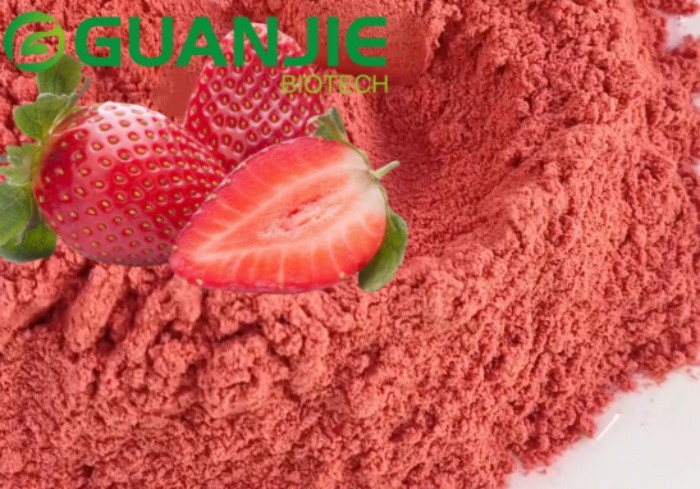
•Spray-drying and hot-air drying
Spray-drying and hot-air drying involve higher temperatures; these can lead to partial losses of heat-sensitive compounds (some anthocyanins and flavonoids) unless protective carriers or encapsulation are used. Comparative studies show variation: for some phenolics, retention is fairly good across methods; for anthocyanins and some flavonols retention can be poorer with thermal methods. For fisetin specifically, data is scarcer, but the general pattern is heat and light can degrade flavonoids; formulation and protective steps (e.g., addition of carriers, rapid drying, low oxygen) mitigate losses[5].
•Pretreatments, encapsulation, and stabilization
Pretreatments (e.g., blanching, pulping), protective carriers (maltodextrin, gum arabic), microencapsulation and sonoprocessing can enhance fisetin stability in powders and delivery systems. Encapsulation can also improve fisetin's stability to heat, light, and moisture and help control release/bioavailability. Where pure Strawberry fruit powder is prepared specifically to maximize polyphenol retention (as in many research freeze-dried powders), fisetin is expected to remain detectable and bioactive[6].
How to stabilize Fisetin in Strawberry Powder?
●Stability:
Fisetin, like many flavonoids, can be susceptible to degradation by heat, light, oxygen and moisture. Powder formulations that minimize exposure to these factors - e.g., freeze-dried powders kept in airtight, opaque packaging under refrigeration or cool, dry storage - will better preserve fisetin. Encapsulation and use of carriers can significantly increase stability[4][2].
●Bioavailability:
Fisetin has relatively poor water solubility and limited oral bioavailability in its native form. Research into nanoformulations, cyclodextrin complexes, lipid carriers and other delivery systems is active to improve fisetin's absorption and tissue distribution. This is important: even if a powder contains fisetin, how much of it is absorbed and reaches target tissues depends on the matrix (whole food vs. isolated compound), the form (free vs. glycoside), the presence of other food components, and individual metabolism. Thus the biological impact of fisetin delivered as part of strawberry powder can differ from pure fisetin supplements[2].
Specific studies on Fisetin in Strawberry Powder
Below are representative studies and reviews that examine fisetin in foods, and/or evaluate freeze-dried pure strawberry fruit powder in human or experimental studies. These papers are essential reading for the question at hand.
•A survey/review identifying dietary fisetin sources and levels
Several reviews report strawberries as the highest common dietary source with an upper-range figure near 160 µg/g fresh weight (≈16 mg/100 g)[7]. These are compiled in both older and more recent reviews of fisetin's dietary presence[8][9].
01
•Clinical interventions with freeze-dried strawberry powder (FSP):
Human trials using FSP (13–40 g/day) report improvements in lipid profile, inflammatory and oxidative stress markers, and vascular parameters in at-risk adults[4]. These trials establish that processed pure strawberry fruit powder retains biologically active polyphenols and delivers them in a usable form. Such studies usually profile anthocyanins and total polyphenols; flavonols like fisetin are part of that mixture[5].
02
•Analytical and methodological studies:
Studies using LC-MS methods have monitored postprandial polyphenol metabolites after FSP ingestion, documenting varietal metabolites and the plasma appearance of strawberry-derived compounds[10]. These analytical approaches are the foundation for quantifying fisetin and understanding its metabolism.
03
•Processing and retention studies:
Comparative work on drying methods (freeze-drying, spray-drying, hot air) shows that freeze-drying is best for preserving heat-sensitive phytochemicals; spray-dried pure strawberry fruit powder products can be acceptable if protective carriers or encapsulation are used. These processing choices directly influence how much fisetin remains in the final powder[5].
04
How To Choose Your Products?
•If you want fisetin preserved in a powder:
Choose freeze-dried pure strawberry fruit powder produced under low temperature and low oxygen conditions; check whether the manufacturer quantifies fisetin or total flavonols (certified analysis is ideal). Microencapsulation or protective carriers will help stabilize fisetin during storage and subsequent food applications. You can choose fisetin powder.
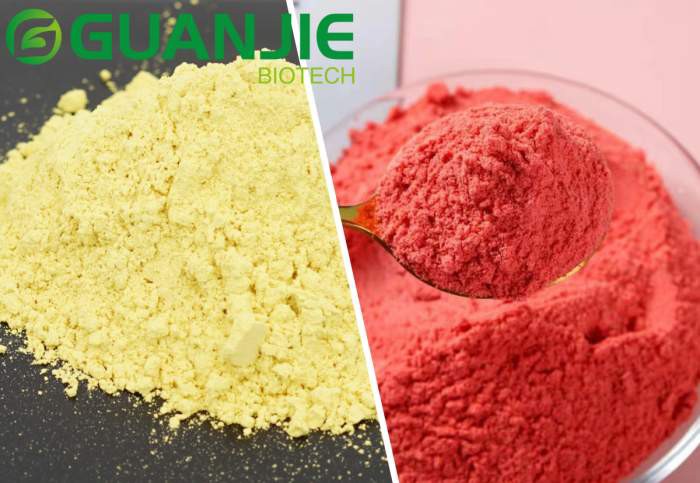
•If you aim to use food as a source of fisetin for health effects:
Freeze-dried strawberry powder at trial doses (e.g., 13–40 g/day) supplies meaningful polyphenols and has shown clinical effects; however, if you intend to reach high supplemental fisetin doses used in some experimental protocols (100+ mg/day), a large intake of powder or a fisetin-standardized extract would be required. Strawberry powder has a certain fisetin, you can choose strawberry powder.
Whatever you choose, fisetin powder or pure strawberry fruit powder, you can consult Guanjie Biotech's team. We can make you a plan that works for you. Guanjie Biotech is a professional fisetin powder or strawberry fruit bulk powder supplier. Welcome to enquire with us at
Conclusion
Yes - pure strawberry fruit powder can and often does contain fisetin because strawberries are among the richest natural sources of this flavonol. Literature values place strawberries near ≈160 µg/g fresh weight (≈16 mg/100 g). Freeze-dried strawberry powders, such as those used in clinical trials, retain polyphenols and thus contain fisetin, though exact amounts vary with processing, concentration, and formulation. For everyday dietary intake and research on whole-food matrices, pure strawberry fruit powder is a good choice. For higher, targeted fisetin dosing, you can choose purified extracts or standardized supplements, which are available as fisetin powder.
References:
[1] Aune D., et al. - Fisetin: A Dietary Antioxidant for Health Promotion. (Review, PMC) - Reports dietary sources with highest fisetin in strawberries (≈160 µg/g) and summarizes health-related evidence. PMC
[2] Recent review on fisetin bioavailability and delivery - Fisetin-In Search of Better Bioavailability-From Macro to Nano (open access review, 2023) - discusses fisetin's presence in foods and challenges in stability and bioavailability. PMC
[3] Frontiers review - New Perspectives for Fisetin - summarizes estimates and practical challenges for isolating fisetin from strawberries and reports the 160 µg/g value in dietary context. Frontie
[4] Human trials using freeze-dried strawberry powder (FSP) - Multiple clinical studies and trial registrations (e.g., trials administering 13–40 g/day FSP) showing physiological effects of FSP (lipids, inflammation, vascular measures). Representative clinical trial entries and publications.
[5]Processing and drying studies - MDPI and other comparative drying investigations that show freeze-drying preserves antioxidant activity and that pretreatments and drying conditions affect polyphenol retention in strawberry powders.
[6]Encapsulation / stabilization research - Studies on sonoprocessing, encapsulation and spray-drying to stabilize fisetin and improve release and storage stability. These works speak to options for producing powders with better fisetin retention.
[7]Maher, P. (2013). Fisetin: A Dietary Antioxidant for Health Promotion. Nutrients. - Reports strawberries as the highest common dietary source (≈160 µg/g). PMC
[8]Pal, H., et al. (2019). New Perspectives for Fisetin. Frontiers in Chemistry - Reviews fisetin sources and notes the ~160 µg/g estimate for strawberries; discusses feasibility of isolation. Frontiers
[9]Garg & colleagues (2024). Fisetin-In Search of Better Bioavailability-From Macro to Nano. PMC review (2024)
[10]Prieto-Ramos et al. / A pilot study to investigate bioavailability of strawberry anthocyanins (2013).


