

Yes, natural strawberry powder can be added to milk beverages. With increasing consumer focus on clean-label products and natural nutrients, strawberry powder, as a natural ingredient that retains the color, flavor, and dietary fiber of fresh fruit, is gradually replacing some artificial flavorings and colorants, becoming a preferred raw material for dairy companies developing differentiated products, such as strawberry-flavored fermented milk, blended milk, and milk-based beverages.
However, directly introducing strawberry powder into milk beverage systems is not a simple physical mixing process. The key challenges faced by milk beverage manufacturers include particle suspension stability, protein denaturation and precipitation, as well as color degradation during shelf life.
What Is Strawberry Powder?
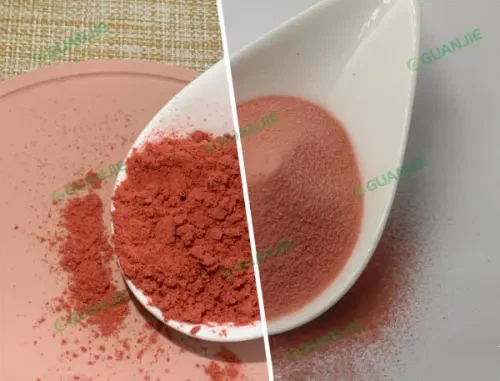
For customers asking what strawberry powder is, it is a concentrated fruit ingredient made from fresh strawberries through advanced dehydration technologies such as freeze-drying or spray-drying. It is widely used in beverages, dairy products, nutritional supplements, and strawberry powder for baking applications.
As a leading organic strawberry powder exporter and provider of organic strawberry powder exports, Guanjie Biotech offers both conventional and organic product options for global buyers.
Can Strawberry Powder Be Added to Milk Beverages?
From a food industry application perspective, adding strawberry powder to milk beverages and fermented dairy products is technically feasible.
Milk beverages are mainly divided into neutral milk beverages and acidic milk beverages (pH < 4.5). The application of freeze-dried strawberry powder is especially common in acidic dairy beverages and fermented milk systems.
Because strawberry powder itself usually has a pH between 3.0 and 3.5, manufacturers must carefully consider its effect on total acidity and system stability.
Studies have shown that this issue can be addressed by using appropriate composite stabilizers. For example, a stabilizer system consisting of monoglycerides, sucrose esters, carrageenan, and xanthan gum can effectively maintain product stability and prevent stratification.
Different Strawberry Powder On Dairy Beverage Applications
Guanjie Biotech's two main product forms have different performance characteristics in dairy beverage applications. Manufacturers should choose according to the positioning and formulation requirements of their final product.
|
Characteristics |
Freeze-dried (FD) strawberry powder |
Spray-dried (SD) strawberry powder |
|
Particulate structure |
Maintains a sponge-like porous structure with excellent rehydration properties. |
Solid granules, good flowability |
|
Flavor retention |
Highly effective at preserving heat-sensitive aromatic compounds. |
Medium density, slight loss due to high-temperature process |
|
Dispersibility in milk |
Extremely easy to disperse and does not easily clump. |
Requires high-speed shearing or premixing |
|
Suspension stability |
Low particle density and good suspension properties. |
Dense particles, prone to sedimentation |
|
Cost and applications |
A high-end product line emphasizing "freshness" and "authenticity". |
Suitable for large-scale industrial production, high cost-effectiveness |
For customers concerned about the strawberry powder manufacturing plant cost, spray-dried powder is generally more cost-effective for large-volume production, while freeze-dried powder is positioned as a premium ingredient.
Technical Challenges and Solutions for Spray-Dried Strawberry Powder
The production of spray-dried strawberry powder faces two main technical challenges. Firstly, the high content of oligosaccharides and organic acids (such as citric acid and malic acid) leads to a lower glass transition temperature. Secondly, the powder is prone to wall adhesion during the drying process, resulting in a highly hygroscopic finished product. These issues can significantly affect processing efficiency and product storage stability.
To address these problems, industrial production can incorporate small amounts of protein (such as whey protein isolate) as an anti-sticking agent. Studies have shown that controlling the protein addition to below 5% not only improves the flowability of the spray-drying process and reduces the likelihood of wall adhesion, but also enhances the physicochemical stability of the strawberry powder during storage. From a B2B application perspective, when using this type of spray-dried strawberry powder, the trace protein components can work synergistically with milk proteins in dairy beverage systems to help maintain the overall stability of the formulation.
Color Protection and Acidification Treatment of Freeze-Dried Strawberry Powder
In fermented milk applications, color is a key indicator in sensory evaluation. Studies have shown that adjusting the pH of strawberry pulp to 3.0 with citric acid and adding 0.06% EDTA-Na2 can effectively improve the color retention of freeze-dried strawberry powder. Guanjie Biotech's stringent color protection treatment, implemented before the freeze-drying process, helps ensure that the final dairy products do not undergo browning during their shelf life.
The production of spray-dried strawberry powder wholesale products faces challenges such as wall adhesion and hygroscopicity.
To solve these problems, manufacturers often add small amounts of whey protein isolate during processing. This not only improves powder flowability but also enhances compatibility with dairy beverage systems.
This is why selecting the right strawberry powder supplier is essential for product stability and long shelf life.
What Is Strawberry Powder Used For in Dairy Beverages?
• Blended Acidic Dairy Beverages
In blended acidic dairy beverages, dry mixing or pre-dissolving before addition is recommended. According to relevant patented technologies, due to the low pH of this system, acid-resistant non-dairy creamer and acid-resistant sodium carboxymethyl cellulose (CMC) are required as stabilizers. Formulation examples show that controlling the amount of strawberry powder added within the range of 5% to 10%, combined with 0.2% to 0.5% acid-resistant CMC, can effectively prevent protein demulsification and system stratification.

• Fermented Milk (Yogurt) Premix Powder
In the application of yogurt premix powder, strawberry powder serves the dual function of flavor carrier and visual indicator. Studies show that adding approximately 5% strawberry powder and 7% sucrose to a base with 88% whole milk powder, fermented at 43℃ for 6 hours, yields optimal sensory evaluation. This product has undergone 18 months of stability testing at room temperature, and the viable cell count and taste meet quality standards.
• Fermented Lactic Acid Bacteria Beverages
For sterilized fermented lactic acid bacteria beverages, the amount of reconstituted strawberry juice added can be increased to 16%, along with 5% added sugar and 3% inoculum, and the fermentation temperature is set at 37℃. In a high-acidity environment (pH approximately 3.5), the dissolution and homogenization processes of strawberry powder are particularly critical; a homogenization pressure of 20 MPa is recommended to ensure the fineness and stability of the product system.
Conclusion
In summary, strawberry powder can certainly be added to dairy beverages, but its successful application depends on three key factors:
• Choosing a strawberry powder processing method (freeze-drying or spray-drying) that is suitable for the product positioning.
• For acidic dairy systems, use acid-resistant stabilizers (such as pectin, acid-resistant CMC, or modified starch).
• Strictly controlling the microbiological indicators and physical properties of the raw materials.
As a trusted strawberry powder manufacturer, organic strawberry powder exporter, and global strawberry powder supplier, Guanjie Biotech relies on its comprehensive quality control system-from raw materials to finished products-to provide highly stable and standardized solutions for dairy industry clients, helping them develop competitive new products. Welcome to enquire with us at info@gybiotech.com.
References:
[1] Hou Yuru, et al. Research on the processing of strawberry powder solid beverage by the vacuum freeze-drying method [J]. Food Industry Technology, 2013.
[2] Strawberry powder product specifications and application guidelines [J]. Food Partner Network, 2017.
[3] Zhao Yuncai, et al. Strawberry milk tea powder patent [P]. CN103652023A, 2014.
[4] Development of strawberry fermented milk beverage [J]. Agricultural Product Processing, 2012.
[5] Gong Zhiqing. Study on the effect of low protein addition on the wall adhesion and storage of spray-dried strawberry powder [R]. National Natural Science Foundation of China, 2014.
[6] Bilbao-Sainz, C., Sinrod, A. J. G., Chiou, B. S., & McHugh, T. H. (2019). Functionality of strawberry powder on frozen dairy desserts. Journal of Texture Studies, 50(6), 556–563. https://doi.org/10.1111/jtxs.12464
[7] Gong, Z., Yu, M., Wang, W., & Shi, X. (2018). Functionality of spray-dried strawberry powder: effects of whey protein isolate and maltodextrin. International Journal of Food Properties, 21(1), 2229–2238. https://doi.org/10.1080/10942912.2018.1506477
[8] Baldelli, A., Oguzlu, H., Liang, D. Y., Subiantoro, A., Woo, M., & Pratap-Singh, A. (2022). Spray freeze drying of dairy products: Effect of formulation on dispersibility. Journal of Food Engineering, 335, 111191. https://doi.org/10.1016/j.jfoodeng.2022.111191
[9] Huang, L. L., Zhang, M., & Yan, W. Q. (2011). Rehydration characteristics of freeze-dried strawberry pieces as affected by whey protein edible coatings. International Journal of Food Science and Technology, 46(4), 671–676.
[10] Effect of Drying Methods on the Physical and Surface Properties of Blueberry and Strawberry Fruit Powders: A Review. (2025). Applied Sciences (MDPI).


