Natural spirulina powder has a clearly defined shelf life; it will eventually expire. Although spirulina, as a microalgae, can maintain its stability for a relatively long time under ideal conditions such as dryness, protection from light, and airtight sealing, it is still considered a food/dietary supplement ingredient and cannot be stored indefinitely. Typically, high-quality spirulina powder has a shelf life of 24 months (2 years). Beyond this period, even if there are no obvious changes in appearance, its nutritional components, safety, and functionality will gradually decline.
Does Spirulina Expire?
Spirulina bulk powder is a natural dietary supplement ingredient that changes its physicochemical properties during storage, which can lead to a decline in product quality. These changes are primarily caused by the following five mechanisms.
1. Fat Oxidation and Rancidity
Natural spirulina powder contains a high proportion of polyunsaturated fatty acids, including gamma-linolenic acid and linoleic acid. These fatty acids are prone to auto-oxidation when exposed to oxygen, light, or high temperatures. The oxidation process initially generates peroxides, which then decompose into low-molecular-weight aldehydes, ketones, and other secondary oxidation products. These reactions result in several consequences: an unpleasant odor, typically a rancid or fishy smell characteristic of fat oxidation; a reduction in usable fatty acids, leading to decreased nutritional value; and the possibility that long-term intake of high levels of oxidation products may have adverse effects on the body.
2. Protein Degradation and the Maillard Reaction
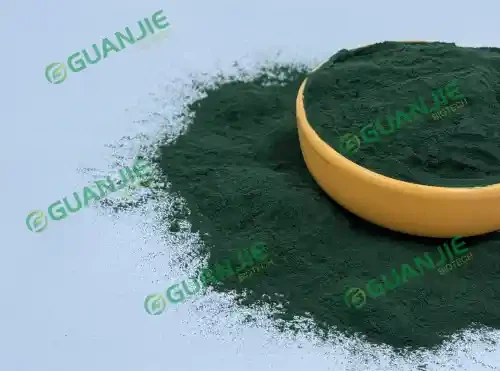
Spirulina contains 55% to 70% protein. During storage, even when the residual moisture content is below 8%, fluctuations in ambient temperature and relative humidity can still trigger protein hydrolysis. Protein decomposition produces free amino acids, some of which can be further converted into biogenic amines. Biogenic amines may exhibit physiological toxicity when present in excessive amounts. Simultaneously, the Maillard reaction occurs between reducing sugars and amino acids. This reaction causes the natural spirulina powder color to change from bright green to dark green or yellowish-brown and reduces the digestibility and utilization of proteins.
3. Degradation of Chlorophyll and Phycocyanin
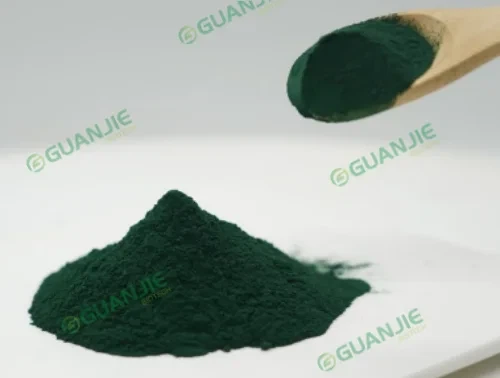
The green appearance of natural spirulina powder mainly comes from chlorophyll a, while its blue color comes from phycocyanin. Both of these natural pigments are sensitive to light, heat, and acidic environments. During prolonged storage, the phycocyanin content decreases significantly; this component is an important antioxidant in Spirulina. At the same time, chlorophyll molecules undergo a demethylation reaction, generating pheophytin and causing the product color to change to olive green or brownish-green. This color change may prevent the product's appearance from meeting the quality standard requirements for "green fine powder."
4. Risk of Microbial Proliferation
The water activity of natural spirulina powder in its dry state is below 0.5, which creates an environment that inhibits the growth of most microorganisms. However, during long-term storage, if the packaging is damaged or the natural spirulina powder product absorbs moisture, the water activity increases, allowing some microorganisms to proliferate slowly. Specifically, molds (such as Aspergillus and Penicillium) may grow and produce mycotoxins; some drought-resistant bacteria may also multiply under these conditions. Furthermore, if the initial total bacterial count of the product is high, the risk of microbial contamination increases further during the later stages of storage.
5. Loss of Trace Elements and Vitamins
Natural spirulina powder is rich in B vitamins, vitamin E, and beta-carotene, among other micronutrients. Research data show that after 18 months of storage at room temperature, the loss rate of beta-carotene can reach 30% to 50%, and the biological activity of vitamin B12 also decreases significantly. While minerals such as selenium and iron do not decompose chemically, their bioavailability may decrease due to changes in the physicochemical properties of the product matrix.
Specific changes in expired spirulina
|
Indicators |
Qualified fresh spirulina powder |
Typical changes after expiration: |
|
Appearance |
Green fine powder |
Yellow-green, dark green, or brown |
|
Odor |
Light algae smell (similar to seaweed) |
Oil-like, musty, or rotten smell |
|
Moisture |
≤7% |
Potentially increases to 9%–12% |
|
Protein |
≥55% |
Decreases by 5–10 percentage points |
|
Phycocyanin |
≥5% (some specifications) |
Significantly decreases, even below 1% |
|
Total Colony Count |
≤1,000 CFU/g |
Potentially increases to 10⁴–10⁵ CFU/g |
|
Peroxide Value |
≤0.25 g/100g |
Potentially exceeds 0.5 g/100g |
Shelf Life Requirements
In major global markets, natural spirulina powder, whether used as a dietary supplement ingredient or a general food ingredient, must be legally labeled with a shelf life. The regulatory requirements vary by country and region as follows:
• China:
According to GB 19643-2016, "National Food Safety Standard - Algae and its Products," natural spirulina powder products must be labeled with both the production date and shelf life. The recommended shelf life is 24 months.
• United States:
The U.S. Food and Drug Administration (FDA) requires that dietary supplement ingredients meet the corresponding specifications and standards. Products exceeding their shelf life cannot be sold as "legal supplements."
• European Union:
According to EU 1169/2011, "Food Information Regulation," food and supplement labels must clearly indicate the shelf life, i.e., the "best before" date.
• International Practice:
Natural spirulina powder suppliers with quality control systems, such as Guanjie Biotech, will include the production date and re-inspection date on the Certificate of Analysis (COA) for each batch of products to provide traceable quality information.
It is important to emphasize that even if expired spirulina powder does not show obvious changes in appearance, it must not be used as a qualified raw material in the production of dietary supplements. Reputable companies, including Guanjie Biotech, explicitly refuse to purchase any raw materials that have exceeded their shelf life. This practice is based on food safety risk control principles and aims to avoid potential problems such as decreased nutritional content, accumulation of oxidation products, or microbial proliferation that could affect the quality of the final natural spirulina powder product. Adhering to shelf-life regulations is a necessary measure for companies to implement quality control, protect customer interests, and comply with regulatory requirements.
How To Properly Store Spirulina Powder?
Based on the experience of its independent R&D center and factory, Guanjie Biotech recommends the following optimal storage conditions:
• Sealed:
Use aluminum foil bags or high-barrier packaging. Use as soon as possible after opening or reseal via vacuum sealing.
• Avoid Light:
Natural spirulina powder can be stored in an opaque container, avoiding direct sunlight.
• Low Temperature:
The optimal storage temperature is 15-25°C; for long-term storage, it can be placed in a 4°C cold storage (but moisture absorption is necessary).
• Dryness:
Relative humidity ≤40%. Avoid repeated temperature fluctuations in the refrigerator to prevent condensation.
• Odorless:
Keep away from volatile chemicals, fragrances, etc.
Under these conditions, natural spirulina powder can maintain its excellent quality throughout its shelf life. All Guanjie Biotech products undergo rigorous testing, with 98.0% passing through an 80-mesh sieve to ensure fine, uniform powder, which is beneficial for storage stability.
Practical Advice for Buyers and Consumers:
• Purchasing Bulk Spirulina Powder:
Choose spirulina suppliers with strong R&D capabilities and strict quality control (such as Guanjie Biotech), request real-time Certificates of Account (COAs), and confirm the production date and remaining shelf life.
• Inventory Management:
Adhere to the FIFO (First-In, First-Out) principle, install thermometers and hygrometers in the storage environment, and conduct regular spot checks.
• Identifying Abnormalities:
Discontinue use if clumping, unusual odor, or significant darkening of color occurs, even if the product is not expired.
Conclusion:
Natural spirulina powder does expire, typically with a shelf life of 24 months. The root causes of expiration are lipid oxidation, protein degradation, pigment fading, microbial risk, and vitamin loss. While ideal storage conditions of bulk spirulina can slow this process, it is irreversible. Expired spirulina powder should not be used as a food or supplement ingredient.
Guanjie Biotech strictly controls the quality of every batch of natural spirulina powder from R&D to production. We provide customers with clear production dates, shelf lives, and storage guidelines to ensure that our natural spirulina powder products maintain their excellent characteristics of green fine powder, high purity, and high activity within their shelf life. For high-quality spirulina powder, please contact: info@gybiotech.com.
References
[1] Zhou, Y., Huang, Z., Liu, Y., Li, B., Wen, Z., & Cao, L. (2024). Stability and bioactivity evaluation of analytical grade C-phycocyanin during the storage of Spirulina platensis powder. Journal of Food Science, 89(3), 1442–1453. https://doi.org/10.1111/1750-3841.16931
[2] Colla, L. M., Bertol, C. D., Ferreira, D. J., Bavaresco, J., Costa, J. A. V., & Bertolin, T. E. (2017). Thermal and photo-stability of the antioxidant potential of Spirulina platensis powder. Brazilian Journal of Biology, 77(2), 332–339. https://doi.org/10.1590/1519-6984.14315
[3] Nugrahani, O. P., Budhiyanti, S. A., & Husni, A. (2012). Stability of Spirulina platensis microcapsules during storage. Jurnal Perikanan Universitas Gadjah Mada, 14(2). This study confirms that aluminum foil packaging and low-temperature storage significantly improve spirulina stability.
[4] Food and Agriculture Organization (FAO). (1987). Production and utilization of products from commercial seaweeds. FAO Fisheries Technical Paper No. 288. Rome: FAO.
[5] European Parliament and Council. (2011). Regulation (EU) No 1169/2011 on the provision of food information to consumers. Official Journal of the European Union.