Sophora Flower Powder Manufacturer | Wholesale Sophora Japonica Powder
Guanjie Biotech is a professional Sophora japonica flower powder Supplier, providing bulk Sophora flower powder for B2B customers. Our natural Sophora flower powder is a fine, brownish-yellow to pale yellow powder with the characteristic aroma and flavor of the raw material. We offer customizable particle sizes, with standard specifications ranging from 80 to 100 mesh to meet different application requirements. As an experienced Sophora Flower Powder Manufacturer, we provide product samples, specification screening, technical documentation, testing coordination, and customized packaging. We also support small-batch trial production, flexible order scheduling, and long-term bulk supply arrangements. Guanjie Biotech aims to provide reliable ingredient sourcing and customized supply solutions for food, botanical ingredient, and supplement manufacturers.
Why Choose Guanjie Biotech as Your Sophora Japonica Flower Powder Supplier?
Since 2003, Guanjie Biotech (Shaanxi Guanjie Biotechnology Co., Ltd.) has specialized in manufacturing and supplying natural plant powders. With two manufacturing facilities and three production lines, we provide a stable supply of bulk Sophora Japonica Flower Powder and support consistent order fulfillment.
Quality Documentation and Certifications
We provide essential documents, including COAs, product specifications, non-GMO statements, and allergen declarations, to support supplier audits and product registration. Our ISO 9001, Halal, and Kosher certifications support customers with different market requirements.
Responsive Customer Service
Our professional sales team aims to respond to inquiries within two hours. We assist with sample requests, technical data, product specifications, and order communication to support efficient B2B procurement.
After-Sales Support
We take product quality and contractual responsibilities seriously. If a quality-related issue occurs, we handle it according to the agreed contract, including applicable complaint and recall procedures.
Customized Product Specifications
As a Sophora Japonica Flower Powder manufacturer, we offer customization options for particle size, packaging, and rutin content, subject to production feasibility. Customers can request samples and confirm technical specifications before placing bulk orders. Our goal is to provide reliable Sophora Japonica Flower Powder wholesale solutions for dietary supplement, food, and botanical ingredient manufacturers.
COA:
|
ITEM |
SPECIFICATION |
RESULTS |
|
Physical&Chemical Control |
||
|
Appearance |
Fine Powder |
Complies |
|
Color |
Green powder |
Complies |
|
Sieve Analysis |
98% pass 80 mesh |
Complies |
|
Loss on drying |
≤5.0% |
Complies |
|
Ash |
≤5.0% |
Complies |
|
Heavy Metals |
≤10ppm |
Complies |
|
Cadmium(Cd) |
≤1ppm |
Complies |
|
Mercury(Hg) |
≤0.1ppm |
Complies |
|
Arsenic(As) |
≤1ppm |
Complies |
|
Lead (Pb) |
≤2ppm |
Complies |
|
Bulk Density |
45~65g/100ml |
Complies |
|
Microbiology Control |
||
|
Total Plate Count |
≤1000 cfu/g |
Complies |
|
Yeast & Mold |
≤100 cfu/g |
Complies |
|
E.Coli |
Negative |
Complies |
|
Salmonella |
Negative |
Complies |
How Is Sophora Japonica Flower Powder Produced?
Guanjie Biotech produces Sophora Japonica Flower Powder through physical processing and mechanical pulverization without chemical solvents. Our production process helps maintain the natural properties of the raw material while ensuring consistent powder quality.
The manufacturing workflow includes:
Raw Material Inspection → Impurity Removal and Cleaning → Drying → Coarse Grinding → Fine Pulverization → Sieving → Metal Detection → Packaging
During drying, hot-air drying or low-temperature drying methods are selected according to product requirements. Temperature control helps reduce the degradation of heat-sensitive components, including rutin. Stainless steel grinding equipment with food-grade material-contact surfaces is used during pulverization. Specific mesh screens are applied to control particle size and achieve consistent fineness. Before packaging, the bulk Sophora flower powder passes through metal detection to support product quality and safety control.
In addition to natural Sophora Japonica flower powder, Guanjie Biotech supplies Sophora flower extracts standardized to 95% or 98% rutin. These extracts are manufactured using solvent extraction or supercritical CO₂ extraction, depending on the required specifications.
Raw Sophora Japonica powder and concentrated extracts serve different applications. Whole flower powder is suitable for formulations that require the natural plant material, while high-rutin extracts are more suitable for concentrated ingredient formulations, including tablets and capsules. Customers can select the appropriate ingredient according to their formulation and purchasing requirements.
What Are The Chemical Constituents of Sophora Japonica Flower Powder?
Sophora japonica flower powder, derived from the flowers or flower buds of the Japanese pagoda tree (Styphnolobium japonicum), contains several naturally occurring plant compounds. Its main chemical constituents include flavonoids, triterpenoid saponins, tannins, and phytosterols. These compounds are important considerations when evaluating Sophora japonica raw materials for food, botanical, and dietary supplement applications.

Flavonoids
Flavonoids are the major chemical components of Sophora japonica flowers and buds. Rutin (quercetin-3-O-rutinoside) is one of the most representative compounds. Other identified flavonoids include quercetin, isorhamnetin, and kaempferol-3-O-rutinoside. Rutin content is commonly used as a quality indicator when evaluating Sophora japonica flower and bud materials. Buyers sourcing rutin-rich Sophora japonica powder should check the botanical part, assay method, and specified rutin percentage.
Triterpenoid Saponins
Sophora japonica flower powder also contains triterpenoid saponins, including azukisaponins and soyasaponins. Their presence contributes to the overall chemical profile of the botanical raw material.
Other Natural Constituents
Additional components include tannins, phytosterols such as β-sitosterol, and fatty acids, including palmitic, stearic, and linoleic acids.
What Is Sophora Japonica Flower Powder Used For?
Solid Beverages and Instant Food Mixes
Sophora japonica flower powder, also known as Japanese pagoda tree flower powder, can be used as a plant-based ingredient in solid beverages and instant food mixes. It may contribute natural color, characteristic aroma, and botanical appeal to beverage formulations. Manufacturers should conduct small-scale trials to determine the appropriate inclusion level and compatibility with sweeteners, stabilizers, thickeners, and spray-drying carriers. Testing under different water temperatures and storage conditions can help evaluate dispersion, flavor retention, and suspension stability. For commercial production, manufacturers should also assess the nutritional composition and verify labeling information.
Compressed Candies and Chewable Tablets
Sophora japonica bud powder can be evaluated as a botanical ingredient in compressed candies and chewable tablets. Its particle size, bulk density, moisture content, and flowability may influence the compression process and finished product quality. Manufacturers should test its compatibility with excipients such as microcrystalline cellulose and lactose. Important quality parameters include tablet hardness, friability, disintegration time, and moisture stability. Proper humidity control, drying, and packaging can help reduce sticking, capping, and other production issues.
Bakery and Cereal Products
Natural Sophora japonica flower powder can be explored for use in cookies, cakes, bread, cereal bars, and instant cereal mixes. Its color and characteristic flavor may contribute to product differentiation. However, baking temperature, processing time, moisture content, and formulation pH can affect its sensory properties. Manufacturers should conduct baking trials to evaluate color stability, flavor retention, and consumer acceptance. Ingredient declarations and nutritional information should comply with applicable food labeling regulations.
Pet Nutrition
Bulk Sophora japonica flower powder may be evaluated for selected pet food and treat formulations. Before application, manufacturers should verify ingredient eligibility, target animal species, inclusion levels, and relevant feed regulations. Palatability, digestive tolerance, and potential allergen risks should also be assessed. Human food ingredient standards should not automatically be applied to pet food products.
Personal Care and Natural Colorants
Sophora japonica flowers are known for their use as botanical sources of natural color compounds. Sophora japonica powder may be investigated for selected personal care formulations and plant-based colorant applications. However, cosmetic, textile dye, and food ingredient applications have different regulatory requirements. Manufacturers should verify color performance, formulation compatibility, safety, and regulatory compliance before commercial use.
FAQs:
Q1: Does Sophora Japonica Flower Powder contain rutin?
Yes. Sophora Japonica flowers and flower buds naturally contain rutin, a flavonoid glycoside. However, the rutin content of whole Sophora flower powder varies depending on the plant material and processing conditions. Buyers who require a specific rutin concentration should request an analytical report and batch-specific Certificate of Analysis (COA). For applications requiring higher rutin concentrations, standardized Sophora flower extracts containing 95% or 98% rutin may be more suitable than ordinary flower powder.
Q2: What is the difference between Sophora Japonica Flower Powder and Sophora Japonica Extract?
The main difference is the manufacturing process and concentration of botanical constituents.
|
Comparison |
Sophora Japonica Flower Powder |
Sophora Japonica Extract |
|
Raw material |
Whole flowers or flower buds |
Extracted flower or flower bud constituents |
|
Processing |
Drying and mechanical pulverization |
Extraction, filtration, concentration, and drying |
|
Composition |
Contains a broader range of natural plant components |
Concentrates selected botanical constituents |
|
Rutin content |
Naturally variable |
Can be standardized |
|
Applications |
Food, botanical blends, and plant-based formulations |
Concentrated botanical and supplement formulations |
Sophora flower powder is suitable for formulations requiring the whole botanical material, while standardized extracts are more appropriate when a specific rutin concentration is required.
Q3: Can Sophora Japonica Flower Powder be used in capsules and tablets?
Yes. Sophora Japonica Flower Powder can be evaluated as a botanical ingredient in capsule and tablet formulations. However, formulators should assess particle size, bulk density, moisture content, flowability, and compatibility with excipients before commercial production.
For tablet manufacturing, additional tests may include compressibility, tablet hardness, friability, and disintegration time. If a formulation requires a concentrated source of rutin, a standardized Sophora japonica extract may be a more appropriate option.
Q4: Can Sophora Japonica Flower Powder be used in food and beverage products?
Yes, Sophora Japonica Flower Powder may be evaluated for selected food and beverage formulations, depending on its regulatory status in the target market. Potential applications include solid beverages, instant food mixes, cereal products, bakery products, and botanical blends.
Manufacturers should conduct application trials to evaluate its natural color, characteristic aroma, flavor, dispersion, and compatibility with other ingredients. Food-grade specifications and permitted-use requirements should be confirmed before commercial production.
Q5: What packaging options are available for bulk Sophora Japonica Flower Powder?
Packaging options depend on order quantity and customer requirements. Guanjie Biotech provides the following packaging and sample options:
|
Item |
Available options |
|
Standard bulk packaging |
25 kg/drum |
|
Sample sizes |
100 g, 1 kg, 5 kg, 10 kg |
|
Packaging material |
Food-grade plastic containers |
|
Customized packaging |
Available upon request |
|
Transportation |
Courier, air freight, and sea freight |
Customized packaging can be discussed according to product specifications, transportation conditions, and customer requirements.
Certificate
• ISO9001 Quality Management System Certificate
• FSSC22000 Food Safety System Certificate
• HACCP System Certificate
• HALAL Certification
• FDA Registration
• Organic Certification

Quality Control:
Quality control is essential when sourcing Sophora Japonica Flower Powder from a bulk supplier or manufacturer. If a product deviation occurs, customers should retain relevant evidence, including samples, photographs, batch numbers, shipping documents, test reports, and communication records. The Sophora Japonica Flower Powder supplier should conduct an internal investigation to determine whether the problem is limited to one batch or indicates a wider quality issue. For systemic problems, the release of affected batches should be suspended. The supplier should then perform root cause analysis, implement corrective and preventive actions (CAPA), and complete re-validation when necessary. Guanjie Biotech emphasizes transparent communication and closed-loop quality management. We recommend defining response times, investigation procedures, return or replacement terms, cost responsibilities, and improvement plans in a formal quality agreement. These measures help ensure consistent product quality and support reliable, long-term B2B partnerships.

Usage and Storage Recommendations:
To maintain the quality of Sophora japonica flower powder, store it in a tightly sealed container in a cool, dry place away from direct light and strong-smelling substances. After opening, use the Japanese pagoda tree flower powder as soon as possible. Reseal any unused portion promptly and store it with a suitable desiccant to reduce moisture exposure. As natural Sophora japonica powder is slightly hygroscopic, high humidity may affect its flowability and handling properties. Consider moisture control when designing storage, transportation, and production processes for bulk Sophora japonica powder.
If customers intend to export products containing this ingredient, they are responsible for verifying the regulatory status of raw materials derived from Sophora japonica in the target market. Regulations regarding the classification and labeling of botanical ingredients for use in food or dietary supplements vary by jurisdiction. While Guanjie Biotech can provide basic product information to assist with compliance assessments, the ultimate responsibility for regulatory compliance lies with the importer or the brand owner.

• Bulk packaging: 25 kg/drum for commercial orders
• Sample sizes: 100 g, 1 kg, 5 kg, and 10 kg options available
• Packaging material: Food-grade plastic containers to ensure product integrity
• Storage conditions: Cool, dry environment, away from direct sunlight
• Transportation: Available via courier, air freight, or sea freight
• Lead time: 3–5 business days for samples and items in stock
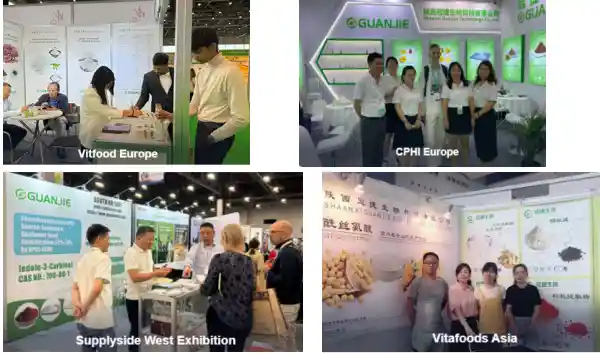
Our Teams & Exhibitions
Hot Tags: sophora flower powder, China sophora flower powder manufacturers, suppliers, factory