

Whether natural spirulina powder should be stored in refrigeration is not a simple "yes" or "no" conclusion, but requires comprehensive consideration. In the bulk trade and industrial applications of spirulina bulk powder, the setting of storage conditions directly affects the product's physicochemical properties, microbial safety, nutrient retention rate, and final application efficacy.

Should Spirulina Powder Be Refrigerated?
How is Spirulina Made?
100 pure spirulina powder is a microalgal product rich in protein (approximately 55%–70% of dry weight), polyunsaturated fatty acids, phycocyanin, carotenoids, vitamins, and minerals. These components are sensitive, to varying degrees, to temperature, oxygen, light, and humidity.
• Protein and Phycocyanin:
Phycocyanin is a water-soluble pigment–protein complex that is easily denatured by heat. In environments above 40°C, its native conformation gradually breaks down, leading to the loss of its blue fluorescence properties and a color change from blue-green to gray-green or brownish-gray. This process of natural spirulina powder not only deteriorates sensory characteristics but also indicates a decline in protein functional activity.
• Unsaturated Fatty Acids:
GLA and other ω-6 polyunsaturated fatty acids contain multiple double bonds and are highly susceptible to auto-oxidation in the presence of oxygen, generating small molecular compounds such as peroxides, aldehydes, and ketones. For every 10°C increase in temperature, the lipid oxidation rate typically increases by 2–3 times (consistent with the Arrhenius model). These oxidation products not only produce a rancid odor but also reduce the product's nutritional value and safety.
• Pigments:
Chlorophyll and carotenoids are sensitive to light and high temperatures. Under long-term non-refrigerated conditions, chlorophyll undergoes demagnesiation to form pheophytin, resulting in a color change from bright green to yellowish-brown. β-carotene loses its antioxidant activity through isomerization and cleavage reactions.
• Microbial Load:
The water activity (Aw) of natural spirulina powder is generally controlled between 0.3 and 0.4. Within this range, most bacteria cannot proliferate. However, if the packaging is not airtight or the ambient humidity is high, the Aw may rise above 0.6 as the spirulina bulk powder absorbs moisture, allowing molds and osmotolerant bacteria to grow actively. Refrigerated environments are typically associated with lower relative humidity, which helps control increases in Aw.
Specific Effects of Spirulina Powder Refrigeration
The core advantage of refrigeration lies in slowing chemical reaction kinetics by reducing molecular motion, while simultaneously inhibiting the growth of potentially thermophilic microorganisms.
• Improved Nutrient Retention Rate
Studies show that when stored at 2–8 °C in a sealed, light-protected environment for 12 months, the phycocyanin retention rate in natural spirulina powder can reach 85%–92%. In contrast, at room temperature (25 °C), the retention rate drops to 60%–70% over the same period. For GLA, under refrigeration, its peroxide value (PV) increases by ≤0.5 meq O₂/kg per month, whereas at room temperature it can reach 1.5–2.0 meq O₂/kg. For B2B customers operating in high-value-added sectors (such as functional foods, health supplement raw materials, and cosmetic additives), long-term refrigeration can significantly reduce batch-to-batch variation in active ingredients.
• Sensory and Color Stability
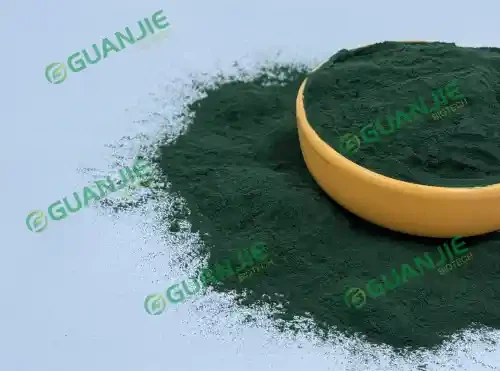
The natural blue-green color is an important quality indicator of the commercial value of natural spirulina powder. Under refrigeration, the synergistic color expression of chlorophyll and phycocyanin is preserved for a longer duration. Comparative experimental data show that under accelerated storage conditions (40 °C and 75% relative humidity for 6 weeks, equivalent to approximately 24 weeks at 25 °C), the color difference (ΔEab) of refrigerated samples was ≤3.0, whereas that of room-temperature samples was ≥8.0, with the latter exceeding the industrially acceptable threshold (typically ΔE ≤5.0).
• Microbiological Control Level
Although microorganisms remain largely inactive under low water activity (Aw) conditions, if the initial total bacterial count of raw materials is high or if packaging integrity is compromised, refrigeration can still slow microbial proliferation by stabilizing water activity and inhibiting the growth of mesophilic bacteria. For pharmaceutical applications or natural spirulina powder products requiring strict hygiene standards, refrigeration serves as an additional risk control measure.
• Extended Shelf Life
For customers making bulk natural spirulina powder purchases, if the expected inventory turnover cycle exceeds 6 months, refrigeration can extend the effective shelf life from 9–12 months at room temperature to 18–24 months. This is particularly valuable in scenarios such as ocean freight and off-season stockpiling within multinational supply chains.
Risks of Non-Refrigerated Storage
Not all B2B customers require refrigerated storage for natural spirulina powder. Under the following conditions, storage at room temperature, with protection from light and moisture, is sufficient to meet quality requirements:
• Short turnaround time (≤3 months):
If the customer quickly puts the product into production after purchase (e.g., tableting, beverage mixing, or feed additives), the natural attenuation of nutrients at room temperature remains within an acceptable range (typically ≤10%).
• End-use applications with less stringent requirements for active ingredients:
For example, when used in general animal feed, agricultural fertilizers, or low-end aquaculture, the loss of phycocyanin and GLA has a limited impact on overall product performance.
• Controlled storage conditions:
If the customer's warehouse can maintain a temperature ≤25°C, relative humidity ≤45%, protection from light, and intact sealed packaging, then room temperature storage can approximate refrigerated conditions. Conversely, in tropical or subtropical summers (with ambient temperatures consistently ≥30°C and humidity ≥70%), the risks associated with room temperature storage increase significantly.
• Impact of packaging type:
Vacuum-sealed or nitrogen-flushed aluminum foil composite bags, combined with desiccants and oxygen indicators, provide effective protection without refrigeration. In contrast, simple PE bags or paper-plastic bags offer insufficient gas barrier properties and therefore require refrigerated storage.
• Situations to avoid:
Natural spirulina powder should never be exposed to temperatures ≥40°C (e.g., in warehouses under direct sunlight or on top of shipping containers), relative humidity ≥60%, or oxygen partial pressure ≥0.21 atm. These conditions can induce Maillard reactions (leading to protein browning and ammonia-like odors), accelerate fatty acid oxidation, and increase microbial risks.
Room Temperature & Refrigerated Storage
In industrial practice, the storage conditions for bulk spirulina powder are generally divided into the following three ranges:

• Room Temperature Storage:
15–25℃, relative humidity ≤40%, protected from light and sealed.
• Refrigerated Storage:
0–8℃, controllable relative humidity (usually maintained automatically by refrigeration equipment), protected from light, and sealed.
• Frozen Storage:
-18℃ and below, mainly used for ultra-long-term storage (over 24 months).
Stability Studies
|
Storage conditions: |
Phycocyanin half-life (time to retain 50% activity): |
Time to reach a total fatty acid peroxide value of 10 meq/kg |
The time it takes for the color (green/blue) to change significantly |
|
25℃/40% RH |
Approximately 6–8 months |
Approximately 9–12 months |
Approximately 8–10 months |
|
4–6℃ |
Approximately 18–24 months |
Over 24 months |
Over 24 months |
|
-18℃ |
Over 36 months |
Over 36 months |
Over 36 months |
Note: The above data is based on sealed packaging in aluminum foil composite bags (oxygen permeability <5 cc/m²·day), stored away from light.
For high-quality spirulina powder with an expected shelf life exceeding 6 months, especially products with phycocyanin or high unsaturated fatty acids as key indicators, refrigerated storage can significantly extend shelf life. If the customer only intends to use it for short-term turnover (e.g., within 2–3 months), a dry, light-protected, ambient temperature warehouse is also sufficient.
How To Store Spirulina Powder?
|
Fields: |
Recommended Storage Conditions: |
Based on the following criteria: |
|
Health Supplements/Dietary Supplements |
Refrigerate at 2-8℃, sealed in aluminum foil, protected from light. |
Phycocyanin and GLA activity must be retained; shelf life is typically 18-24 months. |
|
Functional Beverage Premixes |
Refrigerate at 2-8℃ or room temperature ≤20℃. |
The final product has a low pH and is sensitive to oxidation; spirulina powder typically accounts for ≥30% of the premix. |
|
Natural Pigments |
Refrigerate at 2-8℃, nitrogen-filled packaging. |
Color stability is a key indicator; temperature fluctuations directly lead to color difference complaints during product switching. |
|
Animal Feed/Aquaculture |
Room temperature (≤25℃), dry and protected from light. |
Cost-sensitive, with a fast turnover (≤2 months), and low requirements for nutritional activity. |
|
Cosmetic Raw Materials |
Refrigerate at 2-8℃. |
Aldehydes and ketones produced by the oxidation of polyunsaturated fatty acids can affect the odor and stability of creams. |
|
Agricultural Fertilizers |
Recommended Storage Conditions: |
Primarily utilizes its organic matter and trace elements; retaining active ingredients is not required. |
Room temperature, but avoid high temperature and high humidity. As a professional spirulina powder supplier, Guanjie Biotech serves clients in over 100 countries, spanning various industries including food, health supplements, cosmetics, feed, and bio-fermentation. Based on the usage patterns and logistics requirements of different B-end clients, a tiered storage strategy is recommended.
The refrigerated container should be equipped with a temperature and humidity recorder to prevent condensation from contacting the packaging.
When removing natural spirulina powder from the refrigeration system, leave the unopened packaging at room temperature for 30-60 minutes to allow the temperature to stabilize before opening. This prevents condensation from forming on the inner walls of the packaging due to temperature differences.
Regularly (e.g., every 3 months), sample and retain samples for testing of color difference, peroxide value, and phycocyanin content.
Conclusion:
Natural spirulina powder does not necessarily require refrigeration, but refrigeration (2-8℃) can significantly extend the stability period of its functional components (phycocyanin, polyunsaturated fatty acids, vitamins), making it particularly suitable for high-value applications. B2B customers should make decisions based on a comprehensive consideration of their product standards, ambient temperature, expected shelf life, and cost structure. Refrigeration is strongly recommended for storage periods exceeding 6 months or in high-temperature summer environments. Guanjie Biotech provides tailored storage solutions to its clients through rigorous process control and data support for 100 pure spirulina. As a professional spirulina powder supplier, providing stable, high-purity spirulina raw materials to global B2B customers.
References:
[1] Chen Xiaofeng, Li Jianhong, Zheng Weifa. Effects of temperature and water activity on fatty acid oxidation during the storage of spirulina powder [J]. China Oils and Fats, 2016, 41(8): 45-49.
[2] Liu Lina, Zhang Dongsheng, Wang Xueqing. Study on thermal stability and protection strategies of spirulina phycocyanin [J]. Food Science, 2018, 39(11): 97-102.
[3] State Administration for Market Regulation, Standardization Administration of China. GB/T 16919-2021 General Rules for Quality of Edible Spirulina Powder [S]. Beijing: China Standards Press, 2021.
[4] Zhou Lin, Guo Siyuan, Li Lin. Extraction and stability study of spirulina polysaccharide and phycocyanin [D]. Doctoral dissertation of South China University of Technology, 2017: 56-72.
[5] Papalia T, Sidari R, Panuccio M R. Influence of storage conditions on the stability of bioactive compounds in spirulina powder[J]. Food Science and Technology International, 2020, 26(6): 513-522.
[6] Oliveira E G, Rosa G S, Moraes M A, et al. Phycocyanin content and color stability of spray-dried spirulina powder during storage[J]. Journal of Food Engineering, 2018, 226: 23-30.
[7] Martínez-Hernández G B, Castillejo N, Artés-Hernández F. Effect of storage temperature on the shelf life of spirulina (Arthrospira platensis) powder: Kinetic modeling of quality degradation[J]. Foods, 2021, 10(5): 1032.


