Dragon fruit powder for superfood blends provides natural color, dietary fiber, and antioxidant compounds. Red dragon fruit powder contains betalains, which can serve as natural colorants in clean-label food formulations. Its fiber and phenolic compounds can contribute to the nutritional profile of functional beverages, smoothies, nutritional powders, and food products. When selecting a dragon fruit powder supplier, manufacturers should evaluate raw material specifications, betalain content, particle size, sensory properties, and processing stability. Proper formulation and packaging help maintain color quality, product consistency, and shelf stability while supporting regulatory compliance and commercial application requirements.
What Does Dragon Fruit Powder Do in Superfood Blends?
• Natural Coloring Function
Red-fleshed dragon fruit powder is rich in betalains, which provide a purple-red to magenta color. This makes dragon fruit powder for natural food coloring a useful option for manufacturers seeking alternatives to synthetic colorants. Both spray-dried and freeze-dried dragon fruit powder can be incorporated into superfood blends, powdered beverages, and functional food products. The inclusion rate depends on the desired color intensity and the characteristics of the final product. Combining red dragon fruit powder with berry powders or beetroot powder can help improve color consistency. Its dual role as a natural coloring ingredient and a nutritional component makes it suitable for various food formulation applications.
• Contribution to Antioxidant Activity
The antioxidant properties of dragon fruit powder are another consideration in functional food development. Laboratory-prepared red-fleshed dragon fruit powder has been reported to contain up to 576.56 mg GAE/100 g of total phenolic compounds and 96.93 mg BCE/100 g of total betalains, with a FRAP antioxidant capacity of 120.80 mg AEAC/100 g. These values are research-specific and may vary depending on the fruit variety, processing method, and analytical conditions. For dragon fruit powder for superfood blends, manufacturers may combine it with blueberry, pomegranate, raspberry, or goji berry powder. Inulin can also be used as a formulation base. Ingredient compatibility and the overall nutritional profile should be evaluated when developing antioxidant-focused powdered products.
• Matrix Compatibility and Flavor Balance
Dragon fruit powder has a mild flavor and relatively low sweetness, allowing it to complement other ingredients without strongly affecting the overall taste. It can be used in meal-replacement powders, functional beverages, and botanical blends. In some formulations, a 5% inclusion level has been used to support acceptable color and flavor characteristics. However, red dragon fruit powder can absorb moisture, potentially affecting powder flowability and storage stability. Manufacturers should evaluate moisture content, packaging performance, and storage conditions. Tests such as the angle of repose and Carr index can help assess powder flow properties. Selecting suitable bulk dragon fruit powder specifications and processing methods supports consistent product quality.
How To Add Dragon Fruit Powder To Superfood Blends?
• Basis for Determining Inclusion Levels
The amount of dragon fruit powder used in a superfood blend formulation is governed by several factors: target color intensity, compliance with antioxidant-related claims, cost control, and sensory acceptability.
|
Application Scenarios |
Recommended addition amount |
Key Criteria |
|
Color-focused (solid beverages, smoothie base powders) |
2%~8% |
Must provide a discernible pink hue without compromising dispersibility upon reconstitution. |
|
Products with antioxidant functional claims |
5%~15% |
Must be calculated in conjunction with the total phenolic content of the formulation to ensure the antioxidant profile of the final product is quantifiable. |
|
Meal replacement/satiety-focused blended powders |
3%~6% |
Must balance color, flavor, and cost, while avoiding issues related to hygroscopicity. |
Compatibility of Dragon Fruit Powder with Other Superfood Ingredients
When formulating products with dragon fruit powder, manufacturers should consider color stability, nutritional compatibility, and processing performance.
• Color Compatibility:
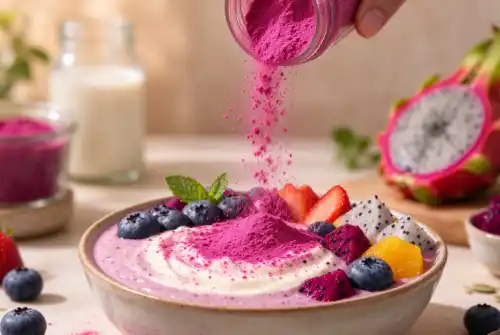
Combining red dragon fruit powder with blueberry, raspberry, or cranberry powder can create natural red-to-purple hues. However, when blending dragon fruit powder with turmeric or cinnamon, adjust the proportions to maintain the desired color.
• Nutritional Compatibility:
Dragon fruit powder contains betalains, which complement the anthocyanins in berry powders and curcumin in turmeric. High vitamin C levels from acerola cherry powder may accelerate betalain degradation during storage. Light-resistant packaging and controlled water activity can help improve dragon fruit powder color stability.
• Processing Compatibility:
When mixing bulk dragon fruit powder with whey protein or pea protein, ensure uniform distribution and minimize electrostatic adhesion. Geometric dilution, gradual ingredient addition, and pre-blending sieving can improve dragon fruit powder solubility and dispersion. For consistent blending, a target of at least 95% passing through an 80-mesh sieve can help control particle size.
The Impact of Processing Methods on the Application of Dragon Fruit Powder
• Selection of Drying Methods and Powder Characteristics
The processing method used for dragon fruit powder directly influences its performance in blended formulations. Dragon fruit powders prepared via different drying techniques exhibit significant differences in their physicochemical properties:
|
Drying Methods |
Flowability (Angle of Repose) |
Dispersion time |
Retention of total phenolics/total flavonoids |
Applicable Scenarios |
|
Starch-based whole-fruit powder |
36.6° (Good) |
135 s |
Moderate |
Products with low solubility requirements, such as compressed candies and nutritional fortifiers |
|
Dextrin-based whole-fruit powder |
38.6° |
156 s |
Highest (total flavonoids 13.06 mg/g, total polyphenols 14.29 mg/g) |
Nutritionally fortified powder blends that can accommodate a slightly longer dispersion time |
|
Dextrin-based instant powder |
42.1° (Poor flowability) |
75 s (fastest) |
Lower |
Products requiring rapid and complete dissolution, such as solid beverages |
|
Spray-dried powder |
Poor flowability |
Good solubility |
Lower than samples dried in the laboratory using trays |
General-purpose powder blends (to be used in conjunction with flow-promoting agents) |
For superfood blends, if the target product is an instant powdered beverage, it is recommended to use either an "instant" (highly soluble) dragon fruit powder or a spray-dried powder. In such cases, 0.3%–0.8% silicon dioxide or tricalcium phosphate should be added to the formulation to compensate for the powder's inherently poor flowability. Conversely, if the target product is a nutritional bar or a compressed tablet, a whole-fruit powder (often starch-based) is preferable due to its superior flow properties.
Key Aspects of Dragon Fruit Powder Blending and Storage Stability
Dragon fruit powder blending requires careful control of mixing conditions to maintain color consistency and product quality. First, pre-blend bulk dragon fruit powder with primary ingredients, such as inulin or protein powder, before adding minor components like sweeteners and vitamins. A blending time of 15–20 minutes may help achieve uniformity while limiting frictional heat that can degrade betalains. Maintain relative humidity below 45% to reduce moisture absorption, and transfer the finished red dragon fruit powder blend to packaging promptly.
For dragon fruit powder storage stability, protect betalain pigments from light, heat, oxygen, and moisture. Ingredients containing unsaturated fatty acids, such as flaxseed or chia seed powder, may increase oxidation risks and accelerate color fading. To improve the shelf life of natural dragon fruit powder, consider light-resistant aluminum foil packaging and a final water activity (aw) of ≤0.30. Mixed tocopherols at 0.02%–0.05% may also provide antioxidant protection when compatible with the formulation. These measures help manufacturers maintain the color quality and stability of bulk dragon fruit powder in functional foods, beverage mixes, and nutritional powder formulations.
What Should be Considered when Dragon Fruit Powder Processing and Stability Control?
Dragon fruit powder processing requires careful control of moisture, temperature, and light to maintain product quality in superfood powder blends. These factors are particularly important for red dragon fruit powder, which contains betalain pigments that contribute to its characteristic color.
• Moisture and Hygroscopicity Management
Dragon fruit powder moisture control is essential during dry blending, granulation, and portioning. Under humid conditions, the powder can absorb moisture, form clumps, and lose its flowability. This risk increases when blending dragon fruit powder with hygroscopic ingredients such as fructooligosaccharides (FOS) and other fruit powders.
To improve processing stability, manufacturers should maintain production-room relative humidity below 45%, where practical, and minimize the powder's exposure to ambient moisture. Adding dragon fruit powder during the final blending stage can also reduce moisture exposure. Water activity should be measured and controlled according to the formulation's specifications.
• Temperature Control During Processing
Dragon fruit powder stability depends partly on processing temperature and duration. Dry granulation or roller compaction may reduce dust generation, but excessive compression can impair powder dispersibility. Wet granulation introduces additional moisture and may accelerate pigment degradation.
For food-grade dragon fruit powder formulation, direct portioning after dry blending may be preferable when granulation is unnecessary. Fluidized-bed processing may also be considered, provided that temperature and residence time are validated to protect betalain stability. A maximum inlet-air temperature of 60°C may serve as an initial process parameter, but product-specific testing is necessary.
• Light Protection and Packaging
Dragon fruit powder packaging should limit exposure to UV and visible light to help preserve color. Aluminum foil composite bags and opaque HDPE containers are practical alternatives to transparent packaging.
During dragon fruit powder shelf-life testing, manufacturers should monitor color changes, moisture, water activity, and microbial quality. Accelerated testing at 37°C and 75% relative humidity for three months may provide comparative data, but it does not directly establish real-time shelf life. Color difference (ΔE) can be measured using a colorimeter; an acceptance limit of ΔE ≤ 5 may be used when justified by product specifications and application requirements.
Dragon Fruit Powder: Regulatory Compliance and Quality Control for Superfood Blends
• Raw Material Specifications
High-quality dragon fruit powder used in superfood blends should meet defined quality standards. The powder should have a fine texture, a characteristic dragon fruit aroma, and a purplish-red to pink color without unusual odors. Recommended specifications include an 80-mesh sieve pass rate of ≥95%, moisture content ≤5.0%, and total ash ≤5.0%. Heavy metals, calculated as lead (Pb), should be ≤2.0 mg/kg. The total plate count should not exceed 10,000 CFU/g, with coliforms and Salmonella testing negative. A typical Certificate of Analysis (COA) for spray-dried dragon fruit powder may report 29.7% total sugars, 1.3% ash, and 3.5% moisture.
• Compliance Boundaries for Label Claims
When formulating dragon fruit powder for superfood blends, manufacturers must ensure that product labeling complies with applicable regulations. Dragon fruit powder may be identified as a natural coloring ingredient where permitted, but labeling must not imply disease treatment or prevention. Antioxidant claims should be supported by appropriate testing of the finished product, including total phenolic content or FRAP values, rather than relying solely on raw material data. If the inclusion level is below 2%, manufacturers should carefully evaluate whether consumer-facing claims about dragon fruit content are adequately supported. Ingredients should generally be listed in descending order by weight, subject to local labeling requirements.
• Supply Chain Consistency Control
Batch-to-batch variations in color and betalain content can affect the appearance and consistency of bulk dragon fruit powder formulations. Manufacturers should evaluate incoming batches and adjust dosage according to validated color or betalain measurements. Suppliers should provide a comprehensive COA, heavy metal and microbiological test reports, allergen information, and a non-GMO statement when applicable. These controls help maintain consistent quality in dragon fruit powder used in functional beverages, nutritional supplements, and other superfood products.
FAQs:
Q1. What are the benefits of using dragon fruit powder in superfood blends?
Dragon fruit powder can contribute fruit-derived dietary fiber and other naturally occurring compounds, depending on the raw material and processing method. Its color and mild fruit flavor also help manufacturers develop visually distinctive superfood formulations. The nutritional composition varies by product, so buyers should review the supplier's specification and analytical data before making specific nutritional claims.
Q2. Which type of dragon fruit powder is best for superfood formulations?
The best type depends on the formulation's nutritional, sensory, and processing requirements. Freeze-dried dragon fruit powder is suitable for applications that prioritize fruit-like flavor and color retention. Spray-dried dragon fruit powder can offer efficient commercial production and convenient powder handling. Buyers should compare color intensity, moisture content, particle size, carrier ingredients, and processing costs before choosing a product.
Q3. Can dragon fruit powder provide natural pink color in superfood blends?
Yes. Red-fleshed dragon fruit powder can provide pink, red, or reddish-purple tones because it contains naturally occurring betalain pigments. The final color depends on the fruit variety, pigment concentration, drying process, storage conditions, and formulation pH. Manufacturers should test color stability under their intended processing and storage conditions to achieve consistent results in commercial superfood blends.
Q4. Is dragon fruit powder suitable for smoothie powders and green superfood blends?
Yes. Dragon fruit powder can be combined with ingredients such as spinach powder, kale powder, spirulina, chlorella, banana powder, and other fruit powders. Its fruit flavor and color can help balance the sensory profile of mixed-ingredient formulations. Formulators should evaluate flavor compatibility, dispersion, moisture control, and color consistency to determine the appropriate inclusion rate.
Q5. Does dragon fruit powder contain dietary fiber and antioxidants?
Dragon fruit naturally contains dietary fiber and various bioactive compounds, including betalain pigments in red-fleshed varieties. However, the amounts retained in dragon fruit powder depend on the fruit variety, processing method, and product composition. Manufacturers should request nutritional analyses and relevant testing data to substantiate claims about dietary fiber, antioxidant activity, or specific bioactive compounds.
Q6. How much dragon fruit powder should be added to a superfood blend?
The appropriate inclusion rate depends on the desired color intensity, flavor profile, nutritional targets, and the proportions of other ingredients. A formulator may begin with several trial concentrations and adjust the recipe according to sensory evaluation, dispersibility, and finished-product stability. Pilot-scale testing is recommended before commercial production. There is no single inclusion rate suitable for every superfood formulation.
Q7. Is dragon fruit powder water-soluble?
Dragon fruit powder is not necessarily completely water-soluble. Its dispersibility depends on the drying method, particle size, fiber content, and presence of carriers such as maltodextrin. Powders containing more insoluble fruit components may produce sediment or suspended particles in beverages. Manufacturers should evaluate wetting, mixing time, sedimentation, and mouthfeel when developing instant drink mixes and ready-to-mix superfood powders.
Q8. How should dragon fruit powder be stored to maintain color and quality?
Dragon fruit powder should generally be stored in a cool, dry environment, protected from moisture, excessive heat, and direct light. Moisture-barrier packaging can help reduce caking and deterioration, while suitable oxygen protection may help preserve sensitive components. Storage requirements and shelf life depend on the processing method, formulation, and packaging. Manufacturers should follow supplier recommendations and verify product stability throughout the intended shelf life.
Summary
Dragon fruit powder is a natural coloring ingredient for superfood blends, valued for its betalain content and antioxidant properties. When selecting natural dragon fruit powder, manufacturers should consider drying methods, specifications, and a typical 2%–15% inclusion rate. Proper blending, moisture control, and light-resistant packaging help maintain color stability and product quality. Manufacturers should also evaluate powder flowability, storage conditions, and labeling requirements when sourcing bulk dragon fruit powder for food and beverage formulations.
Guanjie Biotech is a professional dragon fruit powder supplier and manufacturer, offering freeze-dried dragon fruit powder and spray-dried dragon fruit powder. Freeze-dried powder helps preserve the fruit's natural color and heat-sensitive nutrients, making it suitable for premium superfood formulations. Spray-dried dragon fruit powder offers good flowability and dispersibility for large-scale dry blending. We also provide OEM and ODM services, covering raw material sourcing, formulation development, and customized processing. Our natural dragon fruit powder is suitable for powdered beverages, superfood blends, and meal-replacement products. Welcome to enquire with us at info@gybiotech.com.
References:
[1] Neder-Suárez, D., Estrada-Moreno, I. A., Vázquez-Rodríguez, J. A., Lardizábal-Gutiérrez, D., Hernández-Ochoa, L. R., Ruiz-Gutiérrez, M. G., & Quintero-Ramos, A. (2026). Physicochemical and sensory functions of rice-based third-generation snacks enriched with chickpea and red pitaya powder. AIMS Agriculture and Food, *11*(1), 118-136. https://doi.org/10.3934/agrfood.2026007
[2] Wang, W., Wang, Z., Yu, J., Lin, R., Zhang, S., & Zhang, D. (2024). Preparation and quality evaluation of red dragon fruit (Hylocereus polyrhizus) powder by foam-mat microwave freeze-drying. Transactions of the Chinese Society of Agricultural Engineering, *40*(6), 79-89. https://doi.org/10.11975/j.issn.1002-6819.202310050
[3] Co-microencapsulation of Lacticaseibacillus paracasei and pitahaya juice by spray drying using pitahaya peel flour as a wall material. (2025). Food Bioscience (ScienceDirect).
[4] Stability of encapsulated betalain pigments from red dragon fruit (Hylocereus polyrhizus) peel: Stability-limiting factors and control measures. (2026). Food Science and Technology (DOI: 10.24263/2310-1008-2026-14-1-11).
[5] Wang Wei, Wang Zhandong, Yu Jiahui, Lin Runze, Zhang Shuo, & Zhang Dawei. (2024). Preparation and Quality Evaluation of Red-Fleshed Pitaya Powder via Foaming-Assisted Microwave Freeze-Drying. *Transactions of the Chinese Society of Agricultural Engineering*, *40*(6), 79–89.
[6] Lan Chengguang. (2020). A Nutritional and Health-Promoting Dragon Fruit Meal-Replacement Powder and Its Preparation Method. Chinese Invention Patent, CN111296783A.
[7] Lan Chengguang. (2020). A Nutritional and Health-Promoting Solid Dragon Fruit Beverage and Its Preparation Method. Chinese Invention Patent, CN111296706A.
[8] Research on the Solubility and Color Characteristics of Dragon Fruit Powder (A Comparison of Spray-Dried Maltodextrin-Based Instant Powder, Maltodextrin-Based Whole-Fruit Powder, and Starch-Based Whole-Fruit Powder). Chinese Academy of Agricultural Sciences.