

In industrial food production, natural strawberry powder is widely used as a fruit and vegetable flavoring, coloring, and nutritional additive in beverages, baking, snacks, and functional foods. Mainstream strawberry powder on the market is divided into two categories: strawberry fruit powder and strawberry juice powder. These two types have significantly different water solubility, which directly affects formulation design, production processes, and final product quality.

Does Strawberry Powder Dissolve In Water?
Water solubility is a key technical parameter for fruit and vegetable powders. It determines whether a raw material is suitable for specific applications. Strawberry fruit powder and strawberry juice powder have clearly different solubility characteristics. These differences are consistent with industrial testing standards for food ingredients.
Strawberry fruit powder is partially water-soluble and cannot fully dissolve in water. When added to an aqueous system, it partially dissolves and partially suspends or settles. This results in a slightly cloudy liquid with some residue. It does not form a clear and homogeneous solution. This is not a quality defect. It is a normal characteristic caused by its composition and processing method.
Strawberry juice powder is fully water-soluble, with a solubility rate of up to 99.9%. Natural strawberry powder is suitable for cold water, room temperature water, and warm water. It dissolves quickly without clumping or sticking to container walls. It produces a clear solution without visible particles or sediment. It forms a stable and uniform strawberry-flavored liquid system. It is suitable for high-clarity beverage and liquid food applications.
Core Reasons for the Difference in Water Solubility
The difference in water solubility comes from differences in raw materials, processing methods, and composition. This is the main basis for distinguishing these two ingredient types in industrial applications.
1. Strawberry Fruit Powder: Dietary Fiber Causes Partial Solubility
Strawberry fruit powder is made using whole fruit processing technology. Fresh strawberries are washed, crushed, dried, and milled into powder. The process retains the whole fruit, including pulp, peel, and seeds.
Natural dietary fiber, pectin, and other insoluble plant materials remain in the product. These high-molecular-weight components do not dissolve in water. This is the main reason for its partial solubility.
At the same time, strawberry fruit powder retains a broad nutritional profile, including dietary fiber, minerals, anthocyanins, vitamins, and other bioactive compounds. However, due to the presence of insoluble components, it cannot form a fully clear solution.

2. Strawberry Juice Powder: Refining Process Enables Full Solubility

Strawberry juice powder is produced through a juice extraction and purification process. The raw material is processed through juicing, filtration, concentration, and spray drying.
During processing, insoluble components such as peel, seeds, and coarse fiber are removed. Only water-soluble components remain, including sugars, water-soluble vitamins, aroma compounds, and soluble pectin.
Because it contains almost no insoluble matter, the final product has full water solubility, fast dissolution, and stable dispersion. It is suitable for applications requiring high clarity and uniformity.
What Are The Advantages of the Two Strawberry Powders?
In industrial food production, differences in raw material properties can be converted into product differentiation advantages. Proper use of the water-soluble characteristics of the two strawberry powders can improve product quality, enrich product categories, and reduce production losses.

Strawberry Fruit Powder
• Preserves strawberry's authenticity
First, natural strawberry powder preserves the natural fruit texture and improves product authenticity. The fine suspended particles from partial solubility simulate the texture of fresh strawberry pulp. This helps solve the weak and artificial taste caused by artificial flavors and colors. The final product has a natural fruit flavor and a light pulp-like texture. It meets consumer demand for "natural, additive-free, and high-quality ingredients."
• High Nutrition
Second, it provides more complete nutrition and higher added value. It retains insoluble dietary fiber while also preserving polyphenols, minerals, and other nutrients. Compared with pure juice powder, it offers a more complete nutritional profile. Food manufacturers can use this feature to develop products positioned as high-fiber and high-nutrition. It is suitable for meal replacements, healthy snacks, children's food, and functional foods.
• Good stability
Third, natural strawberry powder has good stability in solid and semi-solid systems. The suspension properties do not negatively affect baked goods, pastes, sauces, or instant powder systems. Instead, it can improve texture, layering, and color intensity. During high-temperature processing, the fiber helps retain flavor and reduces aroma loss. This improves overall flavor retention in the final product.
Strawberry Juice Powder
• Excellent Clarity And Appearance
First, it provides excellent clarity and appearance in liquid systems. It is fully water-soluble, with no sediment or turbidity. It is suitable for clear beverages, sparkling water, fruit teas, and functional drinks. It solves the common problems of settling and layering in traditional fruit powders. The final product appears clear, bright, and evenly colored, with a more premium visual quality.
• Strong Processing Adaptability
Second, it has strong processing adaptability and reduces production loss. Strawberry juice powder dissolves quickly in both hot and cold water. It does not require high-speed mixing or homogenization. It is suitable for automated production lines. It dissolves without clumping or residue. This improves production efficiency and reduces material waste and cleaning costs.
• Smooth And Clean Taste
Third, natural strawberry powder delivers a smooth and clean taste with wide application. It has no fibrous or grainy mouthfeel. The taste is smooth and consistent after reconstitution. It is suitable for dairy products, yogurt, jelly, and pudding. It does not affect texture or mouthfeel, even in products requiring high smoothness.
How to Choose Strawberry Powder?
For food manufacturers, choosing the wrong strawberry powder can lead to poor product quality, damaged brand reputation, and raw material waste. Based on the water-solubility characteristics, the application scenarios and production notes are summarized below.

Suitable Application Scenarios for Strawberry Powder
Strawberry fruit powder is suitable for products that do not require transparency and focus on natural fruit texture and nutrition. Typical applications include baked goods such as strawberry cakes, bread, cookies, and crisps. It is also widely used in solid instant beverages like meal replacement powders, oat powders, and cereal drinks. Other uses include sauces such as strawberry jam and baking fillings, dairy products like flavored yogurt and milkshakes, and snack foods such as strawberry candies, freeze-dried fillings, and puffed snacks.
Production Precautions
When natural strawberry powder is used in liquid systems, slight stratification may occur. This is normal. It can be improved with mild homogenization or a small amount of food-grade thickener. Complete transparency is not expected. However, it should not be used in high-end clear beverages, as it may cause turbidity and sedimentation, which affects appearance.
Strawberry Juice Powder Applications
Strawberry juice powder is suitable for liquid and semi-liquid products that require clarity, smooth texture, and no sedimentation. Applications include clear fruit-flavored water, sparkling water, bottled tea, fruit syrups, jellies, puddings, room-temperature dairy drinks, functional oral liquids, and premium instant beverages.
Production Considerations
This powder contains no fiber. It provides a cleaner flavor but lacks fruit pulp texture. It is not suitable for baking or meal replacement products that require fruit particles. In such applications, it may result in a thin texture and lower sensory value.
FAQs:
Why does strawberry fruit powder not fully dissolve?
Strawberry fruit powder is made from the whole fruit, including pulp, peel, and seeds. It contains natural dietary fiber, pectin, and other insoluble plant components. These substances cannot dissolve in water. Therefore, when mixed with water, the powder forms a suspension with slight sediment instead of a clear solution. This is a normal physical property.
Why is strawberry juice powder more soluble?
Strawberry juice powder is produced from extracted strawberry juice. During processing, insoluble components such as fiber, peel, and seeds are removed through filtration. Only water-soluble compounds remain, including sugars, organic acids, aroma compounds, and soluble nutrients. This structure allows it to dissolve quickly and completely in water.
Which strawberry powder is better for baking and snacks?
Strawberry fruit powder is more suitable for baking and snack applications. It provides natural fruit particles, improves texture, and enhances fruit authenticity. It is widely used in cakes, cookies, cereals, and other solid food products.
Does full solubility mean higher quality?
No. Full solubility does not indicate higher quality. It only reflects differences in processing methods and raw material composition. Both types are high-quality ingredients designed for different food systems.
How should manufacturers choose between the two?
Selection depends on product requirements. Strawberry Fruit powder is preferred for nutrition, fiber content, and texture. Juice powder is preferred for clarity, smooth mouthfeel, and liquid applications such as beverages and functional drinks.
Is slight sediment in strawberry fruit powder normal?
Yes. Slight sedimentation is normal due to natural insoluble fiber. Natural strawberry powder can be improved with homogenization or stabilizers, but it cannot be eliminated in liquid systems.
Summary
Strawberry fruit powder is not a lower-quality raw material. Its partial water solubility comes from preserving natural fruit nutrients and fiber. Strawberry juice powder, with full water solubility, results from further purification and is better suited for high-end liquid systems. Neither is superior. The correct choice depends on product positioning, processing requirements, and final product appearance.
In today's food industry, natural, healthy, and refined products are key trends. Understanding the differences between these two powders helps companies avoid formulation issues, reduce quality risks, and improve product differentiation. Whether developing high-fiber snack products or clear premium beverages, proper ingredient selection improves product performance and market competitiveness.
To support large-scale procurement needs, Guanjie Biotech has developed a stable and standardized strawberry powder product system. It provides bulk raw materials with consistent quality and reliable supply.
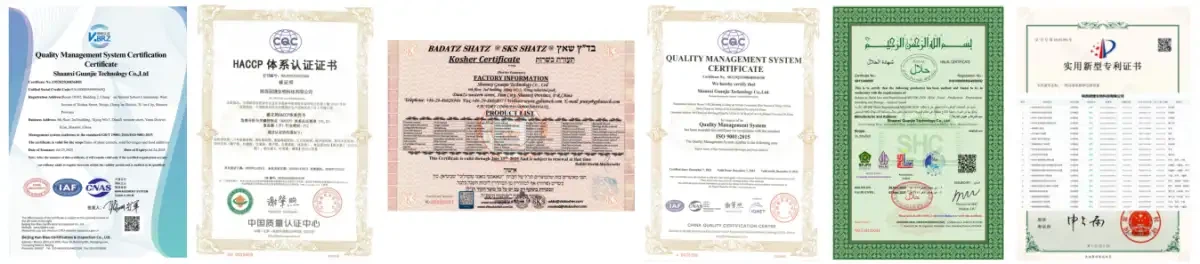
We clearly differentiate between strawberry fruit powder and strawberry juice powder. Solubility performance is stable and consistent. This helps reduce formulation adjustment costs for manufacturers. Advanced processing technologies such as low-temperature drying, aseptic grinding, and precision filtration are applied. These reduce common issues such as caking, aroma loss, and color fading. The final product has uniform particle size and good flowability, making it suitable for automated production lines.
In quality control, we apply a full-process management system. It strictly monitors microorganisms, heavy metals, and impurities from raw material sourcing to final delivery. Products contain no artificial additives and comply with domestic and international food standards. The company also has large-scale production and warehousing capacity, supports long-term bulk orders, and ensures stable global supply with technical and logistics support. Welcome to enquire with us at info@gybiotech.com.
References:
[1] Brennan, C. S. (2015). Dietary fibre, glycaemic response and diabetes. Molecular Nutrition & Food Research, 59(12), 2385-2394.
[2] Jafari, S. M., Assadpoor, E., He, Y., & Bhandari, B. (2008). Encapsulation efficiency of food flavours and oils during spray drying. Drying Technology, 26(7), 816-835.
[3] Karasalan, M., & Ozcan, T. (2019). Functional properties of strawberry powder produced by different drying methods. Journal of Food Processing and Preservation, 43(8), e14045.
[4] Kuck, L. S., & Noreña, C. P. Z. (2016). Microencapsulation of grape (Vitis labrusca var. Bordo) skin phenolic extract using gum Arabic and polydextrose as encapsulating agents. Food Science and Technology, 36(4), 759-766.
[5] Lewicki, P. P. (2006). Design of hot air drying for better foods. Trends in Food Science & Technology, 17(4), 153-163.
[6] Oikonomopoulou, V. P., & Krokida, M. K. (2013). Water sorption isotherms and glass transition temperature of spray dried strawberry juice powder. International Journal of Food Properties, 16(8), 1823-1838.
[7] Shishir, M. R. I., & Chen, W. (2017). Trends of spray drying: A critical review on drying of fruit and vegetable juices. Trends in Food Science & Technology, 65, 49-67.
[8] Chen Jun, Liu Chengmei, Liang Ruihong, et al. (2016). Effects of spray drying conditions on the physicochemical properties of strawberry juice powder. Food Science, 37(13), 106-111.
[9] Li Yahui, Ma Yanhong, Huang Kaihong, et al. (2015). Effects of different drying methods on the quality of strawberry powder. Food Industry Technology, 36(12), 117-121.
[10] Liu Dong, Li Yan, Zhao Li, et al. (2018). Effects of pectinase treatment on the clarification effect and physicochemical properties of strawberry juice. Food Research and Development, 39(8), 78-82.


