


Pure Purple Ube Powder (Yam Powder) – 100% Natural Dioscorea alata Root Powder
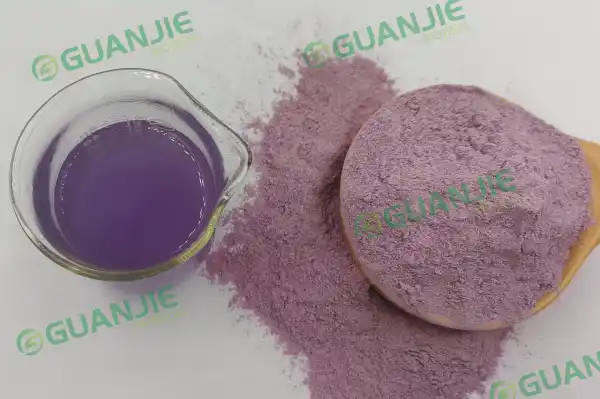
Purple ube powder is also called purple yam powder. It has gained popularity in the health food and natural food colorant industries. However, fluctuations in raw material supply and processing challenges can make it difficult to source consistent, high-quality products. Guanjie Biotech is a purple yam powder manufacturer with its own production facility, producing purple yam powder through hot-air drying. Our purple yam ube powder is suitable for various food and beverage applications, including bakery products, beverages, desserts, and other food formulations. As a bulk purple ube powder supplier, we also offer OEM and ODM services to meet different formulation, processing, and packaging requirements. For product specifications, bulk purple ube yam powder pricing, or customized solutions, contact us at info@gybiotech.com.
COA:
|
Item |
Specification |
Result |
Method |
|
Basic Product Information |
|||
|
Genus and Species |
Dioscorea alata |
Conform |
/ |
|
Part of the Plant |
Rhizome |
Conform |
/ |
|
Country of Origin |
China |
Conform |
/ |
|
Organoleptic Data |
|||
|
Color |
It should have the desired colour of purple yam powder and be purple in colour. |
Conform |
GB/T29602-2013 |
|
Shape |
No lumps, loose, homogeneous powder. |
Conform |
|
|
Odor&Taste |
The product should have its characteristic taste and smell, no irritation, burnt, rancidity and other odor. |
Conform |
|
|
Impurity |
No visible impurities |
Conform |
|
|
Solubility |
A clear or uniform suspension was obtained after dissolution |
Conform |
|
|
Process Data |
|||
|
Method of Processing |
Grinding |
Conform |
/ |
|
Physical Characteristics |
|||
|
Loss on drying |
<7.0% |
4.39% |
GB5009.3-2016 |
|
Heavy Metals |
|||
|
Total Heavy Metals |
<10ppm |
Conform |
USP <231>, method II |
|
As |
<2.0ppm |
Conform |
AOAC 986.15, 18th |
|
Pb |
<2.0ppm |
Conform |
AOAC 986.15, 18th |
|
Cd |
<0.5ppm |
Conform |
AOAC 986.15, 18th |
|
Hg |
<0.5ppm |
Conform |
AOAC 971.21, 18th |
|
Pesticide Residue |
|||
|
666 |
<0.2ppm |
Conform |
GB/T5009.19-1996 |
|
DDT |
<0.2ppm |
Conform |
GB/T5009.19-1996 |
|
Microbiology |
|||
|
Total Plate Count |
<10,000cfu/g |
Conform |
AOAC 990.12, 18th |
|
Total Yeast & Mold |
<1,000cfu/g |
Conform |
FDA (BAM) Chapter 18, 8th Ed. |
|
E. Coli |
Negative |
Negative |
AOAC 997.11, 18th |
|
Salmonella |
Negative |
Negative |
FDA (BAM) Chapter 5, 8th Ed. |
Why Choose Guanjie Biotech?
Guanjie Biotech is a purple ube powder supplier and direct-from-factory manufacturer, providing bulk purple ube powder for food manufacturers and ingredient distributors. The difference between a private-label trader and a direct factory supplier becomes clear when evaluating batch consistency, customization capabilities, and long-term supply stability.
Consistent Quality Control
Batch-to-batch consistency is essential for manufacturers using purple yam ube powder in food formulations. Variations in color, moisture content, and dispersibility can affect product quality and processing efficiency. Guanjie Biotech manages production from raw material intake to finished powder under a unified quality management system. Our purple yam powder has a loss on drying below 7.0%, with a reported typical value of approximately 4.39%. Total heavy metals are controlled below 10 ppm. Microbiological testing protocols cover total plate count, yeast and mold, E. coli, and Salmonella, supporting reliable quality assessment for bulk purple yam powder procurement.
Flexible Manufacturing and Customization
Our established hot-air drying process supports large-scale production of purple ube powder for commercial applications. As a direct purple yam powder manufacturer, Guanjie Biotech can evaluate process adjustments based on customer requirements for color intensity, bulk density, and dispersibility, subject to product specifications and production feasibility. These capabilities help food manufacturers develop customized ingredient solutions for beverages, bakery products, snacks, and other food applications.
Stable Year-Round Supply
Purple yam availability can vary by harvest season and growing region. Our manufacturing facility allows us to process raw yams during harvest periods and store the resulting powder under appropriate conditions. This approach helps reduce dependence on immediate fresh-material procurement and supports more stable bulk purple ube powder supply throughout the year.
For food manufacturers seeking a reliable purple ube powder supplier, Guanjie Biotech offers manufacturing control, quality testing, and production flexibility to support long-term B2B sourcing requirements.
Why Use Purple Yam (Ube) Powder?
Purple yam is unlike white yam. Purple yam contains anthocyanins, natural pigments responsible for its distinctive purple color. It also contains phenolic compounds, polysaccharides, and other bioactive components that are being studied for their potential antioxidant properties.
Purple ube powder is a convenient ingredient for food manufacturers seeking natural color, distinctive flavor, and plant-based ingredients. Compared with fresh purple yam, purple yam ube powder is easier to store, transport, and incorporate into commercial formulations.
Fresh purple yam has a high moisture content and a limited storage life. Processing it into powder helps extend shelf life when properly manufactured and stored, while supporting consistent ingredient handling throughout the supply chain.
Bulk purple ube powder can be used in solid beverages, bakery products, desserts, noodles, snacks, and functional food formulations. For manufacturers and product developers, natural purple yam powder offers a practical option for developing visually appealing products. When sourcing purple ube powder, buyers should evaluate color consistency, moisture content, microbiological quality, and applicable food safety documentation.
How Is Purple Ube Powder Produced?
The production process of purple ube powder directly affects its color, solubility, and retention of natural compounds. Common drying methods include hot-air drying, spray drying and vacuum freeze-drying. Research shows that these techniques produce different results in water solubility, color retention, total phenolic content, and anthocyanin levels. Although spray freeze-drying can help preserve heat-sensitive compounds, hot-air drying requires careful temperature control to minimize browning.
As a purple ube powder manufacturer, Guanjie Biotech uses hot-air drying to produce purple ube powder for commercial food applications. This method offers scalable production, controlled processing conditions, and consistent batch quality. For food manufacturers purchasing bulk purple ube powder, a stable supply and reliable specifications are essential for product development and large-scale manufacturing.
Guanjie Biotech's raw purple ube powder is unpregelatinized, meaning its starch granules have not undergone gelatinization. Unlike pregelatinized purple yam powder, raw powder generally requires heating under suitable moisture conditions for starch gelatinization. Its processing characteristics make it suitable for formulations where manufacturers control the heat-treatment process. Applications may include beverages, bakery products, desserts, and other food formulations, depending on the required texture and processing conditions.
Is Purple Ube Powder Soluble?
For powdered ingredients, solubility affects the final product's texture and consumer experience. Conventional purple yam powder contains starch and dietary fiber, which may cause clumping, sedimentation, or a gritty mouthfeel when mixed with liquids.
Guanjie Biotech's purple ube powder undergoes multi-stage milling and sieving to improve particle-size uniformity and dispersion. In water, it forms a relatively homogeneous suspension with minimal floating residue under suitable preparation conditions. This makes it a practical ingredient for beverage manufacturers, instant drink mixes, and other food applications.
What Is Purple Ube Powder Used For?
Purple ube powder is a versatile ingredient used in food manufacturing because of its natural color, starch content, and potential nutritional value. Its applications mainly include baked goods, instant beverages, and dietary supplements, making it a practical option for food manufacturers seeking natural ingredients.
For Baking and Flour-Based Products
Purple yam powder can serve as a natural coloring ingredient in bread, steamed buns, cookies, cakes, and other flour-based products. Its purple color helps manufacturers develop visually distinctive foods without relying entirely on synthetic colorants. Depending on the yam variety and processing method, the powder may produce light-purple to deeper purple shades. However, hot-air drying and baking can affect anthocyanin retention and color stability. Therefore, purple ube powder is suitable for products requiring a natural purple appearance rather than a guaranteed vibrant color. Replacing part of the wheat flour with purple yam powder can also contribute dietary fiber and minerals while modifying the flavor, texture, and moisture characteristics of the finished product.
For Beverages and Instant Drink Mixes
Purple yam powder is used in instant drink mixes, cereal beverages, smoothie blends, and other powdered food formulations. Its starch content influences water absorption, viscosity, and mouthfeel. Raw purple yam powder may not dissolve completely in cold water and may require heating to achieve a thicker consistency through starch gelatinization. Food manufacturers should evaluate dispersibility, preparation temperature, and sedimentation during product development. Clear preparation instructions can help ensure consistent results for commercial beverage applications.
For Functional Foods and Supplements
Purple yam powder can be incorporated into functional foods, nutrition powders, and dietary supplement blends. It contributes plant-derived carbohydrates and may contain anthocyanins, polysaccharides, and other naturally occurring compounds, depending on the variety and processing conditions. Its suitability for capsule filling or tablet production depends on particle size, moisture content, flowability, and formulation compatibility. Manufacturers should verify these properties through product testing.
For B2B buyers, selecting a reliable purple yam powder supplier is essential for consistent quality, color, and functionality. Bulk purple ube powder can support customized formulations for food, beverage, and supplement manufacturers.
FAQs:
Q1:What Does Purple Ube Powder Taste Like?
Purple yam ube powder features a distinct, mildly sweet, and nutty flavor profile with subtle notes of vanilla, coconut, and white chocolate. Its taste is gentle and earthy, making it versatile for both sweet desserts (cakes, cookies, ice creams) and savory dishes or beverages.
Q2:Does purple ube powder contain gluten or common allergens?
Naturally, pure purple ube yam powder is 100% gluten-free, grain-free, and vegan. It is made solely from ground purple yam roots. However, if you have severe celiac disease or allergies, always check product labels to ensure it was processed in a facility free from cross-contamination with wheat, nuts, or dairy.
Q3:Does purple ube powder contain artificial food coloring or added sugar?
100% pure purple yam powder contains no artificial colors, preservatives, or added sugars. Its intense violet color comes naturally from plant anthocyanins. Be sure to buy pure ube powder rather than pre-mixed ube dessert mixes, which often contain added milk powder, sugar, and synthetic food dyes.
Q4:How do you properly store purple ube powder for maximum shelf life?
Store purple ube powder in an airtight container in a cool, dark, and dry place away from direct sunlight and moisture. Unopened, it typically lasts 12 to 18 months. Once opened, keep the package tightly sealed or transfer it to a glass jar to retain its vibrant color and fresh flavor.
Q5:How To Keep Purple Ube Powder Color?
The vibrant purple color in purple yam powder comes from pH-sensitive anthocyanins.
• Acidic environments (pH < 7):
Adding citrus juice, buttermilk, or acidic ingredients preserves or brightens the deep magenta/purple tone.
• Alkaline environments (pH > 7):
Excess baking soda or alkaline tap water can react with the anthocyanins, causing the batter to shift toward a dull green or bluish-grey shade.
Tip: Pair purple yam powder with a pinch of acid (like cream of tartar or lemon juice) in baked goods to maintain a bright violet hue.
High Quality Control:
We have our own factory and production line. Each batch of purple yam powder be tested.

Certifications:
Guanjie Biotech has Halal, Kosher, ISO 9001, HACCP, and others.

Package:

Delivery Methods

Hot Tags: purple ube powder, China purple ube powder manufacturers, suppliers, factory


