


Bulk Pure Almond Protein Powder – High-Purity Defatted Almond Powder Ingredient
Pure almond protein powder is made from almonds through a multi-step process, including peeling, debittering, defatting, drying, and grinding. It retains the nutritional value of almonds while presenting a pleasant taste and easy processing. Bulk almond powder is widely used in food, nutritional supplements, infant formula, dairy alternatives, plant-based protein beverages, baking, cosmetics, and other applications. Guanjie Biotech is a bulk almond powder supplier. Our pure almond protein powder products are high-quality and have no additives. Please feel free to contact us at info@gybiotech.com.

What is The Classification of almond powder?
Raw Material Source
Pure almond protein powder is primarily made from bitter or sweet almonds, both derived from the mature kernels of the apricot (Prunus armeniaca L.) plant in the Rosaceae family. The type of almond used varies depending on the intended use and flavor profile.

Bitter almonds:
Contain a certain amount of amygdalin. Low-temperature debittering significantly reduces its bitterness and toxicity, making it a popular ingredient in functional foods.
Sweet almonds:
Bulk almond powder has a mild taste and mellow flavor, they are suitable for food and infant products. High-quality almonds should be clean, mold-free, rich in fat, and have a pure aroma. The quality of the final bulk almond powder product is directly determined by the selection of raw materials.
How Many Kinds of Almond Powder Are There?
•Whole-Fat Almond Powder:
Whole-Fat pure almond protein powder retains the natural fats of almonds, resulting in a smooth texture and rich aroma. Guanjie Biotech's whole-fat almond powder is available in three flavors: light aroma, light aroma, and rich aroma.
•Defatted Almond powder:
Part of the fat is removed through physical pressing, resulting in a high protein content. Defatted pure almond protein powder is suitable for high-protein functional foods.
•Micronized Almond powder:
Natural micronized almond powder is ultra-finely ground to a particle size of less than 100 mesh, resulting in improved solubility and absorption. It is widely used in ready-to-eat products and formulas.

almond protein powder supplier in China
As a pure almond protein powder manufacturer, Guanjie Biotech can provide the high-quality almond powder you need. Please contact us.
COA:
There are two kinds of COA for pure almond protein powder. One is Rich Almond Protein Powder. The other is Defatted Almond Protein Powder. If you need others, welcome to enquiry our team.
•Rich Almond Protein Powder
|
Item |
Specification |
Result |
Method |
|
Basic Product Information |
|||
|
Genus and Species |
PRUNUS ARMENIACA |
Conform |
/ |
|
Part of the Plant |
Kernel |
Conform |
/ |
|
Country of Origin |
China |
Conform |
/ |
|
Marker Compounds |
|||
|
Assay(Protein) |
>22.0% |
23.76% |
|
|
Fat |
>56.0% |
58.35% |
|
|
Organoleptic Data |
|||
|
Appearance |
Powder |
Conform |
GJ-QCS-1008 |
|
Color |
Off-White or light Yellow Fine powder |
Conform |
GB/T 5492-2008 |
|
Odor |
Characteristic |
Conform |
GB/T 5492-2008 |
|
Taste |
Characteristic |
Conform |
GB/T 5492-2008 |
|
Process Data |
|||
|
Method of Processing |
Smash |
Conform |
/ |
|
Solvent(s) Used |
Water |
Conform |
/ |
|
Drying Method |
Spray drying |
Conform |
/ |
|
Physical Characteristics |
|||
|
Particle Size (80 mesh) |
>95.0% |
Conform |
GB/T 5507-2008 |
|
Moisture |
<5.0% |
3.14% |
GB/T 14769-1993 |
|
Ash Content |
<5.0% |
2.11% |
AOAC 942.05, 18th |
|
Heavy Metals |
|||
|
Total Heavy Metals |
<10ppm |
Conform |
USP <231>, method II |
|
As |
<2.0ppm |
Conform |
AOAC 986.15, 18th |
|
Pb |
<2.0ppm |
Conform |
AOAC 986.15, 18th |
|
Cd |
<0.5ppm |
Conform |
AOAC 986.15, 18th |
|
Hg |
<0.5ppm |
Conform |
AOAC 971.21, 18th |
|
Pesticide Residue |
|||
|
666 |
<0.2ppm |
Conform |
GB/T5009.19-1996 |
|
DDT |
<0.2ppm |
Conform |
GB/T5009.19-1996 |
|
Microbiology |
|||
|
Total Plate Count |
<30,000cfu/g |
Conform |
AOAC 990.12, 18th |
|
Total Yeast & Mold |
<100cfu/g |
Conform |
FDA (BAM) Chapter 18, 8th Ed. |
|
E. Coli |
Negative |
Negative |
AOAC 997.11, 18th |
|
Salmonella |
Negative |
Negative |
FDA (BAM) Chapter 5, 8th Ed. |
•Defatted Almond Protein Powder
|
Item |
Specification |
Result |
Method |
|
Basic Product Information |
|||
|
Genus and Species |
PRUNUS ARMENIACA |
Conform |
/ |
|
Part of the Plant |
Kernel |
Conform |
/ |
|
Country of Origin |
China |
Conform |
/ |
|
Marker Compounds |
|||
|
Assay(Protein) |
>30.0% |
31.26% |
|
|
Fat |
>28.0% |
29.34% |
|
|
Organoleptic Data |
|||
|
Appearance |
Powder |
Conform |
GJ-QCS-1008 |
|
Color |
Off-White or light Yellow Fine powder |
Conform |
GB/T 5492-2008 |
|
Odor |
Characteristic |
Conform |
GB/T 5492-2008 |
|
Taste |
Characteristic |
Conform |
GB/T 5492-2008 |
|
Process Data |
|||
|
Method of Processing |
Smash |
Conform |
/ |
|
Solvent(s) Used |
Water |
Conform |
/ |
|
Drying Method |
Spray drying |
Conform |
/ |
|
Physical Characteristics |
|||
|
Particle Size (80 mesh) |
>95.0% |
Conform |
GB/T 5507-2008 |
|
Moisture |
<5.0% |
2.63% |
GB/T 14769-1993 |
|
Ash Content |
<5.0% |
1.48% |
AOAC 942.05, 18th |
|
Heavy Metals |
|||
|
Total Heavy Metals |
<10ppm |
Conform |
USP <231>, method II |
|
As |
<2.0ppm |
Conform |
AOAC 986.15, 18th |
|
Pb |
<2.0ppm |
Conform |
AOAC 986.15, 18th |
|
Cd |
<0.5ppm |
Conform |
AOAC 986.15, 18th |
|
Hg |
<0.5ppm |
Conform |
AOAC 971.21, 18th |
|
Pesticide Residue |
|||
|
666 |
<0.2ppm |
Conform |
GB/T5009.19-1996 |
|
DDT |
<0.2ppm |
Conform |
GB/T5009.19-1996 |
|
Microbiology |
|||
|
Total Plate Count |
<30,000cfu/g |
Conform |
AOAC 990.12, 18th |
|
Total Yeast & Mold |
<100cfu/g |
Conform |
FDA (BAM) Chapter 18, 8th Ed. |
|
E. Coli |
Negative |
Negative |
AOAC 997.11, 18th |
|
Salmonella |
Negative |
Negative |
FDA (BAM) Chapter 5, 8th Ed. |
How Is Almond powder produced?
Bulk almond powder production proceeds from raw material selection to milling. Pure Almond Protein Powder undergoes several key process steps to ensure product quality, taste, and nutritional value. Almond powder production can be broadly divided into the following steps.
Bitter almonds
↓
Red peeling
↓
Color sorting
↓
Low-temperature debittering and sterilization
↓
Low-bacteria almonds
↓
Oil extraction
↓
Water washing and centrifugation
↓
Low-temperature drying
↓
Powdering
Raw Material Selection and Preliminary Processing
•Bitter Almond Raw Material
The entire production process of bulk almond powder begins with the selection of high-quality bitter almonds. Bitter almonds contain a certain amount of amygdalin, which has medicinal properties, but untreated, can have a bitter taste, and excessive amounts can be unsafe.
•Dehulling
The outer skin (red skin) of bitter almonds contains tannins and other components that affect taste and color. Therefore, the skin is removed by soaking in hot water or mechanical dehulling. This step helps preserve the pure almond protein powder's flavor and nutritional value during subsequent processing.
•Color Sorting
The dehulled almonds enter the color sorting stage. Color sorting uses a color sorter to automatically identify and remove almonds that are moldy, insect-damaged, or have abnormal color, ensuring uniform raw material quality and cleanliness.
Debittering and Sterilization
•Low-Temperature Debittering and Sterilization
To remove the bitter components (primarily amygdalin) in bitter almonds and sterilize them, debittering and sterilization at low temperatures are necessary. This process of pure almond protein powder typically involves low-temperature enzymatic hydrolysis, water soaking, or other physical debittering methods, supplemented by ozone or UV sterilization. Low-temperature treatment helps preserve nutrients and prevent protein denaturation.
•Low-Bacteria Bitter Kernels
Almonds that have undergone low-temperature debittering and sterilization are called "low-bacteria bitter kernels." At this point, the raw material is suitable for further processing, with significantly reduced bitterness and meeting microbial performance standards.
Oil Extraction and Separation
•Oil Extraction
The low-bacteria bitter kernels are fed into an expeller or screw press for oil extraction. This step is a key step in the production of Pure Almond Protein Powder, primarily aimed at reducing the oil content and increasing the protein and dietary fiber ratios.
•Water Washing and Centrifugation
After oil extraction, a small amount of oil and impurities remain in the almond residue. Water washing and centrifugation further removes residual oil and soluble impurities, improving the purity and stability of the subsequent powder. This process utilizes the solubility of water and the separation capacity of centrifugal equipment.
Drying and Grinding
•Low-Temperature Drying
The centrifuged almond residue has a high moisture content, making it difficult to store and grind. Therefore, Pure Almond Protein Powder requires low-temperature drying, generally at 50-60°C. This prevents the degradation of nutrients, particularly the oxidation of active ingredients like vitamin E and protein, which can be damaged by high temperatures.

•Powdering
The final step is to bulk almond powder the dried almond residue to produce uniform almond powder. The particle size can be customized to meet customer needs (e.g., 60 mesh, 80 mesh, 100 mesh, etc.). This powdered almond powder can be used in health foods, plant protein powders, and baked goods.
This is the production process for whole-fat pure almond protein powder. Guanjie Biotech's process involves a seamless integration of "bitter almonds → de-hulling → color sorting → low-temperature debittering and sterilization → low-bacteria bitter kernels → oil extraction → water washing and centrifugation → low-temperature drying → powdering." Each process ensures bulk almond powder product safety and stability while preserving the nutritional value of the almonds. In particular, gentle processing methods such as low-temperature debittering and low-temperature drying are employed. This ensures almond powder maintains its nutritional value, including protein, fatty acids, and vitamins, while also achieving high sensory quality and safety standards. If you require other almond powder processing methods, please contact our professional team. We can provide you with pure almond protein powder information and free samples.
•Naturally Pure:
Bulk almond powder is Free from additives, preservatives, and artificial flavors, preserving the original almond taste.
•Nutritious:
A good source of protein, unsaturated fatty acids, vitamin E, and dietary fiber.
•Plant-Based:
Pure almond protein powder is suitable for vegetarians, people with lactose intolerance, and those following hypoallergenic diets.
•Versatile Uses:
Guanjie Biotech's bulk almond powder is used in beverages, nutrition bars, energy powders, infant formula, cereals, baked goods, and more.
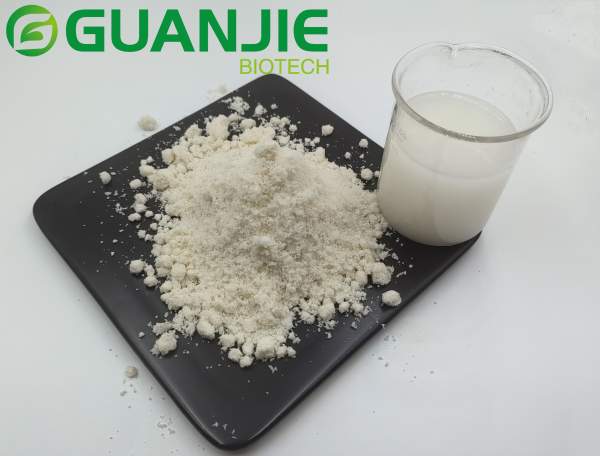
How to Choose Almond Powder?
There are many types of pure almond protein powder available, and their production methods and raw material sources affect their nutritional value, taste, and applications. Here are some key factors to consider when selecting the right pure almond protein powder for your needs.
Choose Based on Usage
•For Baking and Beverages:
Whole-fat almond powder is recommended. Water-soluble almond protein for Beverages retains natural oils for a richer flavor, making it ideal for cakes, cookies, almond milk, and milk tea.
•For Meal Replacements or High-Protein Products:
Choose defatted almond powder. It's lower in fat and higher in protein-perfect for energy bars, sports nutrition, and meal replacement products.
•For Infants, Toddlers, or Sensitive Digestion:
Micronized or ultra-fine bulk almond powder is best. Pure almond protein powder has a smooth texture, dissolves easily, is gentle on the stomach, and has a mild flavor.
Check Ingredient Quality
High-quality pure almond protein powder should come from fresh, mold-free almonds-either sweet or bitter. If bitter almonds are used, they must undergo a low-temperature debittering process to ensure safety.
Evaluate Flavor and Additives
Pure almond protein powder is available in various flavor profiles, such as light, mild, or rich. Select the one that suits your product. Whenever possible, choose almond powder that is free from added flavors, preservatives, or colorants. Our almond powder is 100% pure with no additives.
Review Nutritional and Testing Information
Read the nutrition label to ensure the levels of protein, fat, fiber, and vitamin E align with your dietary needs. Also, confirm whether the bulk almond powder product has passed safety tests for pesticide residues, heavy metals, and microbial contamination. Look for certifications such as QS, ISO, Halal, or Kosher.
Consider Dietary Restrictions
Since almonds are a type of tree nut, individuals with nut allergies should avoid pure almond protein powder. If you are a vegetarian or lactose-intolerant, look for products labeled "plant-based" or "vegan."
Packaging and Storage
High-quality almond powder is typically packaged in aluminum foil bags or vacuum-sealed to prevent oxidation and moisture exposure. Select pure almond powder products that display a production date, batch number, expiration date, and proper storage instructions.
Spray-Dried Almond Powder vs. Ground Almond Meal:
While both products originate from almonds, Spray-Dried Almond Powder and Ground Almond Meal serve fundamentally different food matrix roles due to how they are processed, their fat content, particle size, and water solubility.
|
Attribute |
Spray-Dried Almond Powder |
Ground Almond Meal |
|
Primary Process |
Blanched, defatted, liquid extracted, spray-dried |
Whole/blanched almonds mechanically ground |
|
Particle Size & Texture |
Ultrafine powder (80–100mesh), smooth |
Coarse/granular (10–}30 mesh), gritty |
|
Fat & Oil Content |
Low to Defatted (<10%–20%) |
High 45%–50%, full natural fats) |
|
Protein Content |
High/Concentrated (50%–80%) |
Moderate (sim 20%–22%) |
|
Water Solubility |
High solubility/dispersion in liquid |
Insoluble (settles/floats in liquids) |
|
Shelf Life & Oxidation |
Long (18–24months); low fat resists rancidity |
Short (6–9months); high fat subject to rancidity |
|
Primary B2B Use Cases |
Beverages, RTD shakes, plant milk, cosmetics |
Baking (macarons, gluten-free flour), bar fillings |
Key Technical Differences
Solubility & Viscosity (Liquid Systems):
• Spray-Dried:
Spray drying creates spherical, micronized particles that rapidly hydrate and suspend in water, producing a smooth emulsion without gritty sedimentation. Essential for RTD beverages, instant protein powders, and cosmetics.
• Ground Meal:
Retains native cell wall structures and insoluble fibers. When mixed into liquids, it sinks or floats, causing harsh mouthfeel and phase separation.
Formulation Stability & Fat Management:
• Spray-Dried: The defatting step before spray-drying eliminates oil separation issues in liquid formulations and prevents lipid oxidation during shelf-life storage.
• Ground Meal:
High fat content provides moisture and crumb texture in baked goods, but acts as a destabilizer in clear or low-fat beverage systems.
High Quality Control:

Certification

Package:

Delivery Methods

Hot Tags: pure almond protein powder, China pure almond protein powder manufacturers, suppliers, factory, Waxberry Powder, Spray Dried Fruit Powder


